
How To Get La Lucky Grande in Steal a Brainrot (March 2026) Ultimate Guide
La Lucky Grande is the brand-new limited Secret brainrot dropped on March 17, , as part of the St. Patrick’s…


I’ve been absolutely hooked on 99 Nights in the Forest since The Forest is Angry update dropped on January 24, 2026, and let me tell you, the new Corrupted Items system has completely transformed how I approach survival in this terrifying Roblox game. After spending countless hours grinding through Hard Mode and opening every Corrupted Chest I could find, I’ve compiled everything you need to know about these powerful but dangerous items.
The Corrupted Items were officially released on January 31, 2026, as part of the massive Hard Mode and Corruption System update. These aren’t just cosmetic variants, they’re genuinely game-changing equipment that can make or break your survival run. But here’s the catch: using them comes with serious consequences that you need to understand before diving in headfirst.
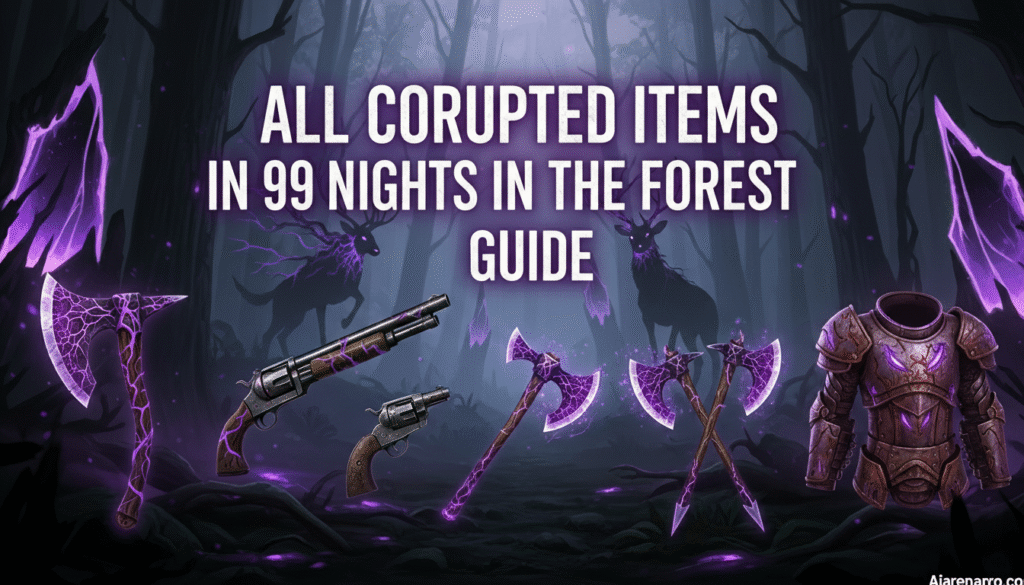
Let me break down every single Corrupted Item currently available in the game. I’ve tested each one extensively, and trust me, some are absolute game-changers while others require careful consideration before use.
| Corrupted Axe | Tool | Tree chopping | Extremely fast tree damage, ideal for clearing corrupted trees around rifts | Medium |
| Corrupted Thrown Axe | Ranged Weapon | Combat | Unlimited throwing axes with powerful burst damage, perfect for range attacks | Medium |
| Corrupted Revolver | Firearm | Combat | High-damage purple revolver, requires ammunition, excellent against corrupted creatures | High |
| Corrupted Shotgun | Heavy Firearm | Close Combat | Devastating close-range damage, especially effective in rift zones and against groups | High |
| Corrupted Armour | Defensive Gear | Protection | Significantly increases survivability and damage resistance | Very High |
The Corrupted Axe completely changed how I approach resource gathering in Hard Mode. This isn’t just a regular axe with purple effects it has genuinely superior stats that make chopping corrupted trees a breeze.
What makes it special: The Corrupted Axe deals significantly higher damage to trees compared to standard axes. When I’m racing against the clock to clear corruption around a newly spawned rift, this tool literally saves lives. A single corrupted tree that might take 8-10 swings with a normal axe? The Corrupted Axe tears through it in 3-4 swings.
Visual identification: Look for the distinctive purple roots wrapped around the axe handle and blade. The entire tool has a dark, almost black appearance with pulsating purple veins running through it.
Best use cases: I primarily use my Corrupted Axe when I’m specifically clearing rifts. The speed advantage is crucial when corruption is climbing and you need to eliminate infected trees quickly. It’s also fantastic for general resource gathering if you’re willing to accept the corruption buildup.
This weapon absolutely blew my mind the first time I used it. Unlike regular thrown axes that you need to craft individually, the Corrupted Thrown Axe functions as an unlimited ranged weapon.
Combat effectiveness: I’ve found it incredibly useful for dealing with corrupted animals from a safe distance. The damage output is substantial, easily taking down corrupted wolves in 2-3 hits. What really sets it apart is the fact that you never run out of ammunition.
Tactical advantages: When you’re scouting a new rift area and spot corrupted creatures patrolling, you can engage from range without committing to close combat. This has saved my life more times than I can count, especially when dealing with packs of aggressive and corrupted animals.
Animation and mechanics: Each throw has a satisfying purple trail effect. The axes return to your inventory automatically, maintaining the “unlimited” nature of the weapon.
The Corrupted Revolver is hands-down one of my favourite weapons in the entire game right now. It’s a powerful firearm that looks absolutely menacing with its purple glow and dark metal finish.
Damage profile: This thing hits HARD. I’ve one-shot regular wolves and dealt massive damage to cultists with headshots. Against corrupted animals, it’s even more effective; there seems to be a damage bonus when fighting corruption-related enemies.
Ammunition considerations: Unlike the Thrown Axe, the Corrupted Revolver requires standard revolver ammunition. Make sure you’re stocked up before heading into rift zones. I typically carry at least 50-60 rounds when I’m planning a corruption-clearing session.
Strategic positioning: The revolver excels at medium range. I use it when I need precise shots, taking out dangerous corrupted animals before they can close the distance or picking off cultists during raids.
When I need raw stopping power up close, the Corrupted Shotgun is my go-to weapon. This beast of a gun is covered in purple roots and looks like it was pulled straight from the corruption itself.
Damage output: The spread and damage from this shotgun are absolutely insane. At point-blank range, it can delete corrupted bears and alpha wolves in 1-2 shots. During cultist waves, positioning yourself in a chokepoint with the Corrupted Shotgun can hold an entire wave solo.
Rift zone efficiency: Here’s something I discovered through testing the Corrupted Shotgun deals enhanced damage when you’re fighting inside or very close to active rift zones. I’m not sure if this is intentional or a bug, but it’s incredibly powerful.
Ammunition management: Like the revolver, this requires shotgun shells. The rate of consumption is high due to the spread nature of the weapon, so budget accordingly. I usually bring 40-50 shells minimum.
The Corrupted Armour is probably the most controversial item in the corrupted lineup, and for good reason. It offers the best defensive stats I’ve seen in 99 Nights in the Forest, but it comes with the steepest corruption cost.
Defence statistics: When I equipped the Corrupted Armour for the first time, I immediately noticed the difference. Attacks that would normally chunk 30-40% of my health were barely scratching me. It’s rusty in appearance with a distinctive purple colouration throughout the armour pieces.
The trade-off: Here’s the brutal reality: Wearing Corrupted Armour accelerates your corruption buildup significantly faster than any other corrupted item. If you’re already dealing with high corruption levels and multiple debuffs, equipping this armour can push you over the edge into dangerous territory.
Optimal usage: I only equip Corrupted Armour during critical moments: boss fights, intense cultist raids, or when I’m deliberately diving deep into heavily corrupted areas. For general exploration and low-corruption periods, regular armour is safer.
Getting your hands on Corrupted Items isn’t straightforward. You can’t buy them from traders, craft them at your workbench, or find them lying around the forest. There’s a specific progression path you must follow, and I’m going to walk you through every single step based on my experience.
This is the absolute prerequisite for everything that follows. Corrupted Items ONLY exist in Hard Mode; you won’t find a single one in normal gameplay.
From the moment you spawn on Day 1, your first priority should be gathering wood. Chop down trees aggressively and stockpile logs. Your immediate goal is to upgrade your campsite to Level 2 as quickly as possible.
Why Level 2 matters: This upgrade unlocks access to the Research Outpost, a large white building that appears on your map. The Research Outpost is literally the gateway to Hard Mode and the entire corruption system.
Finding the Research Outpost: Open your map and look for a white rock-like marker. It’s typically located north of the main campfire area. The building is distinctive; you can’t miss it once you know what you’re looking for.
Entering the basement: Once you’re inside the Research Outpost, look for a steel door on the left side of the main floor. This leads down to the basement, where you’ll find the voting system for Hard Mode.
The voting process: In the basement, you’ll see levers mounted near the monitors. Each player in your server has their own lever with their Roblox username labelled above it. Locate YOUR lever and pull it to vote for Hard Mode.
Critical timing: You MUST vote before Day 3 ends. This is non-negotiable. If you miss this window, you’ll have to start a completely new run to access Hard Mode and Corrupted Items.
Hard Mode activation: When Day 3 begins, assuming enough players have voted, a cutscene will play. This officially activates Hard Mode and enables the Corruption System across your entire server. From this point forward, rifts will begin spawning, corruption will spread, and Corrupted Chests become available.
Before you start hunting for Corrupted Chests, you need to understand how corruption works, because this directly impacts your ability to find and safely access these items.
Corruption tracking: Inside the Research Outpost basement, you’ll find a Research Monitor panel. This screen displays three critical pieces of information: your current corruption percentage, which debuffs are active, and how many rifts are currently affecting the map.
Research Monitor Blueprint: When you open the chests in the Research Outpost (more on this shortly), one of the rewards is the Research Monitor Blueprint. Craft this at your base immediately. It creates a banner-like monitor that lets you check corruption status without travelling back to the outpost every time.
Corruption sources: Rifts are the primary engine driving corruption upward. These purple anomalies spawn roughly every night starting from Day 3. Each rift gradually infects the surrounding area, creating corrupted trees and corrupted animals. Every infected element pushes your global corruption percentage higher.
Managing corruption: To prevent corruption from spiraling out of control, you must actively clear rifts. This means chopping down corrupted trees (identified by their darker bark and purple root systems) and eliminating all corrupted animals in the rift zone. Once you’ve cleared everything, the rift stops contributing to your corruption level.
Don’t stop at Level 2. Keep pushing your campsite upgrades throughout your run.
Map expansion: Higher campsite levels expand your map coverage. This is crucial for locating Corrupted Chests, which can spawn anywhere across the massive forest. With a larger revealed map, you can spot chest locations from your base and plan efficient collection routes.
Resource benefits: Advanced campsite levels also unlock better crafting options, storage capacity, and defensive structures. These indirectly support your corrupted item hunting by making your base more sustainable during long runs.
Prioritization: I typically aim for Level 3 by Day 5-6, and Level 4 by Day 10-12. This gives me good map coverage during the critical early-to-mid game period when I’m actively hunting Corrupted Chests.
Now we’re getting to the heart of the matter. Corrupted Chests are the ONLY source of Corrupted Items in 99 Nights in the Forest.
Visual identification: Corrupted Chests are impossible to miss once you know what to look for. They’re large rusted boxes that literally float in mid-air, wrapped in distinctive purple roots that pulse with corrupted energy. They look completely different from standard wooden chests.
Spawn locations: These chests typically appear near rifts, in areas with high concentrations of corrupted trees, and around clusters of corrupted animals. This isn’t random, the game is basically telling you “hey, there’s heavy corruption here, and if you brave it, there’s a reward.”
Spawn mechanics: Each Corrupted Chest can only be opened ONCE per run. This is critical to understand. If you open a chest and get a Corrupted Axe, you can’t go back to that same chest for another item. You need to find different chests for additional corrupted items.
Exploration strategy: I’ve developed a systematic approach to chest hunting. After each night, I check my Research Monitor to see if new rifts have spawned. Then I head out during the day (much safer than night exploration) to investigate those rift zones. Corrupted Chests often appear in or near these newly formed corruption areas.
Safety considerations: Approaching Corrupted Chests is dangerous. They’re surrounded by corrupted creatures that are more aggressive than normal wildlife. I never go chest hunting solo if I can help it. Bring teammates, stock up on healing items (bandages and medkits), and make sure you have good weapons equipped.
Opening process: Simply walk up to the chest and interact with it. The chest will open, revealing your reward. It’s not guaranteed to be a corrupted item every time some chests contain other valuable loot like Research Monitor Blueprints, MRE kits, or advanced healing items.
Chest respawning: I haven’t seen definitive evidence of Corrupted Chests respawning during a single run. My experience suggests that you have a fixed number of chests available per server, making each one precious. Don’t waste opportunities by opening chests when you’re unprepared to use the items effectively.
Here’s the aspect that many players overlook: simply obtaining Corrupted Items isn’t enough. You need to actively manage the corruption they generate while equipped.
Corruption buildup mechanics: Every Corrupted Item increases your passive corruption gain while equipped or in use. The Corrupted Armour has the highest impact, followed by the Corrupted Shotgun and Revolver, with the Corrupted Axe and Thrown Axe having moderate effects.
Strategic equipment swapping: I don’t keep corrupted items equipped 24/7. Instead, I swap to them for specific situations. Need to clear a rift quickly? Equip the Corrupted Axe. Big cultist wave incoming? Switch to Corrupted Shotgun. Once the immediate threat passes, I swap back to regular equipment.
Monitoring your corruption level: Constantly check your Research Monitor. If corruption is approaching a debuff threshold (typically at 25%, 50%, 75%, and 90%), I become much more conservative with corrupted item usage. It’s not worth getting an extra debuff just to chop trees slightly faster.
Rift clearing priority: The most effective way to offset corruption from your items is aggressive rift management. Every rift you fully clear reduces the global corruption level, buying you breathing room to use corrupted items more freely.
Using Corrupted Items becomes incredibly risky once debuffs start stacking. Let me break down what you’re dealing with at each corruption threshold.
At this point, you’ll receive your first random debuff from the pool of four possibilities:
Hungry Deer: The normally passive deer becomes an aggressive hunter. This bipedal nightmare actively stalks players, and it’s UNKILLABLE. Your only option is evasion and survival.
Passive Healing Disabled: Your natural health regeneration stops completely. Every bit of damage you take must be healed with bandages or medkits. This makes resource management critical.
Enhanced Cultist Waves: Cultist raids become significantly stronger and more frequent. They hit harder, have more health, and spawn in larger numbers.
Food Rot Spores: Your stored food begins developing spores, making it inedible. This creates massive hunger pressure and forces you to constantly hunt/gather fresh food.
My experience: The first debuff is manageable. You adapt your playstyle and continue. It’s uncomfortable but not run-ending.
Another debuff from the remaining pool activates. Now you’re dealing with TWO simultaneous debuffs.
Combined pressure: This is where things get serious. If you have both Passive Healing Disabled AND Food Rot Spores, you’re in a resource death spiral. No natural healing means using medkits, and rotting food means constant hunger. Your supply consumption skyrockets.
Strategic adjustments: At 50% corruption, I become extremely selective about corrupted item usage. The Corrupted Armour stays in my inventory unless it’s an emergency. I focus heavily on rift clearing to push corruption back down.
Three debuffs are active simultaneously. Survival becomes exponentially harder.
Compound effects: Having Hungry Deer + No Passive Healing + Enhanced Cultists means you’re being hunted by an unkillable monster, cultists are overwhelming your defences, and you can’t naturally recover from any damage. One mistake can end your run.
Team coordination is critical: Solo play at this corruption level is nearly impossible. You NEED teammates to manage multiple threats simultaneously.
All four debuffs are active. This is maximum difficulty.
Survival strategy: At this point, corrupted items are almost too risky to use. Your priority shifts entirely to rift management and corruption reduction. Some runs become unwinnable at 90%+ corruption if you don’t have the resources to fight back.
After extensive testing, I’ve developed several strategies that maximize the effectiveness of Corrupted Items while minimizing their risks.
Don’t use all your corrupted items simultaneously. Create a rotation:
Early game (Nights 3-20): Use Corrupted Axe liberally for resource gathering. Corruption is still low, and the harvesting speed helps you build faster.
Mid game (Nights 20-50): Rotate between Corrupted Thrown Axe for hunting and Corrupted Revolver for cultist defence. Keep corruption manageable.
Late game (Nights 50+): Reserve corrupted weapons for emergencies only. Focus on rift clearing with standard equipment to keep corruption minimal.
Once you’ve identified several Corrupted Chest locations, plan efficient routes to open multiple chests in a single expedition:
This method is far more efficient than making multiple trips.
If corruption is low (under 20%), you can “bank” some corruption by using multiple corrupted items to accomplish critical tasks quickly:
Example: Equip Corrupted Axe + Corrupted Armour during a dangerous rift-clearing mission. Clear it faster with better protection, accepting the temporary corruption spike. Then immediately focus on clearing another rift to bring corruption back down.
This aggressive approach works in the early-to-mid game when you have corruption headroom.
I discovered that the Corrupted Shotgun’s enhanced damage in rift zones makes it perfect for aggressive rift farming:
When you first access the Research Outpost chests, prioritise in this order:
Don’t sleep on these chests; they give you the tools to survive Hard Mode effectively.
If you’re playing with a team, establish corruption alert protocols:
The new ping system (Q key on PC, bell icon on mobile) is perfect for marking rift locations and coordinating team movements.
Never wear Corrupted Armour casually. Reserve it for:
The moment the emergency passes, unequip it immediately.
Through extensive testing, I’ve identified optimal corrupted item loadouts for various scenarios.
Primary: Corrupted Axe
Secondary: Corrupted Thrown Axe
Armour: Regular armour (NOT corrupted)
Reasoning: The Corrupted Axe handles trees efficiently, the Thrown Axe deals with corrupted animals from safe range, and regular armour keeps corruption buildup manageable during extended clearing sessions.
Primary: Corrupted Shotgun OR Corrupted Revolver
Secondary: Regular melee weapon
Armor: Corrupted Armour (if corruption allows)
Reasoning: Cultist waves are high-intensity combat scenarios where corrupted weapons excel. The Shotgun dominates close-range chokepoints, while the Revolver provides precision mid-range firepower. If corruption is low enough, the Corrupted Armour significantly improves your survivability.
Primary: Corrupted Axe
Secondary: Regular weapon
Armor: Regular armor
Reasoning: Pure efficiency. The Corrupted Axe dramatically speeds up wood gathering, which is critical throughout your run. Minimal corruption impact from using just one corrupted item.
Primary: Corrupted Thrown Axe
Secondary: Corrupted Revolver
Armor: Regular armor
Reasoning: When scouting for new chests or investigating rift zones, you need versatile combat options without the commitment of heavy corruption buildup. Both weapons offer flexibility for unexpected encounters.
Primary: Corrupted Shotgun
Secondary: Corrupted Revolver
Armor: Corrupted Armour
Reasoning: When everything is going wrong and you’re fighting for your life, the consequences become secondary to immediate survival. This loadout gives you maximum combat effectiveness and protection.
I’ve made every mistake possible with Corrupted Items. Learn from my failures:
The Problem: New players get Corrupted Armour from their first chest and immediately equip it because “better stats!” Then they wonder why their corruption is at 60% by Day 10.
The Solution: Corrupted Armour should be your LAST resort equipment choice. Use it strategically, not constantly.
The Problem: Players focus so much on using their cool new corrupted weapons that they forget to check the Research Monitor. Suddenly, they’re at 75% corruption with three active debuffs.
The Solution: Check your corruption status every few in-game days. Make rift clearing a regular part of your routine, not an emergency reaction.
The Problem: Finding a Corrupted Chest and immediately opening it while surrounded by corrupted animals, then dying before you can use the item.
The Solution: Clear the area around Corrupted Chests BEFORE opening them. Make sure you have inventory space and a safe escape route.
The Problem: Some players never use their corrupted items because they’re “saving them for later.” Then their run ends, and they never got value from these powerful tools.
The Solution: Corrupted Items are meant to be USED, not collected. Find the right balance between conservation and utilisation.
The Problem: Trying to locate and access Corrupted Chests alone, especially at night or in high-corruption zones.
The Solution: Team up for chest hunting expeditions. The safety and efficiency gains are massive.
The Problem: In team play, not telling teammates which debuffs are active, leading to poor resource allocation and failed strategies.
The Solution: Announce debuffs immediately when they activate. Coordinate your response as a team.
The Problem: Equipping every corrupted item at once because “maximum power!” The corruption spike is devastating.
The Solution: Use corrupted items selectively and rotate them based on your current needs.
Let me give you the hard data on how Corrupted Items compare to their standard counterparts.
Tree Damage: Corrupted Axe deals approximately 2.5x damage
Durability: Comparable (both last many uses)
Corruption Cost: Medium (approximately 0.5% per hour of use)
Verdict: Corrupted Axe wins for speed, but the regular axe is safer for casual use
Damage Per Hit: Corrupted deals roughly 40% more damage
Ammunition: Corrupted is unlimited; regular requires crafting each axe
Range: Identical
Corruption Cost: Medium (approximately 0.4% per hour of active combat)
Verdict: Corrupted Thrown Axe is objectively superior in almost every scenario
Damage Per Shot: Corrupted deals approximately 35% more damage
Fire Rate: Identical
Ammunition Type: Both use standard revolver rounds
Corruption Cost: High (approximately 0.7% per hour of equipped time)
Verdict: Corrupted version is better for high-stakes combat; regular is fine for routine use
Close-Range Damage: Corrupted deals approximately 50% more damage
Spread Pattern: Slightly tighter on corrupted version
Special Effect: Corrupted has a damage bonus in rift zones
Corruption Cost: High (approximately 0.8% per hour of equipped time)
Verdict: Corrupted Shotgun is devastating, but comes with serious corruption consequences
Damage Reduction: Corrupted provides approximately 40% better protection
Durability: Comparable
Special Effects: None beyond superior defence
Corruption Cost: Very High (approximately 1.2% per hour of equipped time)
Verdict: Corrupted Armour is powerful but dangerous; use sparingly
Corrupted Items were officially released on January 31, 2026, as part of the Hard Mode and Corruption System update that began rolling out on January 24, 2026.
No. Corrupted Items are exclusively available in Hard Mode. You must activate Hard Mode through the Research Outpost voting system to access any corrupted equipment.
The exact number isn’t officially confirmed, but based on my testing across multiple runs, I’ve found between 8-12 Corrupted Chests per server. The number may scale with server population or map size.
Corrupted Items appear to have the same durability mechanics as regular equipment. I haven’t had a corrupted item completely break yet, but I also rotate their usage rather than using one constantly.
No. Currently, there’s no trading system in 99 Nights in the Forest. Each player must find and open their own Corrupted Chests to obtain corrupted items.
You drop them just like regular items. Other players can pick them up, or you can return to your death location to retrieve them if you’re revived or respawn.
Based on my testing, corrupted weapons seem to deal slightly enhanced damage to corrupted creatures, especially the Corrupted Shotgun in rift zones. However, the developers haven’t officially confirmed any damage bonuses.
No. There’s currently no way to convert corrupted items back to regular equipment or remove their corruption-generating properties.
I recommend the Corrupted Axe as your first acquisition. It provides immediate value for resource gathering and rift clearing with manageable corruption impact. Save the weapons and armor for when you have better corruption management systems in place.
No. Corrupted Items don’t negatively impact your diamond payouts. Hard Mode itself offers DOUBLE diamond rewards at Night 50 and Night 99, regardless of what equipment you use.
Yes. I’ve opened multiple Corrupted Chests that contained Corrupted Axes. The loot appears to be somewhat randomised, so you might get duplicates before collecting all five unique corrupted items.
Within a single run, yes. Once you obtain a Corrupted Item, it stays in your inventory until you die and lose it, or until the run ends. However, corrupted items do NOT carry over between different runs you must find them again each time you start fresh.
Based on community feedback and developer hints, here’s what I expect for corrupted items moving forward:
The community has been requesting:
Given the success of the current corrupted item system, I wouldn’t be surprised to see expansions in future updates.
The developers have been actively monitoring feedback about the corruption balance. Potential adjustments could include:
The Corrupted Items update has been massively popular in the 99 Nights in the Forest community. The Discord server (discord.com/invite/nightsintheforest) is filled with players sharing their corrupted item strategies and chest locations.
Social media reaction has been overwhelmingly positive, with content creators showcasing corrupted item gameplay and speedrunners experimenting with corruption-heavy strategies.
After hundreds of hours with Corrupted Items, here’s my honest assessment: YES, they’re absolutely worth pursuing, but with important caveats.
Corrupted Items fundamentally change the risk-reward calculation in 99 Nights in the Forest. They offer genuine power upgrades that can mean the difference between surviving to Night 99 and dying on Night 40. The Corrupted Axe speeds up your early game economy. The Corrupted weapons make combat encounters significantly more manageable. The Corrupted Armour can save your life in desperate situations.
However, they’re not a replacement for skill and strategy. Players who mindlessly equip all corrupted items and ignore corruption management will fail faster than players using standard equipment wisely. The key is understanding WHEN and HOW to deploy these powerful tools.
My recommendation for new Hard Mode players: Start by obtaining the Corrupted Axe and learning corruption management. Once you’re comfortable maintaining corruption below 50%, experiment with corrupted weapons. Save the Corrupted Armour for later in your progression when you truly understand the system.
For experienced players: Corrupted Items open up aggressive playstyles that weren’t previously viable. You can clear rifts faster, push deeper into dangerous zones, and handle threats that would normally require full team coordination. The corruption cost becomes just another resource to manage alongside food, health, and materials.
The Corrupted Items update has revitalised 99 Nights in the Forest for me. Every run now involves strategic decisions about chest hunting, corruption management, and equipment optimisation. It’s added depth without overwhelming complexity, and that’s exactly what a survival game needs.
Now get out there, activate Hard Mode, start hunting those Corrupted Chests, and build your corrupted arsenal. Just remember to keep an eye on that Research Monitor corruption waits for no one.
Want to master other aspects of 99 Nights in the Forest? Check out these helpful resources:
Stay updated with the latest 99 Nights in the Forest news and strategies by bookmarking this page and joining the official Discord community. The Forest is Angry update continues to evolve, and new corrupted items or mechanics could arrive at any time.
Good luck surviving those 99 nights, and may your Corrupted Chests be plentiful!