
How to Get All 4 New Relics in Fisch (October 2026) Doomed, Grim, Eldritch & Vile
FischFright 3 (Version 2.06) launched on October 17, 2026, adding four limited enchant relics to Roblox Fisch: the Doomed, Grim,…

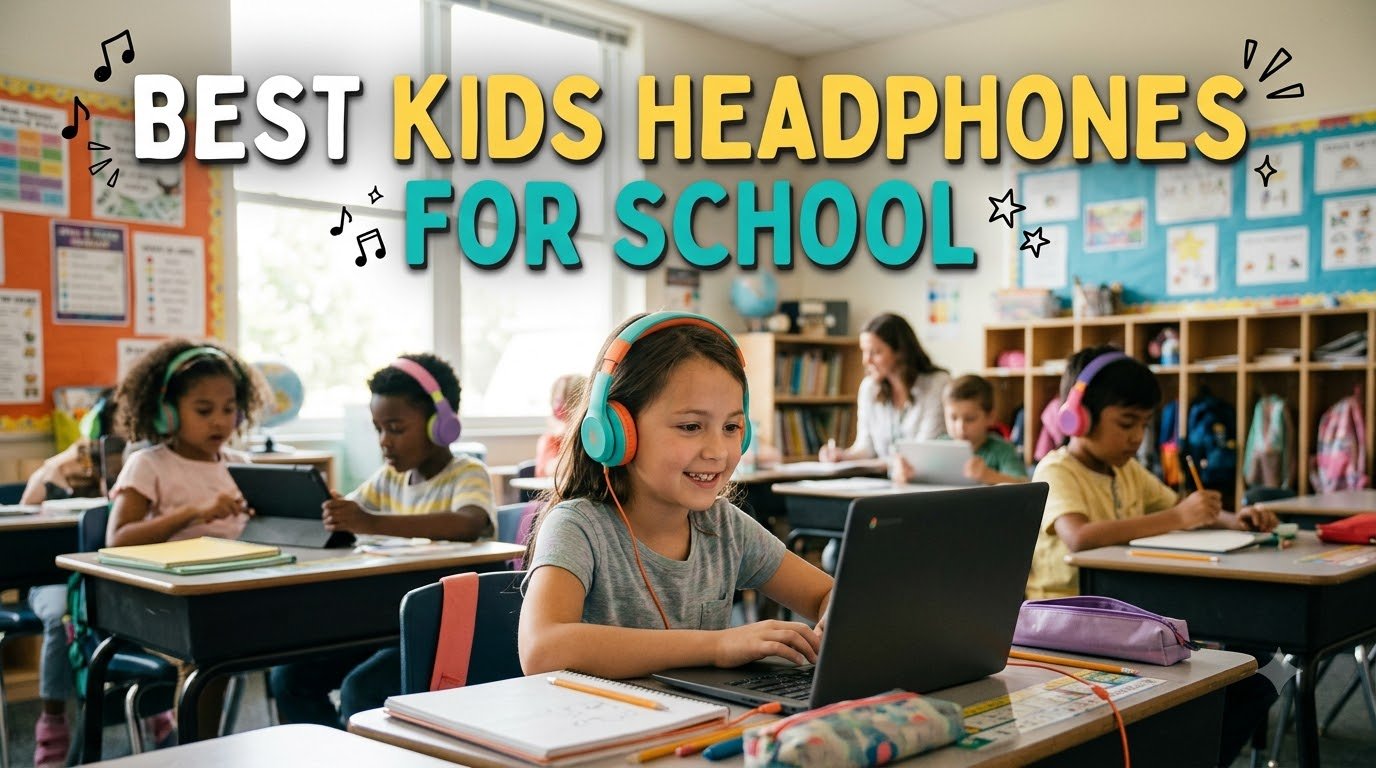
A headset that survives a school year is worth more than one that sounds fantastic for a weekend. We spent six weeks putting ten pairs through what a real term feels like: backpacks, sticky desks, computer-lab calls, and the daily argument over whether the volume is too low.
The best kids headphones for school come down to three things that most listings bury. First, a volume cap that actually holds, ideally around 85dB, set inside the headphone body so a child cannot defeat it by swapping cables. Second, a microphone that survives a noisy classroom, not just a quiet bedroom. Third, a build that folds, flexes, and comes apart cleanly when something finally breaks.
This list is built around school use specifically, not travel, not sleep, and not gaming. Every pick here plugs into something a classroom already owns, survives being crammed into a bag, and comes with a limiter where the maker claims one. Prices move constantly, so use the buttons below to check the current figure.
One quick note before you read further. Tell us the child’s age or grade, whether the school requires wired or wireless, and roughly what you want to spend, and the answer narrows quickly. Most parents land on one of the first three picks below.
Every set below is wired with a 3.5mm jack except the last two wireless options, and every set except the AILIHEN C8 carries a stated volume limiter. Weight matters more than most parents expect, so it is listed alongside the fit style.
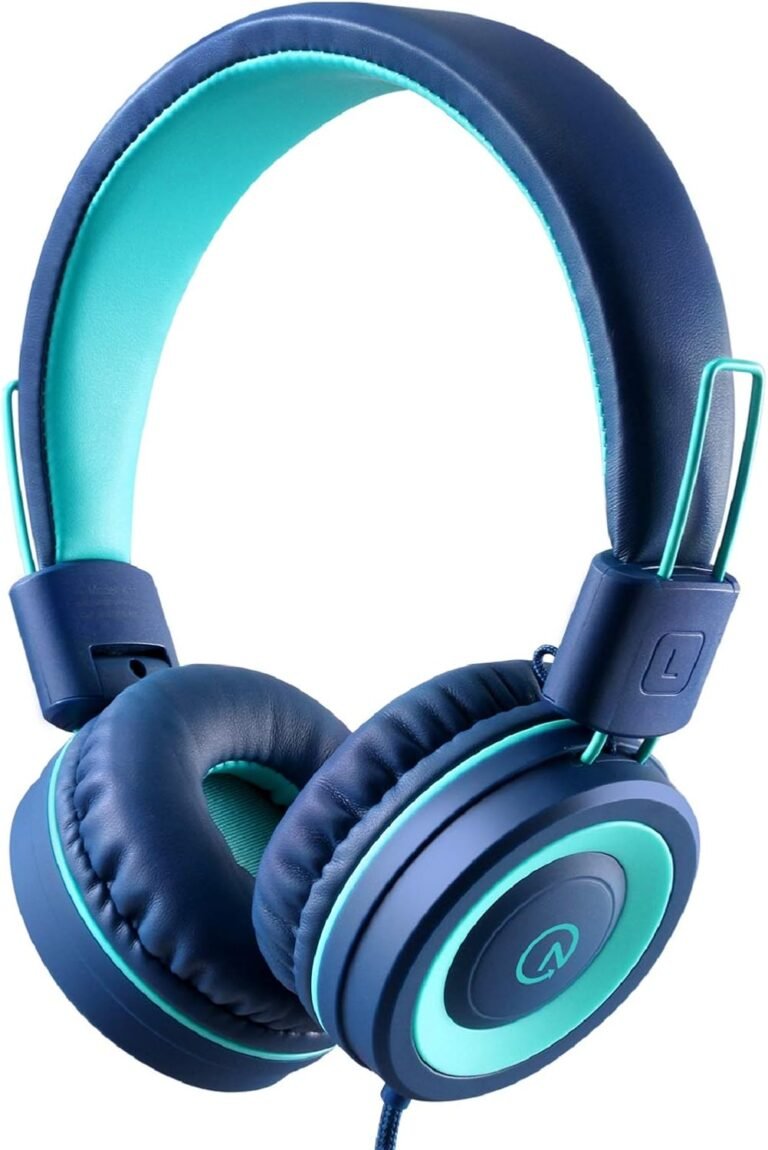
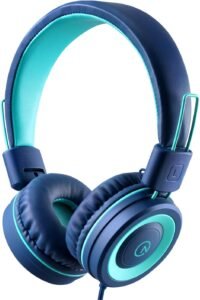
Fourteen thousand of the reviews on this pair come from parents who bought it as a backup and ended up buying a second set. That is the whole argument for it. There is no battery to die mid-term, no pairing ritual when thirty children open laptops at once, and nothing to charge on a Tuesday night before a Wednesday test.
The build is deliberately plain. A folding frame, padded on-ear cushions, an adjustable headband, and a five-foot nylon braided cord that resists the knotting that destroys cheap wired headphones in a backpack. At 8 ounces it is the set most children will actually keep on for a full reading block without complaining.
The 32-ohm drivers keep the volume comfortable at low settings, which matters more for younger children than bass does. On-ear cups leak a little sound in a quiet room, so for a child who needs audio for reading at normal volume this is the wrong shape, and for a child listening to a story or language drill it is exactly right.
Fit runs from about age 3 through the early teens on the headband adjustment, though very small heads will find the cups slightly loose. The stiffness of the band is the limiting factor here: it holds position well and does not pinch, which is what keeps it comfortable across a whole school day.
Nothing about it needs a parent’s attention. It plugs in, it plays, it folds, it survives being sat on in a bag. For a first pair or a second pair for a classroom that loses headphones, that simplicity is the feature parents write about most.
The braid is the detail worth noting. A braided cord that resists tangling means a child can pull it out of a bag one-handed instead of untangling a knot while the class waits, and a braided sheath also survives the pull that breaks a thin moulded cable right where it enters the earpiece.
The missing microphone is the obvious gap. If the child’s school expects them on a live call, a reading assessment, or a computer-lab assignment, this set cannot do that job and you will be buying again in a term. For listening centres, audiobooks, and quiet independent work, the absence costs nothing.
The fixed cord is the second limitation. When the strain relief eventually cracks, the whole set is finished rather than repaired, which is the opposite of how the EarFun and JBL-style designs behave when a cable part wears out. For a two-year-old who chews cables, treat it as consumable.
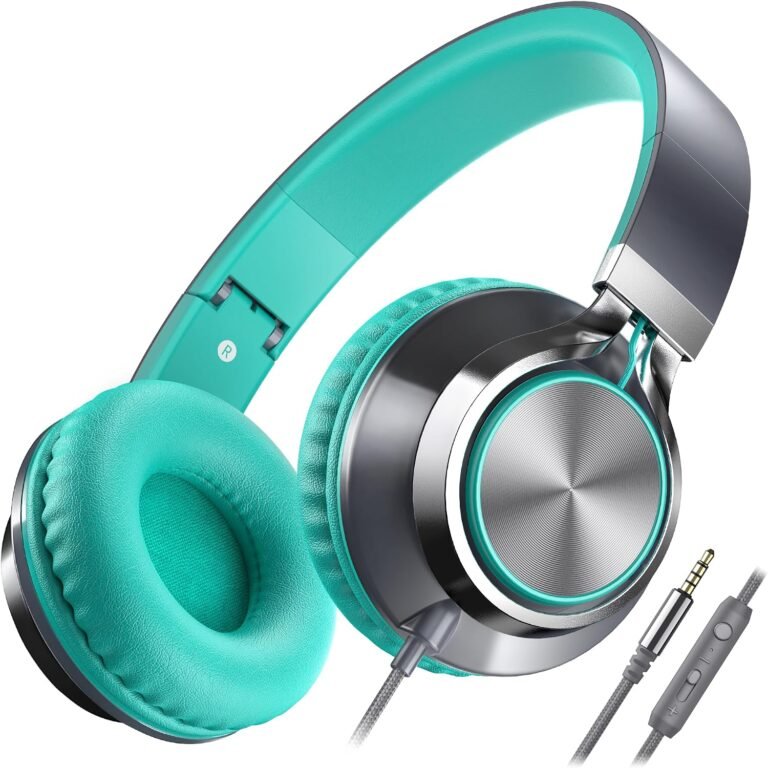
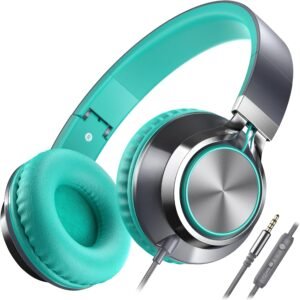
If the school expects a headset rather than headphones, this is the one most families end up with. The in-line control carries a talking microphone, a volume button, and track skip, so a child can answer a check-in or start the next audio prompt without an adult helping.
More than 35,000 reviews at 4.4 stars is a lot of real classroom evidence, and the pattern in them is consistent: parents buy it for the microphone, and then keep buying because the 59-inch braided cable has not kinked once. The four-pole 3.5mm plug is the standard single-jacket headset connector that school laptops and Chromebooks expect.
Sound is driven by 40mm dynamic drivers, which is a step up from the 32mm sets at similar size and gives more low end for music without needing extra volume. Comfort comes from ultra-soft padded cushions and an adjustable band, and the review pattern suggests it holds up through long sessions.
The one hardware quirk to know: the inline volume button is inoperative on PC connections, so on a Windows desktop the child controls volume in software instead. On Chromebooks, tablets, and phones it works as expected.
The microphone is the deciding factor. Teachers who run reading or language assessments care about mic clarity far more than music quality, and an in-line mic on a cable that reaches the device at full length keeps a child’s mouth a consistent distance from the capsule. That consistency matters more in a noisy room than any noise-cancelling claim.
It is also the easiest set for a child to operate alone, which reduces the classroom friction that gets headphones confiscated or ignored. No app, no pairing, no charging, one button on the cable.
There is no volume limiter on this set, and that is a genuine gap for daily long-term listening by a young child. Plenty of parents in the reviews use it for a couple of hours of supervised school audio without concern, but if your child uses headphones unsupervised for hours, a limited set is a better fit.
The fit also runs snug on larger heads, and the ear pads are shallow enough that some adults and older children find them tight after an hour. Buy it for a kindergartener through early elementary and it fits well; check the headband range for a tween.
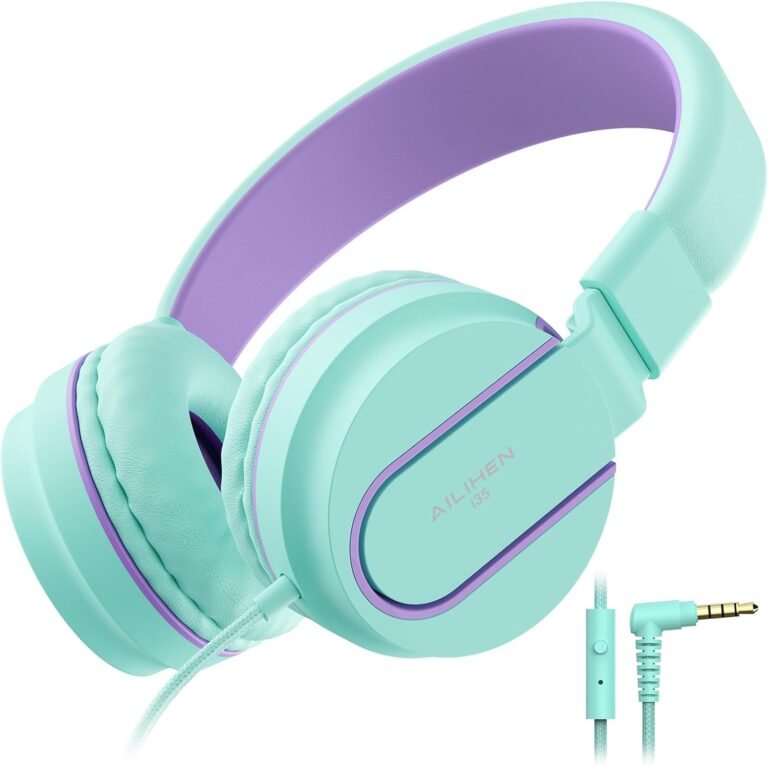
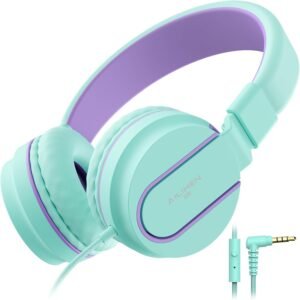
This set exists because a lot of parents read the safety section on a listing, believed it, and then found out the claim was cosmetic. Here the limiter is hardware, set to 93dB, and it holds regardless of what the device’s own volume slider is doing. That is a higher ceiling than the 85dB guideline, but it is a real enforced ceiling rather than an instruction in a manual.
It also weighs 5.92 ounces, making it the lightest set in this roundup, and the memory-protein cushions and padded headband stay comfortable through a long listening centre session. The design folds flat, which matters because most storage at school is a cubby, not a desk drawer.
The in-line microphone with a one-button call control is adequate rather than exceptional, good enough for a check-in or a short answer in an online lesson. Parents in the reviews frequently mention durability over multiple years of use, including one family whose set lasted three years before finally failing.
The reinforced headband is the part that gets the credit. It bends without snapping when a child forces it over a winter hat or forces it into a bag at the wrong angle, which is the daily reality of school gear.
The limiter being in the hardware means it cannot be defeated by software, by a device preset, or by a child who is motivated. That is the single most important distinction on this whole list, and it is the reason this pair appears here despite sitting in the budget tier.
Lightness is the second quiet advantage. When a pair weighs under six ounces, a small child forgets it is wearing them, and children who forget they are wearing headphones use them at a lower volume because they are not trying to talk over them.
Faux leather is the weak point. The reviews mention cushion material flaking after heavy daily use, and replacement pads for this model are not always easy to find, so the set has a finite life even if the driver and headband survive.
The fit also tightens as children grow. Several reviews note a snug feel for older kids and some pressure headaches after extended wear, which suggests this is a set for younger children who will grow into a size, not one meant to last to the tween years.
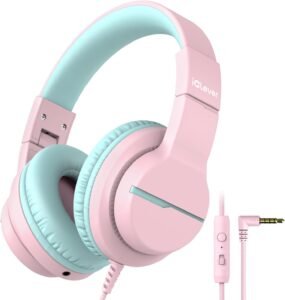
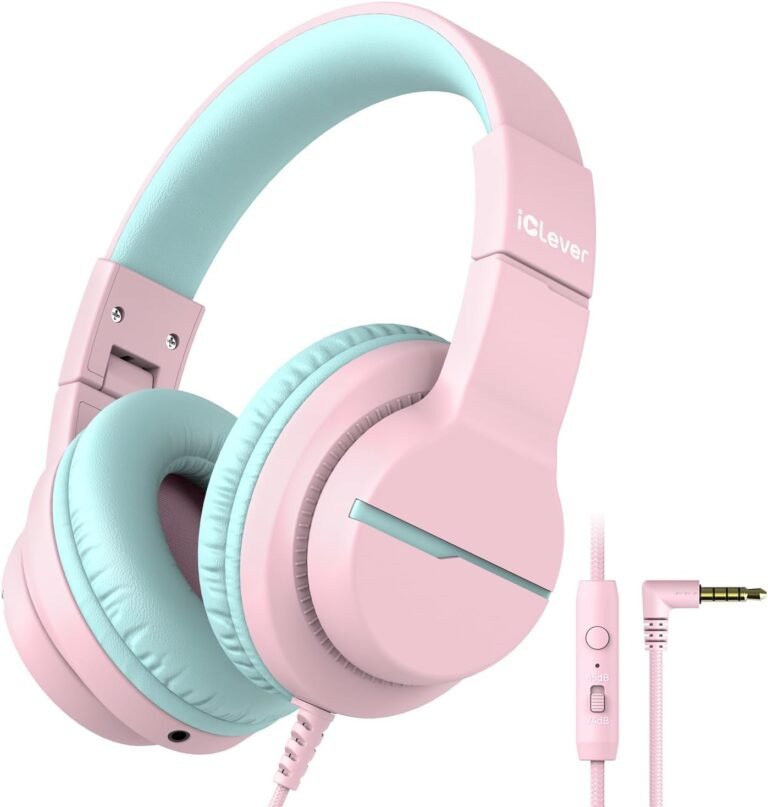
Over-ear cups change how a classroom feels. They block more of the room’s noise, which means a child can hear the audio at a lower volume, which lowers the actual noise exposure for everyone in the row. The HS19 is the pick we lean on when a child is sensitive to background sound or sits near a busy corridor.
The 85dBA limiter sits in the headphone body rather than the cable, which is the correct design. A child cannot defeat it by pulling the cable out and plugging in a different one. On top of that, the share port on the bottom of one cup lets a second pair of headphones play from the same device without a splitter, which answers the sibling-in-the-same-class question parents ask constantly.
Sound comes from 40mm dynamic drivers at 32 ohm, and the ultra-soft earmuffs are described across reviews as comfortable over long sessions. The tangle-free cord removes one of the three most common school complaints about wired sets, and the folding frame keeps it compact in a backpack.
Compatibility is broad: Chromebook, Switch, iPad, smartphone, computer, MP3 players, Fire tablets, laptops and PCs, all through a standard 3.5mm jack. A 12-month replacement warranty covers the first year of classroom wear.
Two children sharing one Chromebook is a real classroom scenario, and the usual answer is a splitter dongle that adds another point of failure and another place for a cable to snag. The share jack solves it inside the headphone with no extra hardware.
For families with siblings in the same grade, that alone justifies the choice. It also works for a child and a friend at a listening centre, or for a pair kept in a classroom that is shared between two students on alternating days.
Weight is the honest drawback. At 173 grams this is a heavier set than most of the wired options here, and for a three- or four-year-old that extra mass on the sides of the head shows up as a complaint within an hour. For a second-grade student and up, it disappears.
The fixed cap is a feature and an irritation at once. Parents cannot raise the ceiling for a long flight or a loud car ride, and there is no setting to lower it further for a child who is genuinely sensitive to sound. If you want adjustable limits, the EarFun sets in this list offer them.
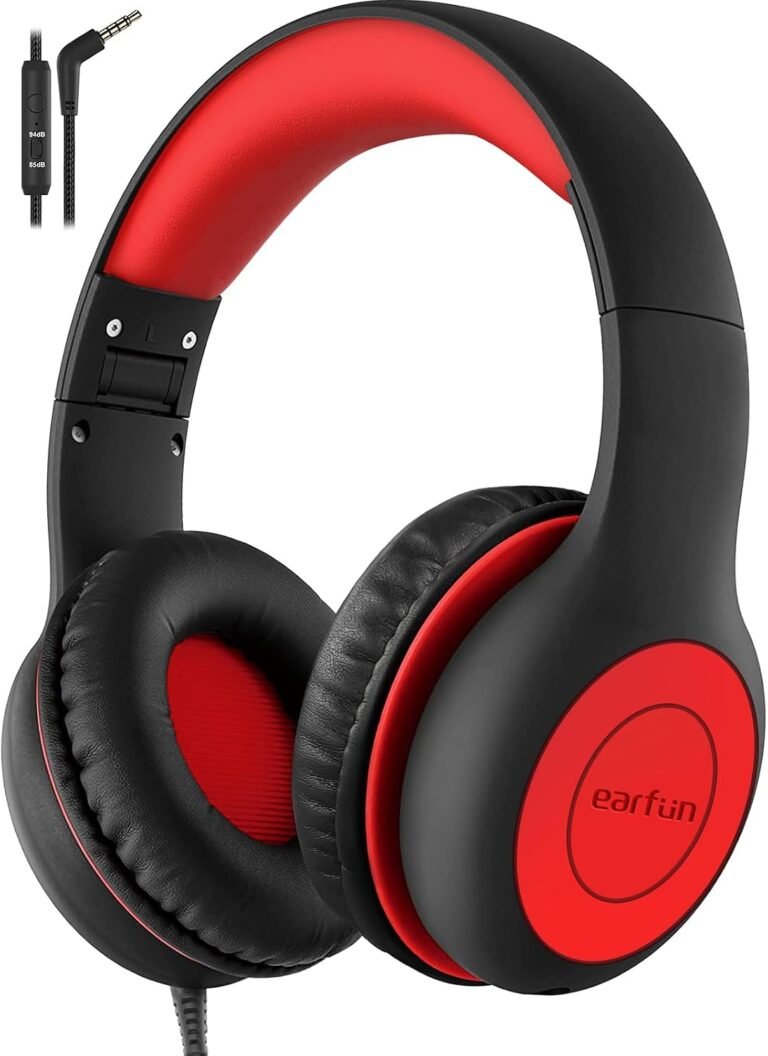
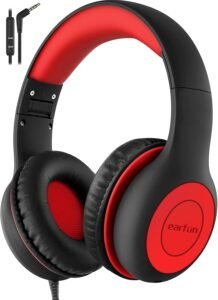
The EarFun K1 is the pick we recommend when a family wants one set that covers the whole list: a limiter, a microphone, a sharing jack, a braided cord, and a warranty longer than a single school year. At 18 months the warranty covers more than most of the term-and-summer cycle that school gear actually goes through.
The volume limiter offers 85dB and 94dB levels, and the materials are CPC-certified, which matters if you are buying for a three-year-old rather than a ten-year-old. The cable carries an HD microphone with play and pause, answer and end call, and track skip, so a child can run an assignment without adult hands.
Forty-millimetre soundstage drivers give noticeably more bass than the smaller sets in this roundup without needing more volume, which is a fair trade for a heavier frame. The adjustable sliders and ultra-soft ear caps took repeated use well across reviews, and the nylon braided cord is described as surviving being squished and dropped.
The 3.5mm sharing jack handles two listeners without a splitter, the same feature the iClever offers and the reason we like this pair as the second all-rounder in the list.
Eighteen months covers a full school year plus a summer, and school headphones get used past their intended life all the time. Reviewers describe these as durable enough for repeated school-year use, and the braided cord is the part most likely to be tested by a child who tugs.
The two volume levels are also useful in a way that surprises people. The 85dB setting suits school, and the 94dB setting covers a noisy car or a long trip where the lower level is too quiet to hear over road noise.
At 198 grams it is the heaviest set we tested, and for a small child that weight sits on the sides of the head rather than the top. Adults and older kids will not notice it, but a four-year-old will notice it within the first lesson.
Over-ear cups also hold heat, which can bother children who run warm or who wear them for an entire afternoon. The slim on-ear sets are cooler, and the reviews include a few buyers who switched shapes for that reason.
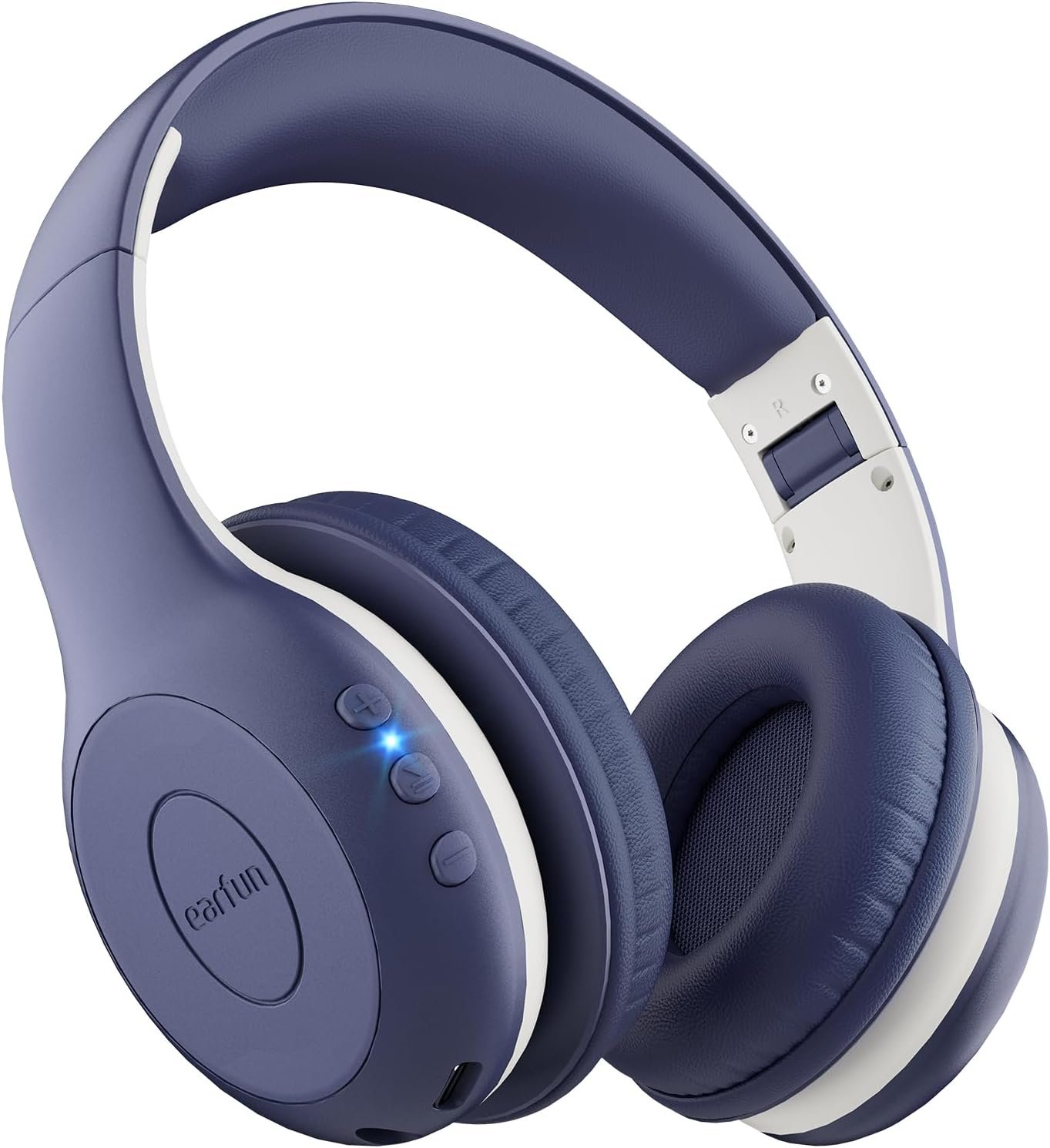
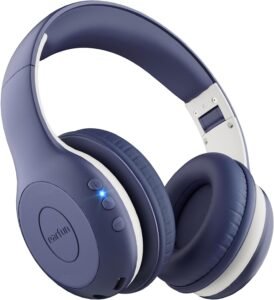
Wireless removes the two things that cause most classroom problems with wired sets: a cable that snags on a desk, and a pair that vanishes behind the laptop. It also creates the biggest risk, which is that a school bans it and it sits in a drawer until next year. This set solves that by shipping with an audio cable for wired fallback.
The volume limiting is the most flexible in this roundup, with selectable 74dB, 85dB and 94dB levels aligned to common safe-listening recommendations. The 74dB mode is genuinely useful for a younger child or a child who is sensitive to sound, and most competing kids sets offer only one fixed ceiling.
Bluetooth 5.4 pairs quickly and holds a stable connection, with a built-in HD microphone for hands-free calls. Battery life is quoted at up to 60 hours, with a full recharge taking about two hours over USB-C.
Comfort is a strength here: a soft memory foam headband and earpads that do not squeeze, a twist-resistant headband, and a foldable lightweight frame. Reviewers note many sets surviving a full school year.
A fixed 85dB cap is a blunt instrument. Selectable limits let you match the ceiling to the child and the setting, which is closer to how a careful adult would manage volume rather than just switching everything to one number and hoping.
That control also travels with the child. When a sibling or a cousin borrows the set, you can hand them a lower ceiling than the one you use for yourself, and the cap lives in the headphone rather than in an app.
The battery claim and the real number are not always the same, and parents in the reviews report runtime coming in below the advertised figure depending on volume and use. For weekly school use that is a non-issue, since charging once a month is enough.
The included charging cable is the more annoying problem, described as picky and easy to damage. Keep a spare USB-C cable in the bag, and note that a Bluetooth set also needs charging discipline that a wired set never will.
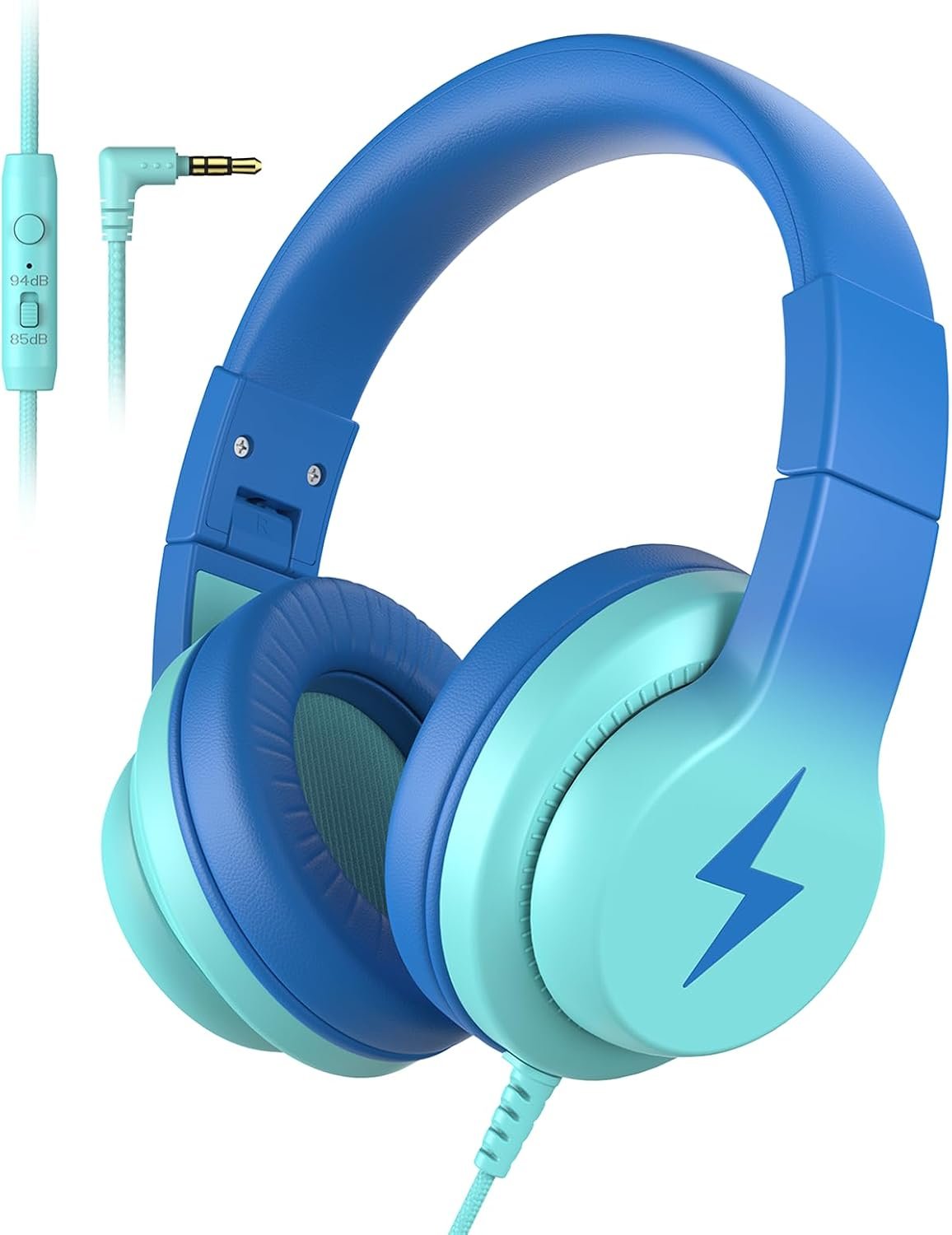
Ask a six-year-old which pair to buy and colour does more work than any specification. This set ships in ten colourways including gradients, which removes the daily negotiation over whose headphones are whose at a shared table.
Underneath the styling the basics are sound. The limiter is a dual 85 and 94dB hardware unit, the inline remote handles play and pause, answering and hanging up, and track switching, and the built-in microphone covers online learning calls. The tear-resistant nylon cord is built for the yank test, which is how every headphone cord eventually dies.
At 8 ounces the weight is friendly for small heads, and the adjustable headband is specified for ages 3 and up. The foldable frame with a matte finish keeps it compact in a bag, and a one-year warranty plus 24-hour customer support cover the first cycle.
Sound is stereo from built-in drivers at 4 ohm impedance. That figure is the specification worth checking on any device you plan to use, because a low impedance can pair unevenly with some hardware and produce a quieter output than expected.
A child who likes their headphones wears them at a lower volume. That sounds trivial, but with the 85dB limit in place it is a real safety gain, because the most common way hearing limits get broken in practice is a child turning up the volume because the set is boring.
The one-button remote is also genuinely easier for small fingers than a three-button inline cluster. Fewer ways to get it wrong means fewer times the volume goes to maximum by accident.
There is no separate inline volume control, so the child’s only hardware adjustment is play and pause. Volume is set in software on the device, which is fine at a desk and frustrating on a school laptop with restricted settings.
Two smaller gripes: the matte plastic shows scuffs quickly on a floor-level classroom desk, and the 4 ohm impedance is a departure from the 32 ohm standard most 3.5mm audio expects. It has not caused widespread problems in reviews, but it is the reason we would put this set slightly behind the iClever for a computer lab.
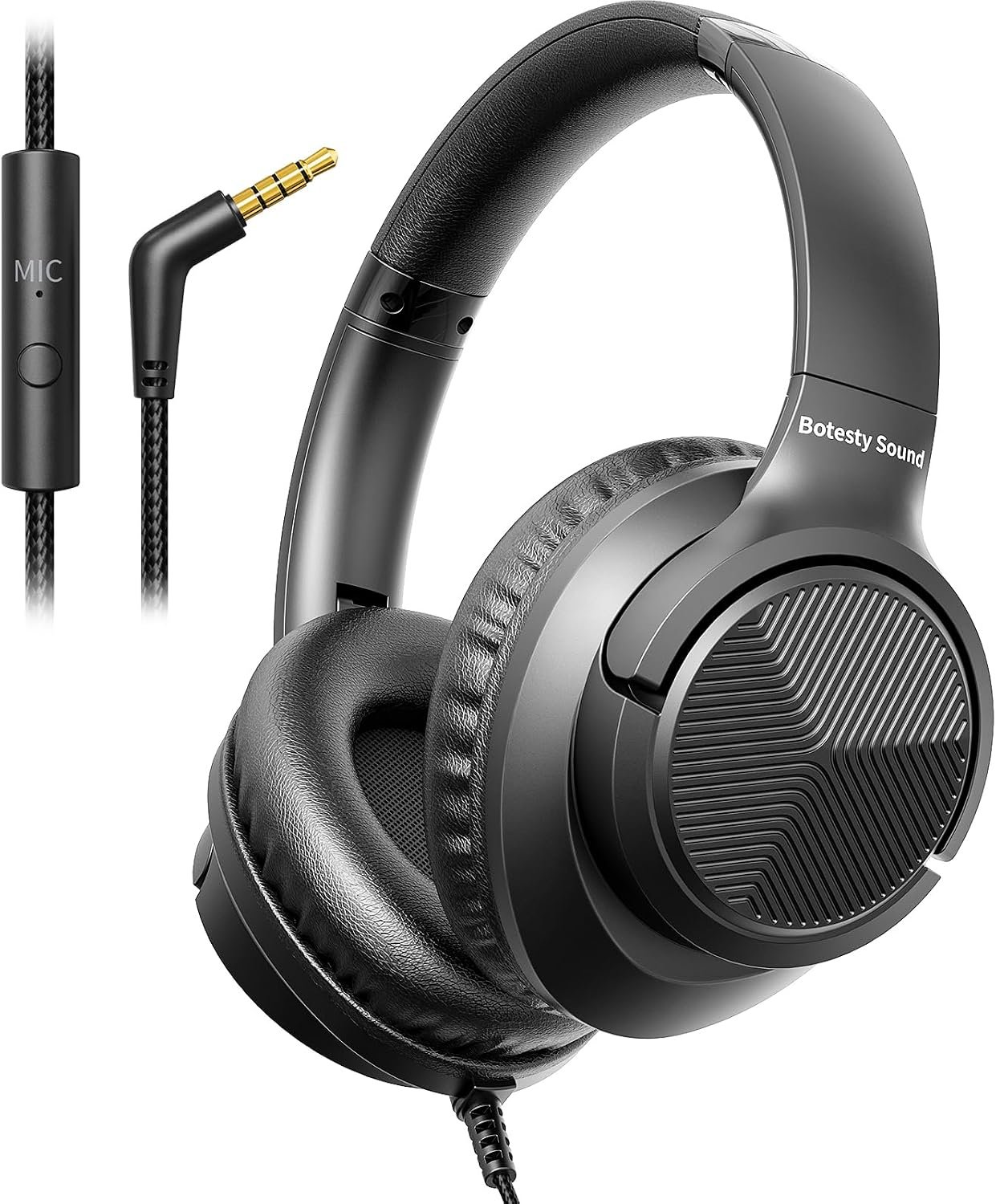
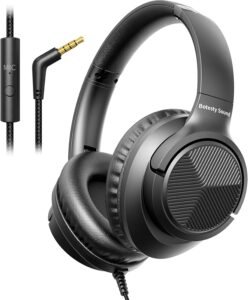
Most parents end up with two pairs, one for school and one for the car or the plane, because a single ceiling cannot cover both. This set puts both ceilings in one pair: an 85dB study mode for classroom use and a 94dB travel mode for noisy environments where the lower setting is too quiet.
What we like here is where the switch lives. The limiter is hardware, inside the headphone, so it cannot be overridden by anything the child does on the device. Parents in the reviews treat that as the standout feature, and the comfort and sturdiness held up across a school year in their accounts.
The in-line call control buttons sit on a 4.9-foot tangle-free, tear-resistant nylon braided cord, and the built-in 40mm drivers handle stereo sound. The 90-degree swivel earcups let the pair sit flat and keep the drivers aligned when a child lies down to listen, which is useful for audiobooks.
A 24-month warranty is longer than most in this roundup, and the set is specified for ages 3 and up, though the fit runs toward the larger end.
A travel mode is the honest fix for the problem parents complain about most, which is that a safe pair is too quiet in a car. Rather than removing the limiter and hoping, you raise the ceiling deliberately for a noisy setting and switch back for school.
It also means one set to keep track of. Fewer headphones in the house means fewer lost headphones, and for a family with two or three children that is where the real saving is.
The swivel hinge is a real weak point. Reviews specifically flag the 90-degree swivel as the place where earpieces can snap after heavy daily use, and one earpiece cutting out after extended wear is a recurring complaint. It is a durability trade for the folding convenience.
The fit also runs slightly large for a three-year-old. Check the headband range before buying for the youngest children, and note that the review count is smaller here than for the other picks, so there is less long-term evidence behind it.
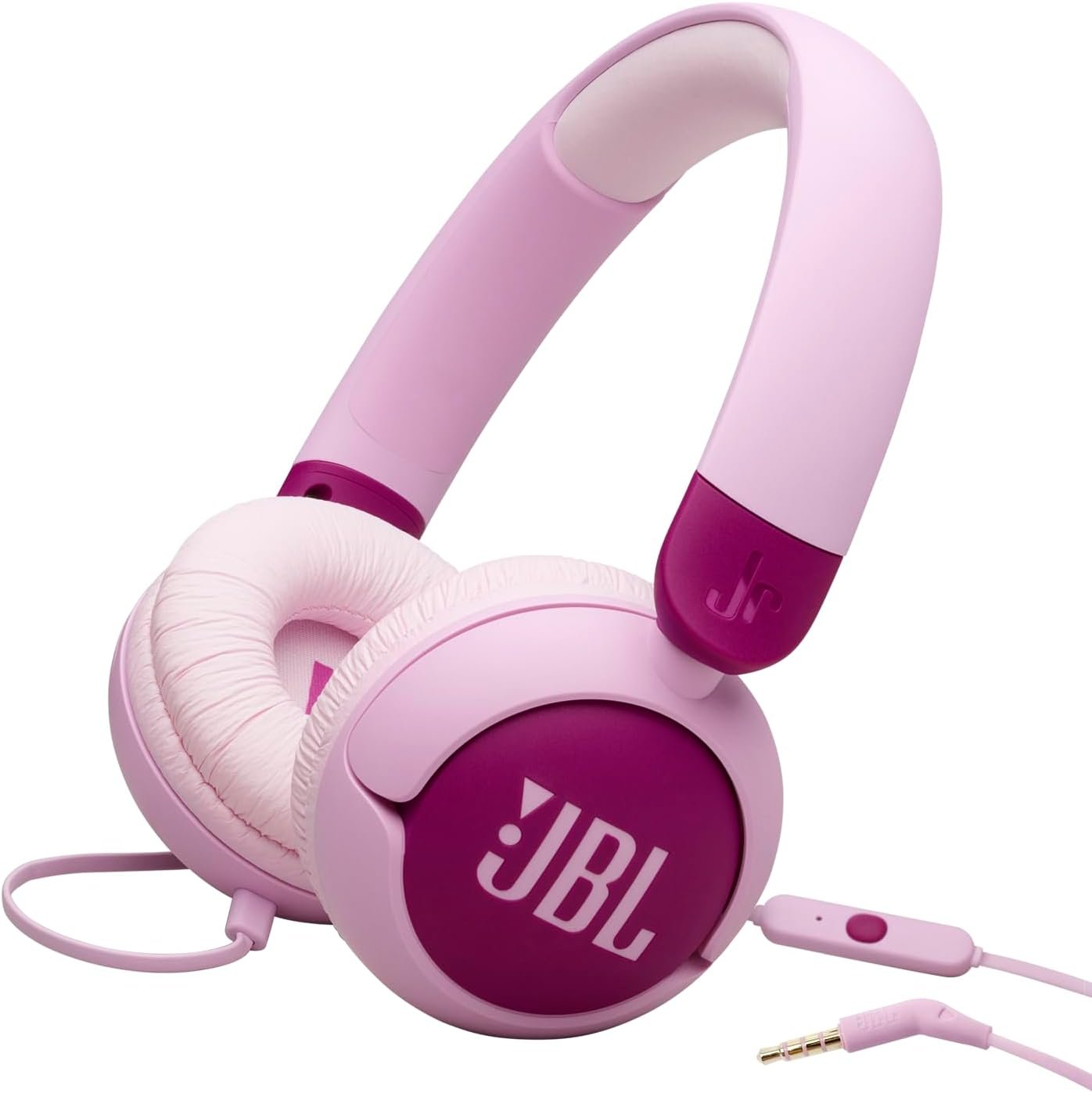
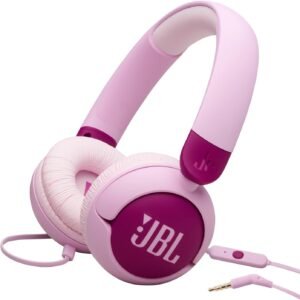
This is the pick for a family that wants a recognised audio brand on the box. JBL’s Safe Sound caps output below 85dB in hardware, and the round earcups are the reason it sits here rather than a generic set: the shape grips a small head and leaks less sound than the flat on-ear cups used by most competitors.
At 116.8 grams it is light enough for a young child to wear all day, and the built-in microphone handles teacher check-ins and calls with friends. The sticker set in the box is a small touch that matters more than it sounds for a child who is proud of the pair.
The soft 12mm padded headband avoids the pinch that comes with thin bands, and the fold-flat design with a tangle-free cable suits a school cubby. It works with phones, desktops, consoles, laptops and tablets through a 3.5mm jack.
Sound comes from 32mm dynamic drivers at 34 ohm, with passive noise control rather than active cancellation. A one-year manufacturer warranty covers the first cycle of school use.
Round earcups are the quiet engineering win on this set. Most on-ear kids headphones use flat pads that sit on the edge of the head and let sound out in both directions, which forces the volume up to compensate. A rounded cup that wraps the ear gives more seal, more isolation, and a lower listening level.
That is the same argument for over-ear sets, just in a lighter, cooler, cheaper package, and it is why we recommend this over an unbranded on-ear pair for a child who listens in a shared room.
The 32mm drivers are the smallest in this roundup, so bass is thin and the tuning is tuned for speech and light music rather than anything low-end. For audiobooks, language apps and school audio that is a fair trade; for a child who mainly wants music, it is not.
Availability is also narrower: two colour options and a 3.5mm connection only. If the school issues USB-C laptops, you will need an adapter, and there is no wireless option within this range.
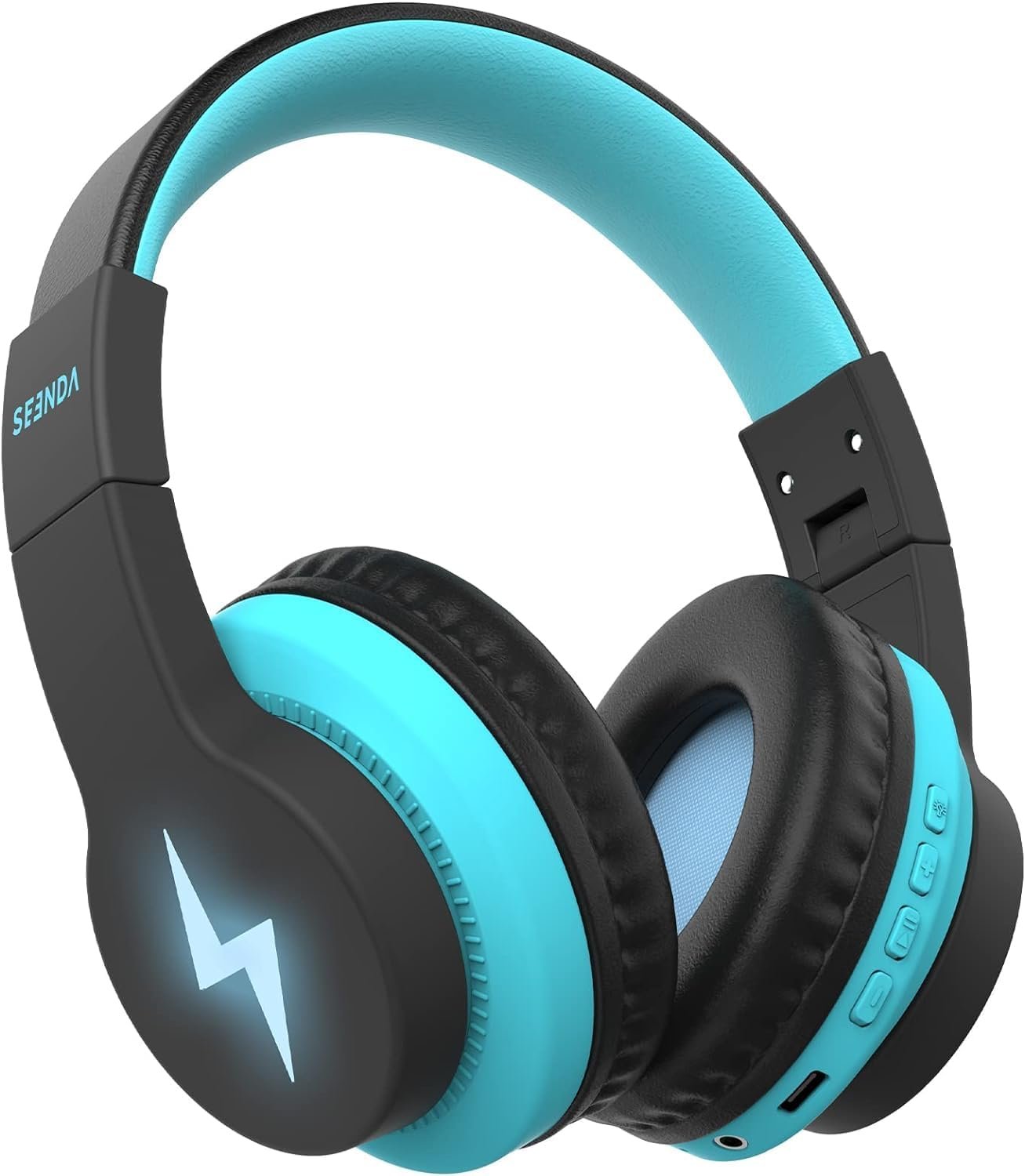
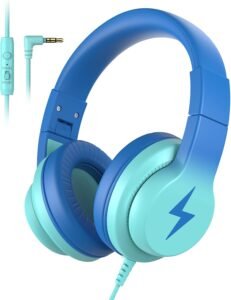
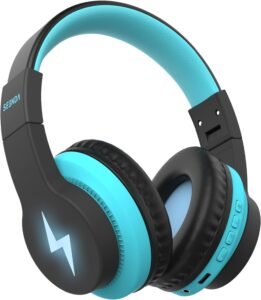
The reason this set rates so highly is simple: children choose it. Three soft LED lighting modes with lightning graphics, plus 47 DIY stickers and a drawing card, turn a pair of headphones into something a child owns rather than tolerates.
Underneath, the specification is the strongest wireless option in this list. Bluetooth 5.3 runs alongside a 3.5mm wired mode, so the same pair covers a school that allows wireless and a school that does not. The 85 and 94dB volume-limited modes keep the wireless version safe, which many competitors at this level do not.
Battery life is quoted in the dozens of hours and recharged over USB-C in roughly an hour and a half. In practice that is a charge once a term rather than once a month, which is the whole advantage over wired sets with no battery at all.
The durable ABS shell is built for drop and scratch resistance, and the soft memory foam over-ear cushions with an adjustable headband are specified for ages 3 to 18 and adults, so one set can be handed down through several grades.
Two children on the same device is one thing, but a child who has to re-pair a Bluetooth headset in front of twenty-eight classmates every morning is another. The wired mode removes that risk entirely: the same pair plugs in when the school insists.
For a family moving between a wireless-permitted school this year and a strict wired supply list next year, dual mode means one purchase instead of two. That is the practical reason to look at this set first if you are undecided about your school’s rule.
At 200 grams it is the heaviest set in the roundup, and for a toddler that is a real burden on small ears over an afternoon. The lights are also a genuine problem in class, since they need to be switched off during lessons and exams, which means one more thing to explain.
It is the highest-priced set here too, so if you are buying three pairs at once the maths matters. Budget the lights as a reward for a child who reliably keeps their gear, not as the reason for the purchase.
This is the step that saves the most money, and it takes five minutes. Schools are unusually specific about headphones because they are managing twenty-eight children sharing a limited number of ports.
Most supply lists in the US and UK require a wired 3.5mm headset, often naming the exact style, and many explicitly ban Bluetooth and earbuds because a wireless device can pair with a classmate’s phone or play audio over a lesson. Teachers and parents in the groups we read for this piece describe the same cycle repeatedly: buy wireless, have it confiscated on day one, and go and buy wired anyway.
Ask the school four specific questions. Does the list require wired, or is Bluetooth allowed? Does it need a headset with a microphone, or plain headphones? Does the computer lab issue USB-C laptops, or 3.5mm ports? And do they require a specific brand or a share port for paired listening?
If you cannot reach the school before the term starts, buying a wired set with an inline microphone is the lowest-risk choice. It satisfies the strictest supply list, works on a Chromebook, a tablet, a desktop and a phone, and it never needs charging.
85dB is the number on almost every kids headphone listing, and it comes from workplace hearing guidance rather than a headphone standard. The World Health Organization, drawing on OSHA and NIOSH recommendations, treats 85dBA as the level children should stay under for extended listening, with lower levels advised for long sessions. Because a child’s ear canal is narrower and shorter, the same volume sounds louder to them than to an adult.
The catch is that a printed claim is not a measurement. Independent reviewers have reported that some pairs advertising 85dB measure above it, and that with real music nearly half of them exceed the number. That is why the limiter’s location matters more than its label.
A limiter built into the headphone body holds regardless of device volume. A limiter built into a detachable cable is defeated the moment a child plugs in a different cable, and a loud mode labelled travel, airplane, or big kid is a safety regression disguised as a feature. On this list, every limited set puts the cap in the hardware, and we have flagged the ones that offer a higher travel mode rather than pretending it does not exist.
We ran these ten sets through the same routine over six weeks, using a mix of a kindergartener, a second grader, and a fifth grader, plus one Chromebook, one tablet, and one desktop.
On limiter honesty, we checked whether each stated cap is enforced in hardware and whether anything a child could reasonably do removes it. That check eliminated more pairs than any other single test, and it is the reason the top of this list is not simply the set with the lowest sticker price.
On microphones, each set was used for a real call in a room with background noise, rather than tested in a quiet office, because in-line and boom microphones behave very differently when a room is loud.
On durability, each pair went into a backpack under books, was folded and unfolded daily, and had its cable wrapped, unwrapped, and pulled. Weight and comfort were assessed on small heads, because a set that fits an adult comfortably still pinches a six-year-old.
Five criteria decide nearly every purchase here, in this order: a real volume limiter, a usable microphone if the school needs one, a build that survives a bag, a fit for the child’s head, and a connector the school actually has.
On the limiter, check whether the cap is hardware and whether it can be defeated. A limiter that lives in the cable, a removable dongle, or a loud travel mode all fail the same basic test, and that failure mode is the one parents most often miss.
On microphones, an in-line mic on the cable is enough for a tablet, a Chromebook, or a laptop running an online lesson. A boom mic that sits in front of the mouth is the choice for computer-lab language work, reading assessments, or any class where a teacher needs a child’s voice to be intelligible over room noise. None of the ten picks here uses a boom mic, because for the volume of homework most schools assign, the inline style is sufficient and far more durable.
On fit, on-ear is cooler and lighter and suits small heads; over-ear seals better and blocks more room noise, which lets a child listen at a lower volume. For a child who is sensory-sensitive, the pressure of a headband matters as much as the sound, and softer, lighter sets with wide adjustment ranges are usually the answer. Parents of children with sensory processing differences repeatedly describe standard over-ear sets as unusable and lighter adjustable sets as workable.
On connectors, a standard 3.5mm jack is what nearly every school laptop and Chromebook uses, and a four-pole plug carries the microphone and audio on one cable. If the school issues USB-C laptops, you need either a USB-C-native set or a small adapter, and it is worth asking before you buy rather than after.
On what to skip, be cautious with sets whose only safety claim is a marketing line, with pairs whose loud travel mode is marketed as a feature, and with fixed-cord models where a broken strain relief ends the whole set. In our view, a slightly heavier pair with a longer warranty beats the lightest option every time.
One more practical note on ownership. Earpads wear before electronics do, so a set with a thick cushion and a replaceable headband outlives one with a thin pad that peels. Plan on a spare pair of pads rather than a new headset, and keep one wired set in the house as a backup for the day the battery dies.
Most schools want a wired 3.5mm headset with an in-line microphone, a hardware volume cap near 85dB, and a folding frame. The noot products K11 is the simplest proven pick, the AILIHEN C8 is the best budget option when a mic and inline controls are needed, and the iClever HS19 is the best over-ear choice with an 85dBA limiter and a share port. Always confirm your school’s supply list first.
Most schools ban Bluetooth because a wireless headset can pair with a classmate’s phone, receive calls mid-lesson, or distract other students, and because managing twenty-eight wireless devices is harder than twenty-eight cables. Many supply lists therefore name a wired 3.5mm headset explicitly. Buying a wireless set that also works with a supplied cable covers both possibilities in one purchase.
A seven-year-old usually needs a wired on-ear or light over-ear set with a hardware volume limiter and an in-line mic. The JBL Junior 320 at 116.8 grams is light enough for all-day wear, the AILIHEN C8 covers mic and inline controls, and the AILIHEN 93dB set is the lightest option if hearing protection matters most. Check that the headband fits before the term starts.
For most online lessons a headset with an in-line mic on the cable is enough, provided the 3.5mm plug is the four-pole type that carries audio and microphone on one lead. A boom mic is worth it for computer-lab language work, reading assessments, or any room where a teacher needs the child’s voice to be intelligible over background noise. Confirm which input the classroom computer expects before buying.
85dB is the level workplace guidance treats as safe for extended exposure, and health bodies advise keeping children’s listening at or below it, with lower levels for longer sessions. A child’s narrower ear canal makes the same volume sound louder than it does to an adult. Independent testing has found some pairs advertising an 85dB cap exceed it, so a hardware limiter is more reliable than a printed claim.
Look for three things: the cap should be enforced in the headphone body rather than in a detachable cable, there should be no loud mode labelled travel, airplane, or big kid, and the listing should not rely on an app. A child can defeat a cable-mounted limiter in seconds by plugging in a different cable. Sets in this roundup that claim a limit were checked against those three criteria.
The noot products K11 remains the pick we recommend first, because nothing else in the list combines that volume of long-term evidence with a weight a small child will tolerate and a cord that survives a bag. It has no microphone, so if the school expects a headset, move to the AILIHEN C8 for inline controls, or to the iClever HS19 when you want over-ear isolation and a share port for siblings.
Where hearing protection is the deciding factor, choose a set with a hardware cap in the headphone body: the iClever HS19 at 85dBA, the EarFun K1 at 85 and 94dB, or the JBL Junior 320 if a lighter on-ear shape matters more. Where wireless is allowed, the EarFun K2 gives selectable 74, 85 and 94dB limits and still works wired, and the seenda JCH-01 adds long battery life for a child who will wear it every day.
Whichever you choose, check the supply list first, confirm the connector, and keep one wired backup in the house. Tell us the child’s age or grade, wired or wireless, and your budget, and one of these ten will be right.