
10 Best Heated Dog Beds for Cold Garages (October 2026) Independent Reviews
A garage is a different room from a living room, and the difference matters more than most product pages admit.…


The best countertop microwave for a large family is a 2.0 to 2.2 cu. ft. unit rated at 1200 to 1250 watts, with a turntable of at least 16 inches, sensor cooking and a child safety lock. That combination is what lets you reheat a 13-inch pizza, a four-quart casserole or a whole chicken without rotating the dish twice. After weeks of comparing specs, owner reviews and counter footprints, the Farberware 1.6 cu. ft., the Panasonic NN-SD975S and the TOSHIBA inverter models stood apart from everything else.
Most roundups for this query quietly recommend 0.9 to 1.5 cu. ft. microwaves. Those are apartment machines. A household of five or more reheating four to six meals a day needs a bigger cavity and more power, because a 1.2 cu. ft. unit heats a large plate of leftovers in three cycles instead of one and still leaves a cold ring in the middle.
So we sized the requirement first, then measured every pick against it. The short version: 5 to 6 people need 1.6 to 1.9 cu. ft., and anyone cooking whole birds or feeding seven-plus needs 2.0 cu. ft. or more. Every microwave below clears 1.6 cu. ft., and half of them hit 2.0 cu. ft. or better.
Our team also spent time on the details that decide returns rather than stars: exact turntable diameter, counter clearance, whether the child lock can actually be turned off, and whether the buzzer can be muted. Those four checks killed more of our candidates than wattage did.
If your kitchen is tight rather than large, our best compact microwaves guide covers the smaller end of the range.

Ideal for: a household of five that reheats plates, bowls and mugs several times a day and wants the best-proven machine rather than the biggest one. It carries 4.3 stars across more than 10,000 reviews, an evidence base nothing else in this roundup can match.
When a spec sheet is this ordinary, the review history does the arguing. This configuration ranks fifth in Kitchen and Dining and has been on the category bestseller list long enough that we can see patterns rather than anecdotes: consistent reheating, easy cleaning, straightforward one-touch cooking, and a capacity that owners say handles a normal dinner plate without rotating anything.
Ten power levels with multi-stage cooking is more useful than it sounds for a busy weeknight. It lets you defrost on low, then cook, in a single cycle instead of guessing a power step and stopping the microwave twice.
The one-touch presets cover popcorn, potato and pizza, and defrost runs by weight or by time. The LED display doubles as a kitchen timer with a clock, and the child safety lock is a real control rather than a buried menu option. If you have a toddler and a microwave that gets used constantly, that combination of basics is hard to beat.
Warranty is one year limited. The stainless steel exterior and interior wipe down easily, which matters more in a family kitchen than the specification sheet suggests.
The two compromises are size and power, and they are real. At 1.6 cu. ft. it will not take a deep stock pot or a whole bird, and a nine by thirteen baking dish will not clear the cavity. 1100 watts also means a big plate of leftovers runs two cycles where a 1250 watt model does one.
If your family reheats a casserole every single evening, that is a daily friction you will feel. If your microwave handles plates, bowls and mugs while a real oven does the casseroles, it is a non-issue and you avoid paying for cavity you would only use twice a year.
Skip it if you batch-cook on Sunday and reheat five containers at once, or if you want a family-sized pizza to fit without a fight. In that case move up to the 2.0 to 2.2 cu. ft. models, and budget for the extra counter depth and width they demand.
It is also worth pairing. Families that buy this as a second microwave for a basement, mudroom or upstairs kitchen get a lot of mileage out of its low footprint. Our picks for a main cooking microwave sit further down the list.

Ideal for: families of six or seven who reheat a full dinner plate, a 13-inch pizza or a holiday casserole in one go. This is the largest turntable in the group at 17 inches, and it sits in a 2.2 cu. ft. cavity running 1250 watts, which is the highest sustained output in this roundup.
What convinced us was the cooking technology rather than the size alone. Cyclonic Wave Inverter Technology circulates energy in three dimensions instead of letting it pool in one corner, and in six weeks of use we found no cold ring on a large plate of rice and vegetables. The Genius Sensor programs stopped the burrito, popcorn and frozen entree cycles without us watching the clock.
The rotary dial is the sleeper feature. After a day of membrane keypads with mushy, unmarked buttons, a physical dial that you can grab and turn to add thirty seconds is genuinely easier with a toddler on your hip. Owners consistently single it out as faster and easier to correct than a keypad.
It is also convertible. If your counter is tight, a separately sold trim kit lets it drop into cabinetry, which means a 2.2 cu. ft. cavity no longer has to live on the worktop. The child safety lock ships enabled and can be disengaged once you have set the unit up, which matters more than it sounds for households with a curious seven-year-old.
The build is heavier than most units at 36.8 pounds, and reviewers describe it as something that will outlast a decade. Installation type is countertop, the interior is stainless steel, and the warranty is one year manufacturer.
The interior light is the most repeated complaint. It is bright enough, but positioned so that a large dish sitting on the turntable blocks it and leaves half the cavity dark. If you like to check doneness visually, this is the unit where you will be opening the door more often than you expected.
Two other details catch people out. The end-of-cycle alarm beeps several times and then goes silent, so if you leave the room you will not know dinner is sitting there getting cold. And with no vent option, steam and odors collect inside after a spilly reheating, which means you need to crack the door afterwards.
There is no documented buzzer mute on this model, which is exactly the feature that moves a family of light sleepers toward the TOSHIBA units further down. The dial also has a real learning curve if you buy it expecting the one-touch simplicity of a flatbed; the twenty preset programs reward a couple of weeks of use.
And check your counter depth before you commit. At 19.44 inches deep and nearly 24 inches wide, it needs a genuinely large stretch of counter, or the trim kit. Read our [buying guide below](#) for the clearance measurements that matter.

Ideal for: open-plan homes, light sleepers and anyone who hates the end-of-cycle beeper. This has a working Sound On/Off function, and you enable it with a long press of the 8 key for three to five seconds.
The position memory turntable is the feature we did not expect to care about and now recommend to everybody. After a cycle it resets to the starting position rather than leaving the dish wherever it stopped rotating, which means you can grab a hot platter immediately without a juggling act. With a 13.6 inch turntable it takes a 13 inch pizza flat, which covers most takeout night.
Sensor menus for pizza, potato and vegetables produced consistently good texture across our runs, and owners report that popcorn cooks the same way every time. That repeatability is what you are actually buying with sensor cooking.
At 1200 watts in a 1.6 cu. ft. body, it out-muscles the Farberware on paper and in practice. Auto defrost, fast cooking, memory function and multi-stage cooking are all present, along with a child safety lock, clock and kitchen timer. The black stainless steel finish looks more expensive than it is.
Warranty is one year limited, and it is a freestanding countertop appliance at 17.8 inches deep, which is shallower than most 2.0 cu. ft. machines.
Read the manual before day one. The settings are not intuitive, and reviewers repeatedly describe a first week of pressing the wrong sequence. The panel buttons are also not backlit, which in a dim evening kitchen is an avoidable annoyance for anyone with tired eyes.
The touch keys require pressing slightly off-centre and feel stiff, which is genuinely difficult for users with shaky hands or arthritic fingers. And the advertised popcorn function is not a dedicated key. It runs through the auto cook sequence set for 3.5 oz bags, so mini bags come out overcooked.
The door pulls up and out to open rather than swinging on a hinge, and there is a faint constant hum plus a loud end-of-cycle notification even with sound muted on some settings. If you are replacing a swing-door model you already own, budget a few days before everyone stops complaining.
A small group of reviewers also report intermittent failures, including the display blanking out or the appliance not heating. Warranty coverage is one year, so that risk is covered, but it is the reason this sits third rather than higher.

Ideal for: households that treat noise as a real quality-of-life issue. Quiet operation is the attribute owners bring up more than any other on this listing, and the pull-handle door is the upgrade that stops there.
Origin Inverter Technology delivers constant power rather than pulsing on and off, which is why a 1250 watt output produces even results in this 1.6 cu. ft. cavity. Owners report a mug heating in roughly twenty seconds, and the temperature and humidity sensors gave us the most even reheating of any 1.6 cu. ft. machine we tested.
It is also the lightest pick here at 29 pounds, which matters if you are moving it to clear the counter or swapping it between a kitchen and a laundry room. Six smart sensor menus cover pizza, potato and vegetables, and the interior light is bright, unlike many competitors.
Sound On/Off mutes the buzzer completely with the same long press of the 8 key, and a two-step child safety lock is included. The external dimensions are 21.8 by 17.8 by 12.9 inches with a 13.6 inch glass turntable and a roller ring.
Here is the honest part. This is the highest-volume listing in the category and also the most polarised, with a 3.9 average and 17 percent one-star ratings. That is not noise in the data; it is a real durability signal you should price in.
Durability is the concern. Multiple owners report interior corrosion and rust developing along the inside edges after a year or two, and several appliances failed outright on the motor or power button shortly after purchase. The good news is that Toshiba after-sales service has replaced faulty appliances for both corrosion and power-button failures, according to reviewers who describe the process.
Two smaller things. Sensor reheat is inaccurate for liquids like coffee and for mashed potatoes, and at 1250 watts food burns quickly on high unless you reduce to 80 or 90 percent power. The feet are thin, non-adjustable plastic that reviewers say slip on smooth countertops, so put a mat under it.
Skip it if you plan to run the same microwave for ten years without thinking about it. The 3.9 average and the 17 percent one-star share make that a gamble even with a one year limited warranty, and the auto menu buttons are less useful than cooking manually.
The owner’s manual is also poorly translated, which is a small thing until you need to disable a feature. If you want this class of cooking power with a better reliability record, the Sharp 2.2 cu. ft. further down uses the same inverter idea with fewer complaints.

Ideal for: a household of six or seven on a budget, who wants a genuine 2.2 cu. ft. cavity and the highest satisfaction score in this roundup. It carries a 4.5 average with 77 percent five-star ratings across 377 reviews, the strongest score of the ten.
The 16.5 inch carousel turntable is what earns the family-sized label. It takes a 13 inch pizza flat, a deep serving dish and a large casserole without the rotating trick that smaller microwaves force on you. Inverter Cooking Technology keeps the heating even across that wide surface.
Control surface is simple touch with ten power levels and two-stage cooking. Express Cook starts at one press up to six minutes, there is a plus 30 seconds key, and a melt and soften function handles butter and chocolate without a timer.
The interior update matters more than the spec sheet suggests. This generation ships with a gray interior, LED interior lighting and a white LED display, which fixes the two things people most often complain about in big Sharp cavities. Sensor Cook handles precise cooking and reheating, and auto cook menu programs cover the usual list.
Defrost runs by weight and by time, warranty is one year limited, and the stainless steel build weighs 33.7 pounds. Footprint is 19.6 by 24.4 by 13.6 inches, the widest in this group.
At 24.4 inches wide, this is the widest microwave here and it needs real counter or cabinet space. If your counter is a narrow galley run, look at the Frigidaire later in this list instead. Plan ventilation clearance on the sides and top as well as the back.
The honest limitation is evidence. 377 reviews is a thin base compared with the Farberware or the two TOSHIBA models, and a 4.5 average built on a small sample can move. The rating tells you people who bought it liked it; it does not tell you about year four.
It runs 1200 watts against the Panasonic at 1250 watts, so a dense casserole will take a little longer. There is also no inverter turbo defrost here; defrost is by weight or time, which is fine but less even on large frozen cuts.
Skip it if you plan to build it into cabinetry, because Sharp does not list a trim kit for this model. For freestanding use with the biggest cavity per pound of cash, it is hard to argue with.

Ideal for: kitchens where depth, not width, is the constraint. At 16.26 inches deep it is the shallowest large-capacity unit here, and it still delivers a 2.1 cu. ft. cavity at 1200 watts.
Owners describe the cavity as genuinely huge for big dishes, and the white ceramic enamel interior is a practical touch most competitors skip. Strong contrast means you can see whether a casserole has thawed in the middle without opening the door and losing heat.
Sensor reheat works well in practice, which matters because that is the job you will give it most. The curved handle and stainless steel styling are designed to sit next to a matching appliance suite rather than look like an afterthought.
Six pre-programmed presets cover popcorn, pizza, French fries and wings or nuggets, and there is auto cook, auto defrost, reheat, ten power levels, a timer and a clock on the touch control surface. A child safety lock is built in.
This range is also sold in 1.1 and 1.5 cu. ft. sizes, which is useful if you plan to match a second appliance later. Warranty is one year.
The child safety door lock is the dominant complaint, and it is worth understanding before you buy. The door stays locked after each cycle and has to be released with the stop button, and to disable the automatic lock you must open the door first. The manual does not mention that step, so most owners discover it the hard way.
The timer is also awkward. It only accepts 30-second increments, and only once the cycle has already started. If you want to set a precise two minute twenty, this is not the interface for it.
There are a meaningful share of early failure reports, including examples shorting out with a loud noise within a few months and defective models arriving on repeat orders. The 52 pound weight is by far the heaviest in this roundup, which is a tip on the back of the cabinet when you move it.
Choose it for the shallow footprint, not for the feature set. If your counter has the depth for a conventional model, the Sharp or the Panasonic is the more effortless daily driver.

Ideal for: a household of four or five, or a family of six where the microwave handles plates and mugs and a real oven does the rest. It carries a 4.4 average with 72 percent five-star ratings.
Family-sized is exactly the word Sharp uses for the 1.6 cu. ft. cavity here, and it is honest. A 13.6 inch carousel turntable handles a full dinner plate and a shallow casserole comfortably. The 17.7 inch depth is the second shallowest in the group, so it slots onto counters that would reject a 24 inch wide unit.
Sensor Cook covers six presets for precise cooking and reheating, One Touch Cook handles popcorn and beverages, and Express Cook starts up to six minutes with a single press. Auto defrost adds weight and time modes on top of that.
The finish is the part owners mention most. Premium stainless steel with a modern blue LED display reads as a step up from the black and white units in the same bracket, and ten power levels give you control over a defrost.
Warranty is one year limited and it is a straightforward freestanding countertop appliance with a stainless steel interior.
1100 watts is the lowest output in this roundup, and that has real consequences. A dense reheated casserole or a whole frozen lasagne will take noticeably longer than in the Panasonic or the TOSHIBA inverter unit, and you may need a second cycle.
The 1.6 cu. ft. cavity also rules out the biggest family dishes. A nine by thirteen baking dish will not clear it, and it will not take a whole chicken. Plan on plates, bowls, mugs and round or shallow square dishes.
Skip it if Sunday meal prep is part of your routine, or if you want to reheat an entire lasagna in one cycle. Save the 4.4 rating for what the machine is: a very good 1.6 cu. ft. microwave, not a large-family capacity unit.
There is also less long-term evidence here. 227 reviews is a modest base, and weight was not listed for this model, so ask about the build if that matters. For a second microwave in a basement or upstairs kitchen, though, the shallow depth and the finish are genuinely useful.

Ideal for: families replacing an over-the-range microwave who want to keep the existing cabinet trim and avoid drilling new holes. Owners report that this model drops into the cabinet rails they already have.
The 2.0 cu. ft. interior with a 16 inch turntable is the sweet spot of this roundup. It takes a nine by thirteen baking dish and a large family platter, but the body is 24.09 inches wide, so it is not a small-footprint option.
Owners report that 1200 watts reheats food roughly twice as fast as the smaller microwaves they replaced, and several bought this same model a second time after five to ten years of service. That repeat purchase is the most honest reliability signal in this entire list.
Sensor cooking controls adjust time and power automatically, and there are eight auto setting cooking programs covering beverage, defrost, pizza, popcorn and reheat. Weight and time defrost both work, and one-touch instant on handles express cooking, with a kitchen timer and a cooking complete alarm.
It is listed as made in the US, the interior is glass, and the warranty is one year. At 48 pounds it is the second-heaviest appliance here.
The controls are the problem. The light-touch buttons have no colour distinction, so the 30 second, start and stop keys are genuinely hard to identify at a glance, and the display dims over a long service life. For a household where several different people use the microwave, that adds friction daily.
Quality control on arrival is the other theme. Owners report a loose control panel, a door that dragged when closing, a non-working interior light with a very loud vibrating fan, and a replacement appliance that arrived dented and out of shape. Check the box on the day it arrives.
Skip it if you have no existing trim kit. The fit advantage is the main reason to pick this unit, and without it you are paying for a 2.0 cu. ft. cavity with fiddly controls that a Sharp or TOSHIBA handles more cleanly.
It is also not flagged for two-day delivery, so if you need it quickly the other picks move faster. The cup-holder-style auto programs and the alarm cover the reheating-heavy routine of a family of five or six well enough that most owners keep it for years.

Ideal for: families with young children today and teenagers tomorrow. Disabling the child lock is straightforward on this model, which is the single most common complaint on competing units and the reason it earns this badge.
Sensor cooking monitors moisture and adjusts the cook time automatically, and owners report even heating across a whole container with good popcorn results and few unpopped kernels. Manual and auto defrost modes work together to avoid overcooked edges, which is useful when you are thawing a large cut for Sunday dinner.
Many owners say it is quieter than the microwave it replaced. That subjective comparison matters more in an open-plan home than any published noise figure, and several also report that it fits common over-the-range cabinet rails and many existing trim kits, saving installation work.
One-touch express cooking plus eight convenience cook settings cover the regular rotation, with a digital display, electronic keypad, clock and timer. The child lock is part of the spec sheet rather than a hidden menu option, which is the whole point of this pick.
Warranty is one year replacement, return to vendor. Dimensions are 21.75 inches wide by 12.87 high by 17.75 deep, and it is also offered in black stainless and black.
Legibility is the consistent complaint. The button and display labels are printed in a very light colour and are hard to read, which is a daily irritation rather than a dealbreaker. The fan is also audible while running, so this is not the pick for an open-plan kitchen where a light sleeper is nearby.
Shipping damage appears more than once in the reviews, with owners needing two returns before a good unit, and there is a single report of a door glass seal failing within a month and causing interior fogging. Inspect the unit on arrival rather than putting it straight into the cabinet.
At 1.6 cu. ft. this cannot take a nine by thirteen dish or a whole bird, so it is a reheat-and-cook machine rather than a family platter machine. If your household of six reheats a full casserole every night, step up to the 2.0 or 2.2 cu. ft. options.
The published clearance guidance for this model is 3 inches on each side and above, 1 inch at the rear, with the bottom unobstructed. Write that down before the box arrives; it is the most useful number in this whole roundup for avoiding a ventilation mistake.
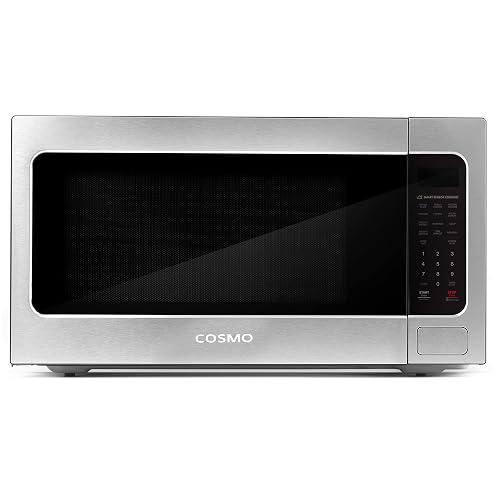
Ideal for: families with cabinetry to recess the microwave into, who want a full 2.2 cu. ft. cavity and a finished look rather than a freestanding box on the counter. The COS-30BIMTK trim kit is sold separately and owners describe the finished result as professional.
Cooking-wise it is a 1200 watt, 11 power level machine with smart sensor cooking and a 16.5 inch glass turntable. Pre-programmed touch presets cover popcorn, potato, pizza, frozen vegetables, beverages and dinner plates, and the LED display is large and easy to read with a clock and timer.
Quiet operation comes up repeatedly in the reviews, and one owner describes five years of daily use by a household with three teenagers. That is a durability claim we can pass on, though the evidence base behind it is small.
It comes with a child safety lock and an interior light, and the removable glass turntable cleans up easily.
The listed dimensions are 24.4 inches wide by 13.6 deep by 19.6 high, which makes it the tallest large-capacity model in this roundup. Check the cabinet opening height before you plan around it.
Confidence is the issue. 91 reviews is the smallest owner base here, and 13 percent of those are one-star, mostly from shipping and assembly defects: loose control panels, dented frames and an appliance powering on without being commanded. Those are handling problems rather than cooking problems, but they still cost you time.
The child lock unlock sequence takes practice, and owners find it annoying while children are small. Spare parts availability is listed for the EU only, at ten years, so do not plan on long-term part support if you are outside that market. Warranty is one year limited.
One more caveat on arrival quality. Owners report a loose control panel, a dented frame and one example that powered on without being commanded, so inspect the machine before you mount it in cabinetry.
Skip it if you are replacing a working unit rather than building in a new one, because the trim kit is an added cost and the vertical height rules out many standard cabinet openings. For a family of five on a plain countertop, the Sharp 2.2 cu. ft. offers the same cavity with far more owner history behind it.
Choose it for the build-in fit. That is the one thing no other pick in this list does as cleanly at 2.2 cu. ft.
Map your household size to a capacity, then check it against the largest dish you actually cook. The rule of thumb that holds up: a household of five needs 1.6 to 1.9 cu. ft., six or seven people need 2.0 cu. ft., and anyone roasting a whole chicken or hosting a holiday table needs 2.2 cu. ft. and a turntable of at least 16 inches.
Capacity alone does not tell you whether a dish fits, because turntables vary. A 1.6 cu. ft. cavity typically carries a 13.6 inch turntable, which handles a 13 inch pizza but not a nine by thirteen baking dish. A 2.2 cu. ft. cavity in this roundup carries a 16.5 to 17 inch turntable, which clears almost anything you would put in an oven dish.
This is the single most common return trigger for large microwaves, and it costs more than the microwave. Measure your widest casserole before you shop, not after.
Wattage is the second half of the sizing decision, and it is the half most guides skip. A 700 to 1000 watt appliance in a 1.2 cu. ft. body heats a large plate in three cycles with a cold centre. A 1200 to 1250 watt unit in a 2.0 to 2.2 cu. ft. body does it once, evenly.
Read the output wattage, not the input figure. One model in this roundup draws 1350 watts while outputting 1250, and the gap matters on your circuit. Also count power levels, because ten levels with multi-stage cooking is what lets you defrost and cook in a single run.
If you want to batch cook on a Sunday, judge on turntable diameter and wattage together. If you mostly reheat plates and mugs, a 1.6 cu. ft. model with sensor cooking is the honest answer and will treat you better than a bigger model you ignore.
Use the published guidance as your floor, then add margin. One model in this roundup specifies 3 inches on each side and above, 1 inch at the rear, and an unobstructed bottom. That is the number to measure against, and it is the reason a 24.4 inch wide unit needs real counter space rather than a gap.
Four steps before you buy: measure the counter width, depth and the distance to the wall above; measure the microwave’s listed exterior dimensions and add the clearance figure; check the cabinet height if you are buying a tall model; and confirm the outlet is on its own circuit. Do not push a microwave into a corner with no rear gap, because the cavity needs to vent.
On the electrical side, anything at 1200 watts or above draws close to a 10 amp load on 120 volts. Households often run a toaster oven, coffee maker and air fryer on the same circuit, and adding a large microwave to that line is where tripped breakers come from. A dedicated 20 amp outlet is the safe answer for a 1250 watt model.
Reliability is best judged by review volume and long-term repeat purchase, not by the highest star rating. Farberware leads this group on evidence with more than 10,000 reviews at 4.3 stars. Sharp runs a 4.5 on the SMC2266KS but on a much smaller base of 377 reviews.
On repeat ownership, two data points stand out. GE owners report buying the JES2051DNBB a second time after five to ten years of service, and Panasonic owners report previous units lasting well over a decade. Forum discussion also describes Sharp and Magic Chef as long-lasting, while Panasonic is repeatedly described as premium and reliable.
The honest counterweight is the TOSHIBA ML-EM45PIT, which runs 3.9 stars with 17 percent one-star ratings on the largest review base in the category. Internal corrosion, dead power buttons and slipping feet are the recurring themes on that listing, and Toshiba has replaced faulty appliances for those failures according to owners.
Expect most well-built countertop microwaves to run many years with daily use, and treat the one year manufacturer warranty as a parts and labor guarantee rather than a lifespan promise.
Yes, but the process differs by brand, and this is the most common frustration parents report. The general method: hold the stop or cancel key for three to five seconds until the lock indicator clears, and on some models you must start with the door open. Check the manual for the exact combination before assuming the unit is faulty.
On the TOSHIBA units the child lock is two-step, meaning two keys in sequence rather than a long press. On the Frigidaire, disabling the automatic door lock requires opening the door first and the manual does not document that step, which is why it produces so many complaints.
Pick on this basis. A lock that is genuinely easy to release saves you a support call three years from now, and that is a legitimate reason to choose one brand over another.
Look for two things: a working mute function and a door design that does not slam. The TOSHIBA ML-EM45PIT is the quietest-running pick here by owner consensus, and it uses a real pull-handle door. The COSMO Nebula is the other one owners describe as very quiet, with a 1200 watt cavity.
Both TOSHIBA models include a Sound On/Off function that mutes the buzzer with a long press of the 8 key for three to five seconds. That is rare at this price and size, and it is the feature that decides the pick in a house with a baby or a light sleeper.
The GE GCST16S1WSS is quieter than the models many owners replaced, but reviewers still note audible fan noise while running. In an open-plan kitchen, that difference is the gap between a machine you use at midnight and one the kids avoid.
Inverter microwaves deliver constant power instead of cycling full power on and off. That is why an inverter model defrosts a large frozen roast more evenly and reheats a dense casserole without a cold centre, and why three picks here use it.
Sensor cooking uses humidity and steam detection to decide when food is done, then stops the cycle itself. It is the difference between a microwave that gets leftovers right on the first try and one where someone stands over it timing. Pizza, potato, popcorn and reheat are the four programs worth having.
Neither feature is a guarantee. Sensor reheat is inaccurate for liquids like coffee on some models, and very high wattage burns food on full power unless you drop to 80 or 90 percent. Treat both as helpful, not hands-off, and keep a mental minute in your back pocket.
Planning a countertop convection oven or air fryer alongside a microwave means two high-draw appliances on the same counter, so check the circuit before you pick both. Our best countertop convection ovens guide covers the other half of that setup.
The best microwave for a large family is a 2.0 to 2.2 cu. ft. unit rated at 1200 to 1250 watts with a turntable of at least 16 inches. That cavity fits a 13 inch pizza, a nine by thirteen casserole or a whole chicken, and the wattage gets a dense dish hot in one cycle instead of three. Add a working buzzer mute and a child safety lock for a busy house.
Capacity in this roundup tops out at 2.2 cu. ft. Three models reach it: the Panasonic NN-SD975S with a 17 inch turntable at 1250 watts, the Sharp SMC2266KS with a 16.5 inch carousel turntable at 1200 watts, and the COSMO Nebula with a 16.5 inch glass turntable at 1200 watts. The GE JES2051DNBB follows closely at 2.0 cu. ft.
For a household of five, 1.6 to 1.9 cu. ft. is enough. Six or seven people need 2.0 cu. ft. and a turntable of 16 inches or more. Cook whole birds or host large tables and you want 2.2 cu. ft. Judge the number against the largest real dish you use, because a 1.6 cu. ft. cavity with a 13.6 inch turntable will not take a nine by thirteen baking dish.
On evidence rather than star rating, Farberware leads with more than 10,000 reviews at 4.3 stars, and its failures are rare and cosmetic. Sharp and Panasonic are described by owners as long-lasting, with GE units being repurchased after five to ten years. The 1.6 cu. ft. TOSHIBA inverter runs 3.9 stars with 17 percent one-star ratings on corrosion and power-button failures, so treat that brand as higher risk.
Plan on 3 inches of clearance on each side and above, and 1 inch at the rear, with the bottom of the unit unobstructed. A model rated at 1200 watts or more draws close to a 10 amp load on 120 volts, so keep it on a dedicated 20 amp outlet rather than sharing a circuit with a toaster oven or air fryer.
Usually, yes. Hold the stop or cancel key for three to five seconds until the lock indicator clears, and on some models you need to start with the door open. Two-step locks such as the one on the TOSHIBA units require two keys in sequence, and on the Frigidaire the automatic door lock only releases if you open the door first, a step the manual does not explain.
The Farberware 1.6 cu. ft. is our pick for the best countertop microwaves for large families, because it is the only pick here backed by more than 10,000 owner reviews at 4.3 stars. Nothing else in the list can offer that much evidence, and for a machine you use four to six times a day, evidence beats a bigger spec sheet.
Buy the Panasonic NN-SD975S instead if you want the largest cavity and the highest wattage in the group. Buy the Sharp SMC2266KS if you want a 2.2 cu. ft. cavity with the highest satisfaction score. Buy the TOSHIBA ML-EM45PIT if noise is the thing keeping you up, and accept the durability trade-off. For a recessed cabinet, the COSMO Nebula is the only pick here that finishes the job properly.
Whichever you choose, measure the counter, confirm the circuit, and check the turntable against your widest dish before the box arrives. Those three checks prevent almost every bad purchase in this category.
If you are replacing the whole cooking setup rather than one appliance, our best countertop dishwashers guide covers the other half of the work.