
Clover Legends Codes (September 2026) All 15 Active Codes
I’ve rounded up every working Clover Legends code so you can grab free Gems, Yul, Race Rerolls, and Keys without…

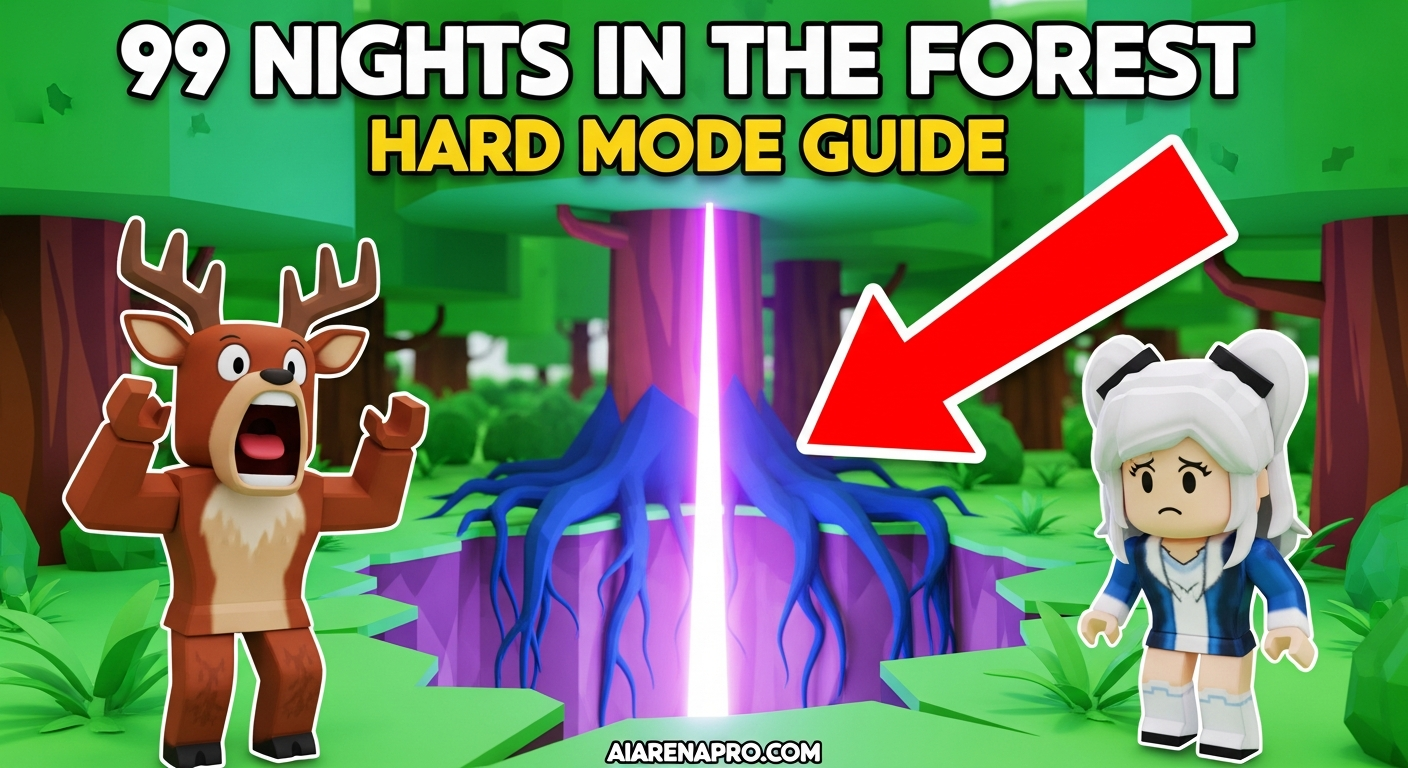
Are you ready to face the ultimate challenge in 99 Nights in the Forest? The Forest Is Angry update has transformed this Roblox survival horror experience into something far more brutal with its new Hard Mode. Released on January 24, 2026, this game-changing update introduces a corruption system that turns the forest itself into your enemy. I’ve spent countless hours navigating corrupted rifts, battling debuffs, and perfecting survival strategies so you don’t have to learn everything the hard way.
| Release Date | January 24, 2026 (The Forest Is Angry Update) |
| Activation | Research Outpost basement lever (before Day 3) |
| Main Mechanic | Corruption System with spreading rifts |
| Rewards | 2x Diamond payouts at Night 50 & Night 99 |
| Difficulty | Permanent debuffs, no passive healing, aggressive enemies |
| Reversibility | One-way switch – cannot be disabled once activated |
Hard Mode isn’t just about tougher enemies or bigger numbers. This is a complete gameplay transformation that adds a corruption layer across the entire map. Once you activate it, the forest begins fighting back through spreading rifts that corrupt trees, wildlife, and even your food supply. The stakes are incredibly high, but so are the rewards with double diamond payouts for those who can survive.
Before we dive into activation steps and strategies, let me explain what makes Hard Mode fundamentally different from normal gameplay.
The Corruption System is the heart of Hard Mode. Think of it as an invisible timer constantly working against you. Rifts appear throughout the forest, spreading corruption that increases a global percentage meter. As this meter rises, you’ll face increasingly severe permanent debuffs that stack throughout your entire run.
Unlike normal mode, where you can focus primarily on base defense and cultist raids, Hard Mode forces you to actively patrol the forest. Every unchecked rift is a ticking time bomb that pushes you closer to debuffs that can make survival impossible.
Rifts are purple anomalies that spawn roughly every night once Hard Mode activates. Each rift creates a zone of corruption around it, infecting nearby trees and animals. These corrupted entities are more aggressive than their normal counterparts and contribute to raising the global corruption level.
The key mechanic here is that corruption never stops on its own. You must actively clear rifts by chopping corrupted trees and killing corrupted animals in their vicinity. Clear a rift completely, and it stops generating corruption until the next one spawns somewhere else on the map.
As your corruption percentage climbs, you’ll face four possible debuffs (your run will get three of them):
These aren’t temporary status effects. Once a debuff activates at a corruption threshold, it remains active for the rest of your run. Let corruption climb too high, and you’ll eventually face a combination that makes survival mathematically impossible.
Now that you understand what you’re getting into, here’s the exact process to enable Hard Mode.
The Research Outpost (also called Scientific Outpost) is a permanent structure that appears on your map once you craft one. It’s a large white building that’s easily distinguishable from other structures like fishing huts, cabins, or watchtowers. On the map, it appears as a white rock-like marker located north of your main campfire area.
You can access the Research Outpost from Day 1, but I recommend scouting it early to discuss with your team whether you’re ready for Hard Mode. The building contains valuable information about corruption and serves as your primary monitoring station once Hard Mode begins.
Inside the Research Outpost’s main floor, look for a steel door on the left side of the interior. Open this door and descend the stairs into the basement. This underground area contains notes explaining the corruption’s origin, monitoring equipment, and most importantly, the lever system.
In the basement, you’ll find one lever per player in your current round. This voting system ensures everyone agrees before Hard Mode activates. Each player must pull their individual lever to cast a vote.
Critical timing: You can only vote for Hard Mode before Day 3 begins. Once Day 3 starts, the voting window closes permanently for that run. If all levers are pulled before this deadline, a cutscene plays, and Hard Mode immediately activates.
Hard Mode officially begins on Day 3, regardless of when you pulled the levers. Use Days 1 and 2 to prepare:
Once Day 3 hits, the activation cutscene plays, and rifts begin spawning immediately. Your corruption journey starts here.
After activating Hard Mode, you need constant visibility into your corruption status. Here’s how the monitoring system works.
Inside the Research Outpost, you’ll find a Research Monitor panel displaying three critical pieces of information:
This monitor becomes your command center for tracking corruption trends. Check it regularly to see if your rift-clearing efforts are actually reducing corruption or if you’re falling behind.
One of the most valuable items from the Research Outpost chests is the Research Monitor Blueprint. This item allows you to build a portable monitor at your base, eliminating constant trips to the outpost.
To get the blueprint:
Build this monitor at your base as quickly as possible. Having corruption data accessible without leaving your camp is crucial for making fast decisions about when to patrol and when to defend.

This is where Hard Mode becomes a strategic balancing act. You need to control corruption while still maintaining base defenses, gathering resources, and surviving nights.
Rifts appear as purple anomalies with distinct visual effects. When patrolling the forest, watch for:
Your map can also help identify rift locations, though visual scouting during daytime is more reliable.
Here’s my proven method for completely clearing a rift:
Step 1: Prioritize the Rift. Treat every new rift as a priority objective. The longer it stays active, the more corruption it generates. Patrol during daylight when The Deer isn’t hunting, and visibility is high.
Step 2: Chop Corrupted Trees. Enter the infected area and begin chopping down the corrupted trees. These trees are visually distinct with dark bark and corruption growing on them. A strong axe or chainsaw significantly speeds up this process. Each corrupted tree you remove lowers the overall corruption contribution from that rift.
Step 3: Kill Corrupted Animals. Hunt down and eliminate all corrupted wildlife near the rift. These enemies are more aggressive than normal animals and deal more damage. Corrupted wolves, bears, and other creatures all contribute to the rift’s corruption output. Use ranged weapons if possible to minimize damage taken.
Step 4: Verify Complete Clearance. Stay in the area until all visible signs of corruption vanish. The rift should dim or disappear entirely, and no hostile corrupted creatures should remain. Only then has the rift been fully neutralized.
Remember, clearing one rift doesn’t solve your corruption problem. New rifts spawn approximately every night, creating a never-ending cycle of patrol, clear, return to base, and repeat.
Early Game (Days 3-20) Focus on aggressive rift clearing. Corruption is manageable at this stage, and establishing good habits now prevents catastrophic debuff stacking later. Use the Research Monitor Blueprint immediately and clear every rift the same night it spawns if possible.
Mid Game (Days 21-50) Rifts spawn more frequently, and corruption pressure increases. You’ll need to balance rift clearing with cultist raid defense. Coordinate with your team – some players patrol while others defend the base. Stockpile healing items because passive healing is likely disabled by now.
Late Game (Days 51-99) At this stage, corruption management becomes your primary objective. Food rot spores may be active, making resource management critical. Every decision counts. Miss clearing even one rift for too long, and the compounding corruption can spiral out of control.
Now let me share the advanced tactics that have kept my teams alive through Night 99 on Hard Mode.
Standard base designs don’t cut it in Hard Mode. You need a layout that supports constant player movement between the base and rifts.
The Trapped Entrance Design: Surround your campfire with log walls, but leave a small tunnel entrance. Line this tunnel with bear traps, laser fences, barbed wire, and lava mines. This setup handles cultist waves automatically while your team patrols for rifts. It’s efficient for runs under Day 120.
The Heavily Walled Fortress. For longer runs, build multiple layers of protection: trees on the outer perimeter, then log walls, then wood rain storage closest to the campfire. Include space inside for farm plots and oil drills for sustainability. This design requires significant resources but pays off when food rot spores make external foraging dangerous.
The Corruption-Ready Layout Leave clear paths to your base entrance so players can retreat quickly from rift patrols. Build your Research Monitor Blueprint near the campfire for constant corruption visibility. Include a freezer for food storage and multiple crafting benches for gear repairs.
The Forest Is Angry update introduced a ping system that becomes absolutely critical in Hard Mode.
PC Controls: Press Q to ping. Mobile Controls: Tap the bell icon
Use pings strategically to:
Communication speed often matters more than raw damage output in Hard Mode. A well-coordinated team using pings effectively can clear twice as many rifts as a silent team with better gear.
Not all classes perform equally in Hard Mode’s corruption-focused gameplay.
Best Classes for Hard Mode:
Classes to Avoid: Classes focused purely on farming or passive bonuses struggle in Hard Mode. You need combat effectiveness and mobility above all else.
Because it does. Hard Mode’s debuffs can cut off your resource streams entirely.
Before Passive Healing Is Disabled:
Before Food Rot Spores Activate:
Fuel Management: Once you hit campfire level 4-5, logs become inefficient. Build a biofuel processor early and an oil drill by campfire level 5. In Hard Mode, you can’t afford to waste time gathering fuel when you should be clearing rifts.
Daytime is for corruption control. Nighttime is for base defense. Follow this pattern religiously:
Day Cycle:
Night Cycle:
The Deer, The Owl, or The Ram (depending on your biome) make nighttime rift patrols incredibly dangerous. Corrupted animals are even more aggressive at night. Unless you’re in a critical corruption situation, wait for daylight.
Here are some expert-level tricks I’ve learned:
The Rift Prediction Method: Rifts spawn roughly every night, often in areas you haven’t recently cleared. After clearing a rift, make note of its location. New rifts tend to spawn in different map sectors, so rotate your patrol routes rather than rechecking the same areas.
The Split Patrol System (Teams) Divide your team into two groups: Patrol Squad and Defense Squad. Patrol Squad handles rifts during the day. Defense Squad maintains the base, crafts supplies, and handles night raids. Rotate roles every 10 days to prevent burnout.
The Emergency Corruption Dump: If corruption spikes unexpectedly, focus entirely on clearing corrupted trees. They’re faster to clear than hunting corrupted animals and still provide decent corruption reduction. Use this when time is critical, and you need quick percentage drops.
Eventually, debuffs will activate. Here’s how to adapt:
When Hungry Deer Activates: The Deer becomes actively hostile and constantly hunts players. Use flashlights to stun it (though stun duration decreases as corruption rises). Never patrol alone. Stay near structures where pathfinding can be exploited to trap it.
When Passive Healing Is Disabled: Bandages and medkits become your only healing source. Avoid unnecessary damage. Use ranged weapons exclusively against corrupted animals. One player should stockpile and distribute healing items.
When Cultist Waves Enhance: Your base defenses must be rock-solid. Multiple layers of bear traps and barbed wire. Assign one player to base defense permanently. Never let cultist waves damage your campfire.
When Food Rot Spores Activate: This is the run-ender if you’re unprepared. Cook food immediately after harvesting. Don’t stockpile raw ingredients. Farm plots with the Crock Pot auto-cook setup become essential. Carry at least 2-3 stews on you at all times.
Let’s talk about what makes all this suffering worthwhile.
Hard Mode offers 2x diamond rewards at two critical milestones:
Night 50: Double diamonds for reaching this checkpoint. Night 99: Double diamonds again for completing the full run
These multipliers make Hard Mode the most efficient diamond grinding method in the game. If you can survive Night 50, you’ve already earned more diamonds than a normal mode Night 99 completion.
Completing Night 99 on Hard Mode is a serious achievement. Very few players can manage the constant corruption management, coordinated team play, and resource optimization required. If you pull it off, you’ve joined an elite group of survivors.
Hard Mode forces you to master mechanics that normal mode lets you ignore. After completing a Hard Mode run, normal mode feels almost trivial. You’ll have learned:
These skills transfer to every other aspect of 99 Nights in the Forest.
Learn from my failures so you don’t repeat them.
Don’t pull the lever just because you can. If your team hasn’t completed at least one full normal mode run to Night 99, you’re not ready for Hard Mode. Master the base game first. Learn enemy patterns, base building, and resource management without corruption pressure.
Minimum Preparation:
Days 3-10 feel manageable. Corruption is low, debuffs haven’t activated, and rifts seem like minor inconveniences. This is deceptive. Every rift you ignore compounds corruption for later days. By Day 30, you’re playing catch-up with 50%+ corruption and multiple active debuffs.
Fix: Clear every single rift the day it spawns during Days 3-20. Establish good habits early.
Solo Hard Mode is exponentially harder than team runs. But uncoordinated teams fare even worse than skilled solo players. If your team isn’t using pings, communicating rift locations, and coordinating patrols, you’re effectively playing solo with harder difficulty.
Fix: Establish clear roles before activating Hard Mode. Designate a patrol leader, a base commander, and a resource manager. Use voice chat if possible, or master the ping system.
Corruption management is crucial, but cultist waves don’t care about your rift-clearing schedule. I’ve watched teams lose promising runs because they invested everything in rift patrols and had zero base defense when enhanced cultist waves activated.
Fix: Balance your time. Days: rift clearing. Nights: base defense. Never neglect either.
When passive healing disables (and it will), bandages and medkits become literal life currency. Running out means your next mistake is a death sentence. I’ve seen teams reach Day 70+ with low corruption, then spiral into failure because they had no healing items when food rot spores activated.
Fix: Stockpile aggressively. 30+ bandages, 15+ medkits minimum before Day 30.
These are insights from players who’ve actually completed Night 99 on Hard Mode:
Don’t treat it as optional. Once you hit campfire level 4, log efficiency drops dramatically. The biofuel processor converts meat, wet wood, and other materials into high-quality fuel. This frees up daytime hours for rift patrols instead of fuel gathering.
Build it by Day 10 at the latest.
Place farm plots around your Crock Pot. When crops grow, they auto-collect into the pot and create stews automatically. This system continues producing food even when food rot spores make stored ingredients inedible.
Set this up before Day 20, when corruption starts pressuring your food supply.
Face your oil drill directly toward the campfire. Oil barrels spawn and roll straight into the fire, automatically fueling it. This eliminates manual fuel management entirely, letting you focus on corruption.
Install by campfire level 5-6.
Corrupted animals drop corrupted meat. While it provides minor corruption reduction, it’s not worth carrying. Regular meat from normal animals is more valuable for biofuel and cooking. Only collect corrupted meat if you have empty inventory space.
When Hard Mode activates, immediately loot all chests in the Research Outpost. They contain:
These items jumpstart your Hard Mode supply stockpile. Don’t delay collecting them.
If corruption is at 85%+ and approaching a catastrophic threshold, you might need to clear rifts at night. Bring flashlights for The Deer, stay in groups, and move quickly. This is high-risk but sometimes necessary.
Only attempt if the alternative is guaranteed run failure.
Corruption applies debuffs at specific thresholds. Watch for these carefully. If you’re at 38% corruption and the next debuff activates at 40%, pause rift clearing and clear corrupted trees around your base. Get that percentage down before crossing the threshold.
Prevention is infinitely easier than adaptation.
The right team makes or breaks Hard Mode runs. Here’s the optimal setup:
Two players are challenging but manageable. Focus on specialization. One player patrols, the other defends. Swap roles every 10 days.
Three is the sweet spot for Hard Mode. Difficulty scales reasonably, and you have enough players to split patrol/defense duties without overwhelming either.
Four players offer excellent coverage, but increase the difficulty. Resource consumption accelerates, especially food. Make sure farm plots are established early.
Five players is Hard Mode on steroids. Events are balanced for five players, meaning cultist waves and resource requirements are brutal. Only attempt with experienced players who’ve completed multi-day normal runs together.
General Rule: Smaller teams (2-3) are more forgiving for Hard Mode. Larger teams require exceptional coordination.
Visit the Research Outpost before Day 3, go to the basement, and have all players pull their individual levers. Hard Mode activates on Day 3 with a cutscene, beginning the corruption system.
No. Hard Mode is a one-way switch. Once activated, you cannot turn it off for that run. This is why preparation and team agreement are essential before pulling the levers.
You earn double diamond payouts at Night 50 and Night 99. This makes Hard Mode the most efficient diamond grinding method in the game, despite the increased difficulty.
The Research Outpost appears as a large white building north of your campfire area. It’s marked on your map with a white rock-like marker once you craft a map.
Clear rifts by chopping corrupted trees and killing corrupted animals in rift zones. Each cleared rift reduces corruption contribution. Use the Research Monitor to track your progress.
There are four possible debuffs: Hungry Deer (makes The Deer actively hostile), Passive Healing disabled (no natural HP regen), Cultist Waves Enhanced (stronger/more frequent raids), and Food Rot Spores (food becomes inedible). Your run will face three of these four.
No. Rifts spawn approximately every night throughout your entire Hard Mode run. You’re in a constant battle to clear new rifts while managing existing corruption.
Alien, Cyborg, and Poison Master excel due to long-range capabilities for safe rift clearing. Berserker and Brawler are excellent for players who prefer close combat and base defense.
Yes, but it’s significantly more difficult than team play. Solo players face the same rift spawn rates with no backup for base defense or patrols. Only experienced players should attempt solo Hard Mode.
Only activate after you’ve completed at least one normal mode run to Night 50+. Make sure your team is prepared, coordinated, and has unlocked mid-tier classes. Early activation without preparation leads to quick failure.
Rifts spawn approximately every night once Hard Mode is active. The exact timing varies, but you should expect at least one new rift per day cycle.
No. Hard Mode doesn’t offer unique weapons or items. The primary incentive is double diamond rewards and the prestige of completing the hardest difficulty.
After dozens of hours mastering Hard Mode, here’s my honest assessment:
Hard Mode is worth it if:
Hard Mode is NOT worth it if:
The Forest Is Angry update has fundamentally changed 99 Nights in the Forest for the better. Hard Mode adds strategic depth that normal mode lacks, forcing players to think beyond simple base defense. The corruption system creates a dynamic, ever-evolving challenge that keeps every run feeling fresh.
My advice? Master normal mode first. Complete a Night 99 run. Learn every enemy pattern, base design, and resource management technique. Then, when you’re ready for the ultimate test, gather your most trusted teammates and pull that lever.
The corrupted forest is waiting. Will you survive 99 nights when the forest itself wants you dead?
Good luck, survivor. The angry forest shows no mercy to the unprepared.