10 Best Touchscreen Laptops Under $500 (November 2026) Expert Reviews
When your laptop hesitates between tabs or makes small text hard to read, I know that daily work becomes frustrating.…

A tangled cable or dead battery can derail your late-night game before a tournament, making the best wireless gaming mice under $100 worth considering. I understand the frustration of paying for a mouse that interrupts play or feels awkward at your desk. Wireless response, battery upkeep, and weight all shape how comfortable your setup is to use.
Logitech G502 is where I would start because its 11 programmable buttons put frequent commands within reach. If a lighter mouse with a simpler layout matters more to you, consider Logitech G309 instead. Its AA battery is included, and you can switch between LIGHTSPEED wireless and Bluetooth.
A pointer that lags behind your hand can make you regret a wireless mouse in the middle of a game. The best wireless gaming mice under $100 were weighed on their features and specs, alongside how mice work in everyday use. A wireless receiver and its connection matter because delays can disrupt your aim.
The battery and charging setup affect how you keep playing when power runs low. Mouse weight changes how quickly you can move it, and balance influences the feel of tracking. Button placement also matters when you want frequent commands close to your fingers.

Logitech G502 is the overall pick when you want a wireless gaming mouse with extensive controls and a fast connection. Logitech G describes its LIGHTSPEED wireless technology as ultra-fast and reliable for gaming. Its 11 programmable buttons let you assign keybinds and macros across games and apps, rather than relying on the keyboard for every command.
The primary buttons use metal-spring tensioning, and the scroll wheel has a hyper-fast mode for moving through long pages. You can give frequently used commands their own buttons and keep scrolling controls close at hand. The Logitech G502 weighs 114 g, giving you one reference point for comparing movement and tracking.
For setup, assign your most-used game commands to the programmable buttons first, then add other shortcuts as you need them. I would start with a few commands and add more only as needed, so the large control set is easier to learn. The mouse is battery powered, so its wireless connection still calls for attention to power.
Range deserves attention if your computer sits away from your mouse surface: the reach is 1.0 meters. Place the mouse within that distance when planning your setup, because a greater separation falls outside its range. The right-handed design connects to a laptop or personal computer, and Chrome OS is named among its operating systems.
The 11 programmable buttons can feel like more than you need for games with straightforward controls. If you prefer a sparse layout, learning and assigning those controls adds work without necessarily helping your play. Unlimited battery life requires a POWERPLAY system, so that accessory is needed if you want to avoid managing battery power. These trade-offs matter less when you want plenty of commands at hand and are comfortable managing power.
This mouse is a strong match for you if low-latency wireless play and many programmable commands take priority. Logitech G309 gives you more reach when the computer must sit farther from the mouse. The G502 instead puts its emphasis on a larger set of controls. Pick it for a nearby gaming setup where you expect to make regular use of those assignments.

Logitech G309 puts a lighter feel and a straightforward control layout ahead of a large bank of buttons. At 86 g with its included AA battery, it gives you a mouse you can move without the greater mass of Logitech G502. Its right-handed design makes hand orientation a consideration when choosing it.
You can switch between LIGHTSPEED wireless and Bluetooth as your gaming and office needs change. Logitech G describes the LIGHTSPEED connection as low latency, a useful priority when response matters in a game. The HERO 25K sensor and optical-mechanical switches give the design a focus on precise tracking and responsive controls.
The package includes an AA battery, LIGHTSPEED USB receiver, USB cable extender and grip stickers. Use the extender to position the receiver closer to your mouse when your computer’s USB port is awkwardly placed. Up to 6 programmable buttons let you assign game commands or shortcuts without giving you a crowded control layout.
Battery management is part of the setup, though the included AA battery gets you started. Logitech G claims 300+ hours with an AA battery, and a POWERPLAY wireless charging system enables battery-free operation. The plastic enclosure and included grip stickers give you a way to adjust the contact surface without changing the mouse’s basic shape.
Windows versions older than 10 are incompatible, which matters if your gaming computer runs an older installation. A current Windows setup avoids that problem, and macOS is also named as an operating system. Keep your computer’s software in mind before choosing this mouse.
This is a good pick if you want one right-handed mouse for gaming and office work, with a lighter feel and two wireless connection options. Logitech G502 offers more programmable buttons if a larger set of game commands matters more to you. Here, the smaller button count keeps your assignments focused on the essentials. Choose the G309 when easy movement and switching wireless modes matter more than extensive controls.

Attack Shark X11 focuses on accurate tracking in a light mouse you can move quickly. Its PAW3311 optical sensor has 6 adjustable DPI levels, giving you room to change sensitivity for different tasks. At 62 g, the mouse also keeps its weight low for players who favor quick movement.
ATTACK SHARK claims accurate gaming and office control from the PAW3311 sensor, which has a 22,000 DPI setting. You can cycle sensitivity using the button on the mouse instead of stopping to open software. The ergonomic shape is designed for palm, claw and fingertip grips, so your preferred hold can guide the decision.
Connection options include 2.4GHz wireless, Bluetooth 5.2 and USB-C wired use. Place the USB receiver in the RGB charging dock to keep the receiver with the charging base and connect over 2.4GHz. The rechargeable mouse and dock make a regular charging spot part of your setup.
Customization extends to macros, shortcuts, DPI, polling rate and lift-off distance through driver software. That software runs on Windows only, so your operating system matters if you want those adjustments. The mouse is compatible with a laptop, and its connection options give you several ways to use it.
The 5 programmable buttons leave less room for extensive command assignments than a larger control set. Players with many macros to place on the mouse will need a different layout.
This mouse makes sense for you if adjustable sensor sensitivity and low weight matter more than a large button layout. Its three connection modes also give you options for moving between gaming and other computer tasks. Windows is the place to use its customization software, though the mouse supports other named operating systems. Pick the X11 for a light, adjustable mouse with a dedicated charging dock.

Redragon M914 is a strong pick if you want long stretches of gaming between charges and plenty of controls. You also get 9 programmable buttons for assigning commands that would otherwise need keyboard input.
Turn off the RGB with its button when battery life matters more to you than lighting. Redragon says the rechargeable battery delivers up to 70 hours in 2.4G mode with RGB off, or about 35 hours with RGB on. You can charge through USB-C as you play, so a low battery need not end your session.
Bluetooth, 2.4 g and wired connections let you change how the mouse connects as your work and games change. The Rapid Fire key sends 3 clicks with 1 click without software, and you can save up to 5 onboard profiles. Its customizable keys and macros give you room to organize commands around different games.
The right-handed shape is an important starting point if you want a comfortable grip for longer sessions. At 4.9 in long, the mouse also needs enough room under your hand and across your mouse surface. Look at that length alongside your grip and available space; an awkward reach or cramped movement can distract from the extra controls.
Customization through the driver requires Windows. If you use macOS and want to remap buttons or assign macros through that software, this restriction matters. It is less troublesome when you mainly want the Rapid Fire key, which works without the driver.
This mouse makes sense for your longer sessions when you want rechargeable power, extra commands and a right-handed shape. It works with a PC, laptop or tablet, and supports Windows and macOS, so match your device and software needs to those options. Its 127 g weight favors a more substantial feel over the quickest movements. Choose it when battery life and configurable controls matter more to you than a light mouse.

HyperX Pulsefire Haste puts quick movement ahead of a crowded button layout. Its 6 buttons include programmable controls, giving you places for useful commands without asking you to navigate a large bank of keys. The ambidextrous shape gives you an alternative to a right-handed design.
At 58 g, this is the lightest mouse among those with a weight in the guide. That low weight is useful when you favor fast movements over a heavier feel for tracking. The mouse is battery powered and includes an AAA battery, so you have its power source ready when you set it up.
Choose the 2.4 GHz connection for gaming, or Bluetooth when that connection is more useful with your compatible device. HyperX says Bluetooth uses less power at a reduced polling rate, giving you a tradeoff between battery use and responsiveness. The wireless range is 10.0 meters, leaving room for distance between you and a connected device.
The 4.89 in length is worth considering against your hand and grip before you settle on this shape. A mouse that feels awkward to reach can make your programmable controls less convenient during play. Compatible devices include a gaming console and personal computer, so keep your intended device in mind as you choose a connection.
Windows is the supported operating system, so this is a narrower option if you use another system. I would accept that restriction for a Windows setup, but it would give me pause if you need one mouse across different operating systems. Device compatibility matters alongside the connection mode.
Quick movement is a clear reason to pick this mouse when you play on a supported setup. Its low weight and 6-button layout put emphasis on movement and accessible commands rather than a large collection of buttons. Bluetooth also gives you another wireless connection for compatible devices. This is a compelling match when a light feel matters more than extensive controls.

Aula SC620 gives you programmable controls without a sprawling button layout. Its 7 buttons include a rapid fire key, and the right-handed design makes hand orientation an early consideration. That combination can keep frequently used commands close at hand without relying on a large button grid.
The hollowed-out design deserves a little care if dust collects around your mouse. Keep the openings clear with gentle cleaning, rather than pushing debris farther inside. The mouse is rechargeable, so you do not need replacement batteries for routine use.
Three connection options let you move between gaming and other computer work: 2.4 GHz wireless, BT5.3 and USB. Strikonx says the mouse can store up to 4 devices for quick switching, supported by those connection modes. Pick the mode that matches the device you are using, rather than assuming every device will connect the same way.
The mouse supports Android, Mac and Windows, and compatible devices include a gaming console, personal computer, smartphone and tablet. That range of devices is useful if your gaming setup shares a mouse with other work. Its optical sensor has adjustable sensitivity up to 12,000 DPI, letting you change pointer response for different tasks.
Programmable buttons can reduce trips to the keyboard when you assign commands you use often. The driver supports remapping and macro recording, along with settings for lighting and sensitivity. Start with a few commands you can remember, then adjust them as your games or work change.
Bluetooth mode is unavailable when you are using the 2.4 GHz wireless or wired mode for Windows. That matters if your workflow depends on keeping Bluetooth active at the same time as another connection. It is less concerning when you use one connection mode at a time.
This mouse is a good match when you want one right-handed control setup for gaming and office work. Its connection options and support for several device types give you ways to move between tasks, and the 7 programmable buttons leave room for shortcuts. Keep the Windows connection-mode restriction in mind if simultaneous Bluetooth access matters to you. Its appeal is a manageable set of controls for a mixed-use setup.

AOC GM401 is a strong pick when responsive wireless play and flexible connections both matter to you. Its 2.4 GHz wireless mode gives you a gaming-focused alternative to Bluetooth, and USB C wired connectivity is available too. AOC credits its 1000Hz polling rate and 6 adjustable DPI levels with smooth, responsive tracking. I understand the frustration of wanting quick controls without giving up the convenience of switching devices.
Seven programmable buttons give you room to put frequent commands close at hand. A dedicated fire button is designed for rapid follow-up shots with a single press, which can reduce repeated clicking during a firefight. The web-based driver lets you assign macros and adjust DPI, polling rate, and lighting effects.
Power planning matters if your gaming sessions run long. The battery-powered mouse has a 70 hr run time and comes with a power cable, manual, and quick guide. Keep the cable near your setup so you have it handy when the battery needs attention. Coverage includes a 12 month warranty and a 60-day return guarantee.
A right-handed shape makes the GM401 a more specific hand match than an ambidextrous mouse. At 4.9 inches long, it is worth comparing with the space under your palm; an awkward reach can make button placement less comfortable. The mouse works with laptops, Macs, personal computers, and tablets, giving you several device options.
The web-based driver can have fewer features than standalone software, so extensive customization is a reason to look closely at its controls. If your needs center on button assignments and basic adjustments, the available settings cover those tasks.
This mouse is a good match when you split time between gaming and work on compatible devices. Its three connection modes give you options, and the included power cable belongs in your setup for battery upkeep. The 7 programmable buttons leave room for several commands without requiring a large control layout. Pick the GM401 when responsive wireless play and device flexibility matter together.

TENMOS V7 keeps battery upkeep simple if you want a rechargeable wireless mouse. Its battery is included, along with a USB charging cable, so you do not need to replace the battery for routine use. TENMOS says the mouse enters sleep mode after 10 minutes without operation to save power. A click on any button wakes it when you return.
The wireless connection uses an included USB receiver, so your laptop or personal computer needs a USB port for that setup. Without an available port, you cannot connect the receiver directly. Its 10.0 meters range gives you flexibility in where you use the mouse, provided the receiver remains connected.
Getting started calls for the receiver and charging cable that come in the box. Plug the receiver into your computer and keep the cable available for recharging, so a depleted battery does not leave you searching for the supplied lead. The plastic enclosure and ambidextrous shape offer a straightforward layout for either hand.
Three buttons keep the control layout simple, and you can switch among 1000/1600/2400 CPI settings to adjust pointer sensitivity. The optical mouse also has a color-changing light with a switch to turn it off. That lets you keep the lighting or leave it dark during use.
The 10.0 meters wireless range matters if your computer sits far from where you use the mouse. Staying within that range is part of the setup, but it is less concerning when your receiver and mouse are kept close together.
This is a straightforward option if you want rechargeable power and a simple button layout for a laptop or personal computer. The included receiver occupies a USB port, and the supplied cable handles charging when the battery runs down. Its ambidextrous shape also gives you the same basic layout regardless of which hand you use. Choose the V7 for uncomplicated wireless control and modest button needs.

DAREU A950 is a flexible pick when you want adjustable tracking for gaming and a mouse that can move between devices. Its AIM-WL sensor has a 1000Hz polling rate, and the maximum sensitivity is 12000 DPI. DAREU says the sensor delivers a delay of 1ms, pairing that claim with its polling rate. You can adjust DPI through the programming software to find a pointer response that works for you.
The included RGB charging dock gives you a dedicated place to replenish the battery. Place the mouse on the dock when it needs charging, so the charging setup is ready for your next session. The maker says 10 minutes in the dock gives you up to 10 hours of gameplay. Keep that dock accessible if a quick charge matters to you.
The ambidextrous design has 6 programmable buttons for assigning commands and macros. Its plastic enclosure has a skin-like surface, and the mouse weighs 88 g. The manufacturer warranty covers 365 days from the date of purchase.
At 4.84 inches long, the A950 deserves a look against your preferred grip and available desk space. A shape that leaves your fingers reaching awkwardly can make frequent button presses less comfortable. It connects through Bluetooth, wired, or 2.4 g wireless and works with laptops, personal computers, smartphones, and tablets.
The fastest charging depends on the dock, so you need to keep it available rather than count on a dock-free quick charge. I see that as a manageable trade-off if your setup has a convenient place for the dock, but less welcome when space is tight.
The A950 makes a good match if you want one mouse for gaming and office tasks across compatible devices. Its three connection modes give you ways to change setups, and the included dock supports its quick-charge claim. AOC GM401 offers a lighter mouse if faster movement matters more to you than the dock. Choose the A950 for its adjustable controls and dedicated charging station.
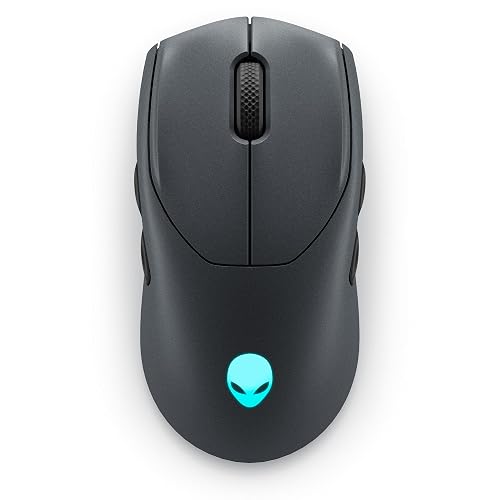
Alienware AW720M gives you a balanced set of controls in an ambidextrous gaming mouse. Its 86 g weight leaves it lighter than some options for moving around your desk, without making low weight its sole attraction. The symmetrical shape and sculpted thumb grips give you a place to rest your thumb, whether you play left- or right-handed.
Getting started gives you several ways to connect your personal computer. The box includes a USB-C dongle and an extender dongle, and the mouse also supports Bluetooth and USB-C wired connections. Position the included extender dongle where it can help the wireless dongle receive a signal, especially if your computer sits away from your mouse.
Button assignments can put frequently used actions close at hand. You get 8 fully programmable buttons, enough to give you options beyond the primary clicks without relying entirely on your keyboard. The rechargeable battery and magnetic snap charging adapter also give you a way to reconnect power when needed.
Battery life depends on how you connect and use the lighting. Alienware claims up to 140 hours through the USB-C wireless dongle or up to 420 hours through Bluetooth, with continuous play, the LED off and a full battery. Those figures give you a useful planning reference, but your own settings and play habits matter.
Desk space and computer compatibility deserve attention before you settle on this mouse. Its 4.9 in length helps you judge how much room it takes under your hand, and its ambidextrous shape may feel different from a contoured right-handed mouse. For your PC, Windows 10 or later is the supported operating system; an older version does not meet that requirement.
Distance and operating system requirements narrow where you can use this mouse. Its wireless range is 5.0 meters, so a computer positioned farther away needs a different arrangement or a wired connection. You also need a personal computer running Windows 10 or later. Neither issue matters much if your compatible PC sits close to your playing position, but both deserve attention in a more spread-out setup.
An ambidextrous PC gaming setup is a good match for Alienware AW720M, particularly when you want programmable controls and several connection methods. The rechargeable battery and included dongles give you useful options for getting connected and managing power. Keep the range and Windows requirement in mind when planning your setup. This mouse makes the most sense at a compatible PC within easy wireless reach.
Competitive aim favors a 2.4 GHz connection because it generally offers lower latency than Bluetooth. Bluetooth earns its place when you move between a gaming PC, laptop, and office devices. I would keep the tournament mouse on 2.4 GHz and leave Bluetooth for work.
Attack Shark X11 can sit in its charging dock for an instant 2.4GHz connection, keeping the receiver organized. HyperX Pulsefire Haste and AOC GM401 both support 2.4 GHz, and Aula SC620 pairs 2.4 GHz wireless with BT5.3 and USB. For a desk full of peripherals, keep the receiver on a short USB extension and away from metal objects.
Among the best wireless gaming mice under $100, Logitech G502 remains the overall choice because its 11 programmable controls cover demanding setups without changing the connection focus. Plan the desk around its 1.0-meter range, and avoid treating a quoted latency figure as a promise in a crowded 2.4 GHz area.
Accuracy comes from a stable signal and a DPI sensor set to your preferred sensitivity, not a huge headline number. A polling rate of 1000Hz is standard, and higher rates offer diminishing returns. AOC GM401 and DAREU A950 each state a 1000Hz polling rate, giving tournament shoppers a clear baseline.
Attack Shark X11 offers six adjustable DPI levels and cycles through them from the mouse. Its sensor has a 22,000 DPI setting, while Aula SC620 states 12,000 DPI and Logitech G502 goes up to 25600 DPI. Maximum DPI indicates a capability ceiling, and tracking also depends on your sensitivity and the game.
Software compatibility matters when you want to tune sensitivity, remap controls, or change polling behavior. Alienware AW720M supports Windows 10 or later, while Aula SC620 supports Windows, Mac OS, Linux, and Android. Before spending money on extra features, make sure the mouse’s software works with your operating system and does not interfere with your game.
Battery confidence starts with the power source and the settings you use during a session. Redragon M914 and AOC GM401 each carry a 70 hr run-time figure, giving your desk options with endurance. Read those figures with care, because battery life claims often assume reduced lighting and lighter wireless activity.
Several rechargeable models remove replacement batteries from your routine. Aula SC620 is rechargeable, TENMOS V7 includes a charging cable, and DAREU A950 includes an RGB charging dock. HyperX Pulsefire Haste includes an AAA battery, while Logitech G309 includes an AA battery. Redragon M914 also lets you turn off RGB to extend battery life when focus matters more than lighting.
Test the expected battery life with RGB off and the connection mode you will actually use. Update firmware before the first session so power and connection behavior settle properly. Never use a damaged or swollen battery, and keep liquids away from the mouse and its charging contacts.
Weight changes how quickly a mouse settles after a flick and how firmly it tracks across the pad. HyperX Pulsefire Haste is the lightest at 58 g, followed by Attack Shark X11 at 62 g. Redragon M914 is the heaviest at 127 g, while Logitech G502 weighs 114 g; the heavier builds can feel steadier during slow tracking.
A palm grip changes the size calculation. Measure from your wrist to your middle fingertip, then look for a mouse around 60-65% of that hand length. For claw grip, the useful range is 50-55%, leaving more room for fingertip control. Mouse width should let your thumb rest naturally without stretching toward the edge.
Logitech G502 gives palm-grip players a right-handed shape and an 11-button control set, while HyperX Pulsefire Haste offers an ambidextrous alternative at 58 g. Alienware AW720M also has an ambidextrous shape with sculpted thumb areas. Click-test both palm and claw positions before tournament play, because side-button pressure can cause accidental inputs.
Six to eight buttons cover most game genres, while 12 or more can benefit MMO players who keep many macros within reach. Logitech G502 has 11 programmable buttons, and Redragon M914 has 9. AOC GM401 and Aula SC620 each have 7, while Logitech G309, HyperX Pulsefire Haste, and DAREU A950 have 6.
The right-handed Logitech G502, Logitech G309, and Aula SC620 keep controls under a familiar palm position. HyperX Pulsefire Haste, TENMOS V7, DAREU A950, and Alienware AW720M use ambidextrous layouts. On an ambidextrous mouse, unused side buttons can be pressed accidentally, so lock or remap them when the software permits.
If you need broad macro access, choose Logitech G502 for its 11-button layout. If you want a simple setup for competitive play, HyperX Pulsefire Haste keeps the count at 6. If your schedule includes gaming and office work, DAREU A950 gives you Bluetooth, wired, and 2.4 g wireless options through one mouse.
Keep the 2.4 GHz receiver close and away from metal
Measure hand length before choosing a mouse shape
Test polling stability during your usual game
Run a battery test with RGB turned off
Update firmware and clean the sensor lens
Yes, some wireless gaming mice can show noticeable input lag, especially when interference disrupts the connection or the wrong wireless mode is used. A 2.4 GHz receiver generally offers lower latency than Bluetooth for competitive play. Keep the receiver close to the mouse, extend it beyond any USB hub, and test the connection in the room where you will compete. Quoted latency often comes from ideal conditions.
You can reduce the risk by turning off RGB lighting, choosing power-saving settings, and charging before a long tournament. Redragon M914 and AOC GM401 each state a 70 hr run time, but your usage and connection mode affect the result. Rechargeable choices include Aula SC620, while TENMOS V7 and DAREU A950 include charging options. Test the battery with your normal lighting setup rather than relying on a headline figure.
Yes, a shape that forces your wrist to angle or your fingers to stretch can create discomfort during long sessions. Palm-grip players generally want more length and support, while claw-grip players need room for fingertip control. Measure your hand from wrist to middle fingertip and compare the mouse dimensions with the 60-65% palm-grip and 50-55% claw-grip ranges. Try both grips before tournament play.
Compatibility can cause problems when configuration software conflicts with your operating system, game, or background utilities. Verify the platform support before choosing advanced polling or remapping features. Also consider whether a keyboard and mouse utility may request unnecessary background access on a lower-end computer.
You can reduce accidental presses by placing the mouse where your grip will not squeeze the side buttons. When the software allows it, lock unused buttons or move their functions to controls you can reach deliberately. Extra buttons can help with macros, but extra reach can create tension in an ambidextrous shape. Test your grip in a real match and adjust the button layout before relying on it in a tournament.
They differ most clearly in weight, connection options, button count, and grip. Logitech G502 is the overall choice with 11 buttons and a 114 g weight. HyperX Pulsefire Haste favors fast movement at 58 g, and Redragon M914 offers Bluetooth, 2.4 g, and wired modes with 9 buttons. Your priority should be whichever difference changes your aim, comfort, or setup most.
Polling rate affects how often the mouse reports movement to the computer, but gains become harder to notice beyond a stable baseline. AOC GM401 and DAREU A950 both state 1000Hz. Test for inconsistent movement or dropped reports in your own setup, because wireless stability matters more than a small polling-rate increase.
The right DPI setting depends on your sensitivity, mousepad size, and preferred viewing distance rather than the genre alone. Competitive shooters often favor lower sensitivity for controlled flicks, while some MMO and strategy players prefer larger movements. Start from your current sensitivity and change it gradually, because an aggressive adjustment usually harms aim more than a large DPI number helps. Use the mouse’s on-board DPI control when available.
Logitech G502 is my recommendation for most wireless gaming buyers, sparing you repeated reaches to the keyboard with 11 programmable buttons.
Attack Shark X11 gives you a value-focused option with adjustable sensitivity and a charging dock if you favor quick movement.
For your gaming and office setup, choose Logitech G309 for switching between LIGHTSPEED wireless and Bluetooth.
I would put Logitech G502 ahead for most buyers because its programmable controls bring frequent game commands within reach. That layout gives you room to assign shortcuts across games and apps without relying on the keyboard for each action. If you prefer a lighter mouse and a simpler control layout, Logitech G309 is the better buy. Its included AA battery gets you started, though you will still need to manage battery power.