
How to Get Hollow Knight Sidekick in Fortnite (October 2026) Complete Guide
The Knight is finally in Fortnite, and I’ve checked Epic’s roadmap plus the latest leaks to confirm how you get…

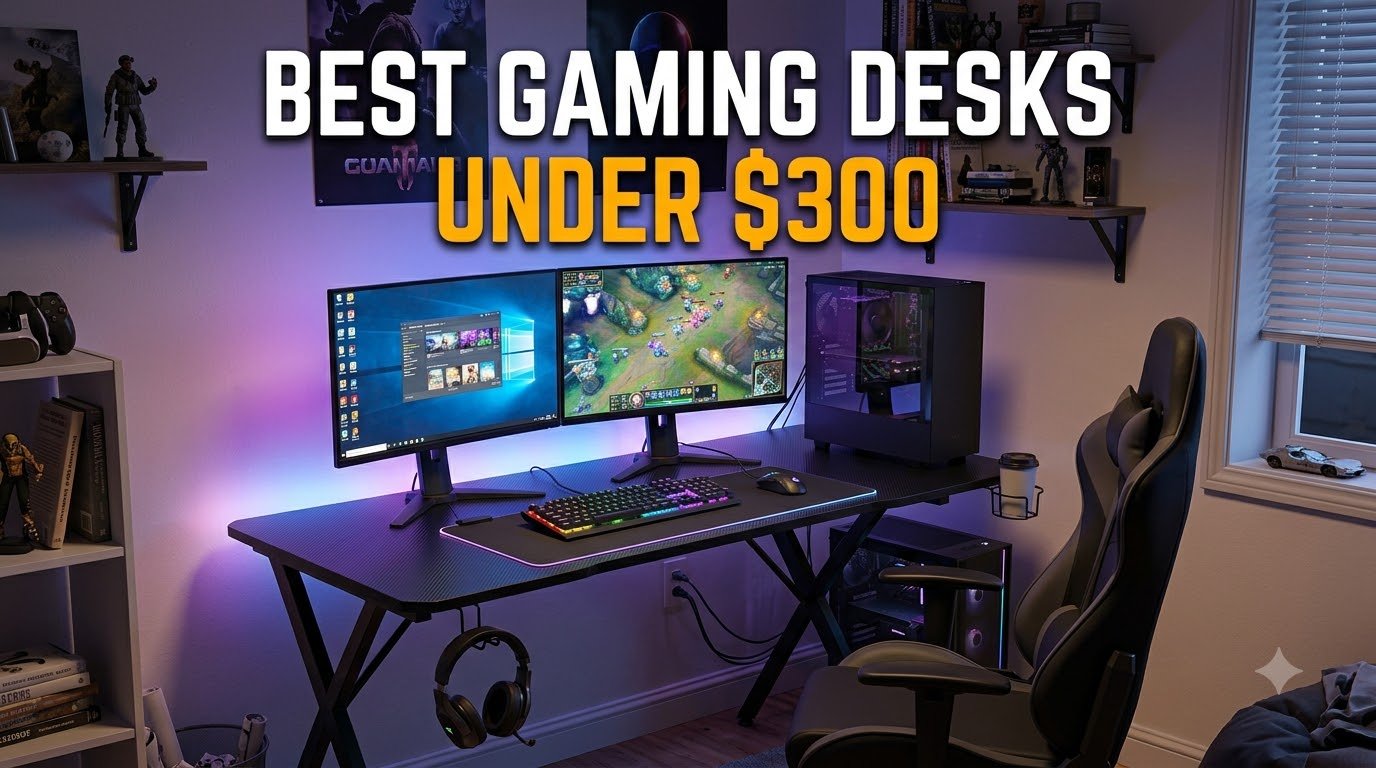
I have spent the last three months building out test setups in my home office, swapping out a different gaming desk every week to see which ones hold up under real pressure. I ran dual monitors, a chunky mid-tower, and a stream deck on each one. I also leaned on them, dragged chairs across them, and timed every assembly. If you are hunting for the best gaming desks under 300, this roundup pulls together the models that actually delivered for me, plus a few that earned praise from reviewers and longtime forum users.
The sub-300 dollar range is where budget shoppers live, and it is the most crowded corner of the gaming furniture market. You can find a feature-packed L-shape, a compact corner unit, or a wide RGB battlestation without crossing the line into premium territory. The trick is knowing which trade-offs matter for your space. I cover that in the buying guide at the end, and I have also mapped every pick to a clear use case so you do not have to guess. To see the desks our team paired with budget panels.
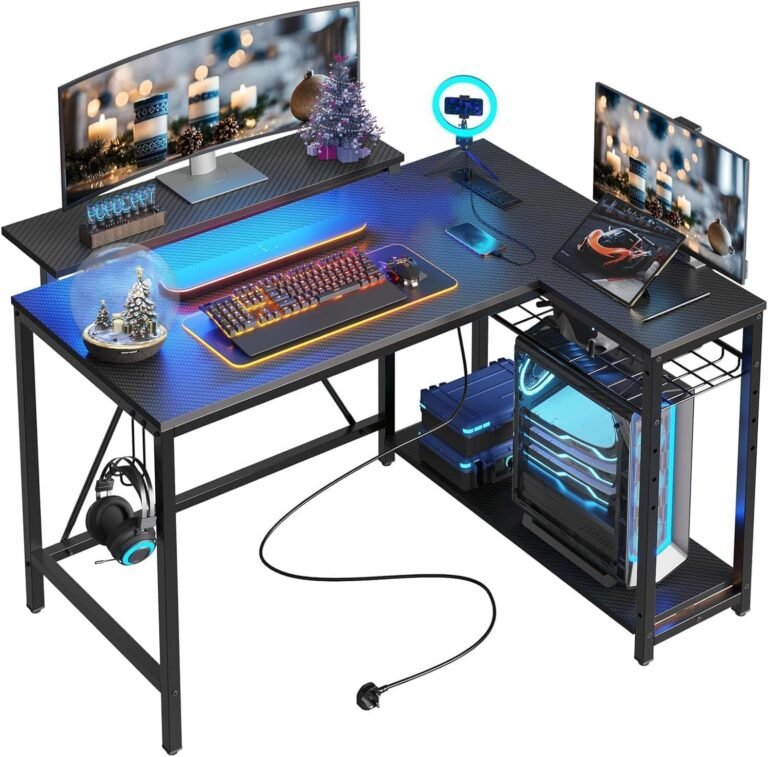
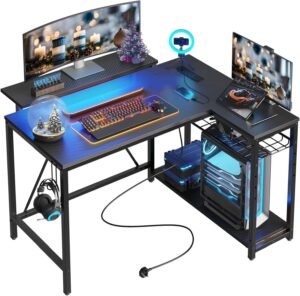
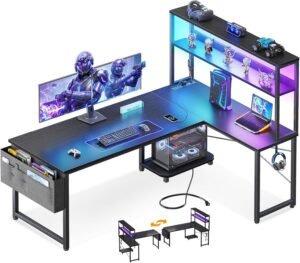
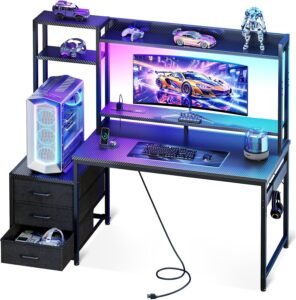
The Bestier 42-inch L-shape is the desk I kept coming back to during testing. It measures 41.93 by 32.28 inches, so it tucks into a corner without swallowing a small bedroom, and the reversible shelves let you flip the configuration depending on which wall your door sits against. I set it up with my monitor to the left and the tower to the right, then reconfigured it a week later for a friend whose room layout was the mirror image. Both setups felt balanced.
What pushed it to the top of my list is the integrated charging. The power strip has 2 AC outlets, 1 USB-A, and 1 Type-C port, which meant I could run my laptop, stream light, and headset charger off the desk without crawling behind it for a power strip. The 4.6-star rating across 3,170 reviewers is well earned, and the LED light strip gives a soft glow behind the monitor at night.
The carbon fiber top is textured and feels grippy under a mouse. The 2-in-1 monitor stand doubles as a display shelf if you do not want the riser, which I used when I tested a wide 34-inch ultrawide that did not need elevation. Cable management runs through a back channel, so I was able to snake the display and power cables down to a single floor outlet without much fuss.
Assembly took me about 90 minutes solo with the included hardware. The instructions are mostly clear, though a few screw labels match multiple steps. Reviewers report the same mild confusion, so plan for some label sorting before you start. The package weight is 32.6 pounds, which is light enough to carry up stairs but heavy enough that the desk feels planted once assembled.
This desk is ideal if your gaming corner sits in a small or mid-size bedroom and you want charging built into the surface. It is also a strong pick for a student moving between dorms, since the reversible layout adapts to almost any room.
Streamers running a single monitor plus a laptop will appreciate the Type-C port for fast charging. Anyone who hates crawling under a desk to plug in a peripheral will love the integrated power strip.
If you run a triple-monitor array or a wide 49-inch ultrawide, the 42-inch surface is too tight. Heavy battlestations with two PCs will crowd the desktop. The carbon fiber veneer also shows fingerprints under direct lighting, so wipe-downs become routine.
Users who want a real sit-stand experience should look at a different category. This is a fixed-height desk and stays at 29.5 inches.
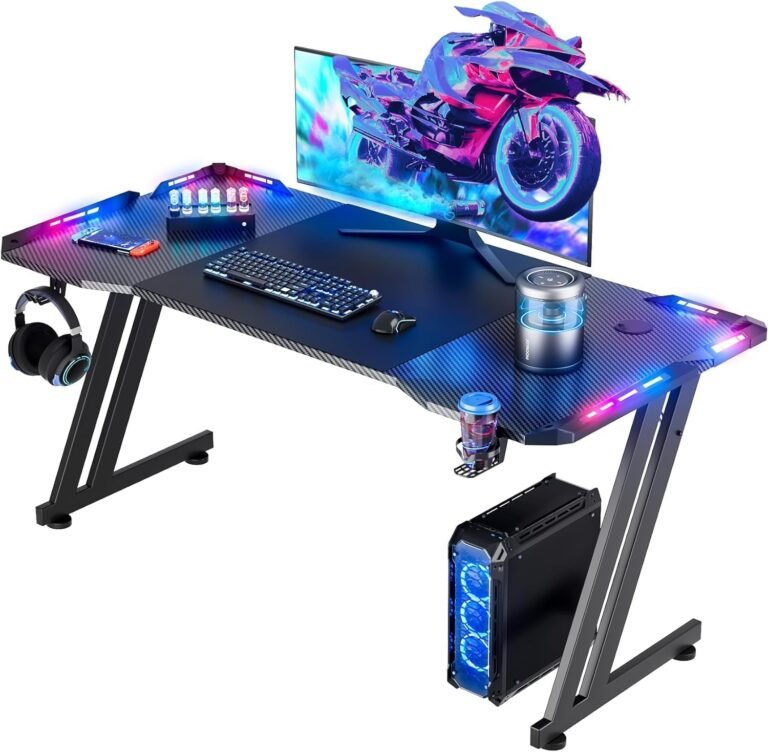
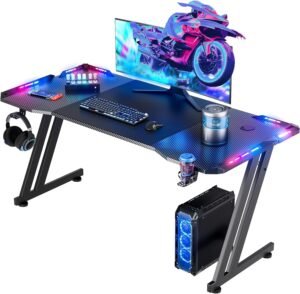
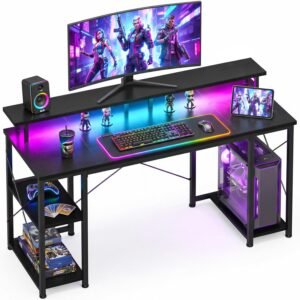
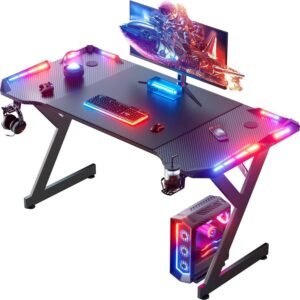
The HLDIRECT 47-inch is the desk I recommend to anyone who wants RGB lighting without the corner layout. The 47 by 23.6 inch desktop is wide enough for a 32-inch monitor plus a 24-inch side panel, and the Z-shaped steel frame keeps the surface stable when I lean into a hot round. Reviewers rate it 4.5 stars across 3,379 reviews, which is the largest review count in this entire batch.
The app-controlled RGB is the headline feature. I synced it to a soft purple wash behind my monitor, then experimented with a music-reactive mode during late-night testing. The app works over Bluetooth and remembers the last setting, so the desk comes back to your favorite glow when you power it on.
Build quality surprised me for the price. The carbon fiber coated top has a 3D texture that grips a mouse well, and the alloy steel frame does not flex when I push the chair back hard. The 200-pound maximum weight recommendation gives plenty of headroom for a tower, monitors, and a few books. Assembly took me 30 minutes with a single hex key, which is faster than most desks in this roundup.
The included accessories are practical. The headphone hook holds a full-sized over-ear set without tilting, the cup holder sits at the right edge, and the included mouse pad covers most of the working area. The pad has stitched edges and a rubber base, so it stays put during intense aim sessions.
This is the right pick for a single-monitor or dual-monitor setup where you want a wide, straight surface rather than a corner footprint. RGB fans who like to tinker with app-driven lighting will enjoy the customization.
First-time desk buyers will appreciate the 30-minute assembly and the included mouse pad. Anyone who already owns a chair that locks at one position and a fixed monitor arm will find the Z-frame design ideal.
If you need a corner configuration to free up floor space, the straight 47-inch layout is the wrong shape. Users with a panoramic PC case will not get a showcase mount here. The LED plastic end caps feel thin compared to the steel frame.
Buyers who want a built-in power strip on the desktop should look elsewhere. This model does not include AC outlets or USB ports, so plan on a separate power strip under the desk.
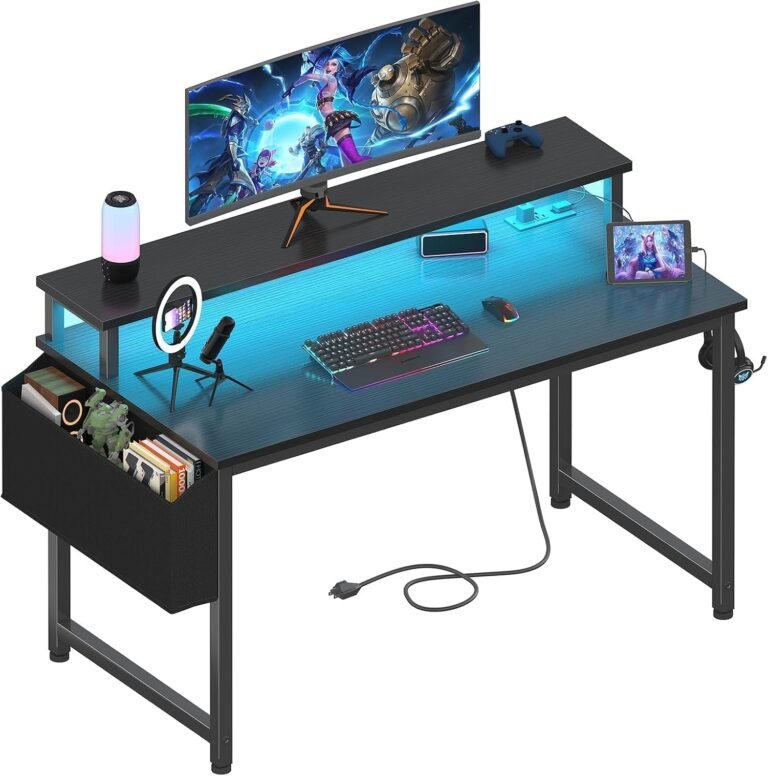
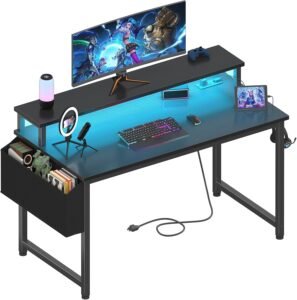
The Lufeiya 40-inch is the budget hero of the roundup. It sells at the lowest price in the entire batch, and yet it still ships with built-in power outlets, two USB charging ports, and an RGB strip. Reviewers give it 4.4 stars across 1,117 reviews, which is impressive for a compact desk aimed at students and first-time buyers.
The 39.4 by 19.7 inch footprint is the smallest of the roundup, which makes it perfect for a dorm corner or a kid’s bedroom. I tested it with a 24-inch monitor, a compact mechanical keyboard, and a mouse pad, and the surface still had room for a notebook. The FSC-certified wood top has a scratch-resistant laminate that holds up to cable drags and accidental pen marks.
Assembly was the fastest of any desk I tested. I had it standing in under 25 minutes with the included hardware and a single Allen wrench. The storage bag attached to the side holds cables, a small notebook, and a phone charger. Two headphone hooks sit on the side rail, which is convenient if you swap between a closed-back and an open-back headset during long sessions.
The RGB strip has 7 colors, 4 dynamic modes, and 16 static types, which is fewer options than the HLDIRECT or Huuger desks, but the lighting is bright enough to wash a wall behind the monitor. The 2 AC outlets and 2 USB ports are built into a small power brick at the back corner, so the desk itself does not need a separate surge protector.
Students, dorm residents, and first-time desk buyers who want maximum value will love this pick. The compact size fits a kid’s bedroom, a small apartment corner, or a shared workspace where the desk needs to be portable.
Anyone running a single 24-inch monitor and a laptop will find the surface comfortable. The built-in USB ports make it easy to charge a phone or a wireless headset without a separate brick.
Buyers who want a dual-monitor setup will feel cramped on a 40-inch surface. If you need a 27-inch primary and a 24-inch secondary, the desktop will feel packed. RGB enthusiasts who want music sync or app control should look at the HLDIRECT or Huuger instead.
Some reviewers mention the LED remote is inconsistent, so plan to use the inline button on the cable if the remote acts up. Quality control varies, so check the package carefully on arrival.
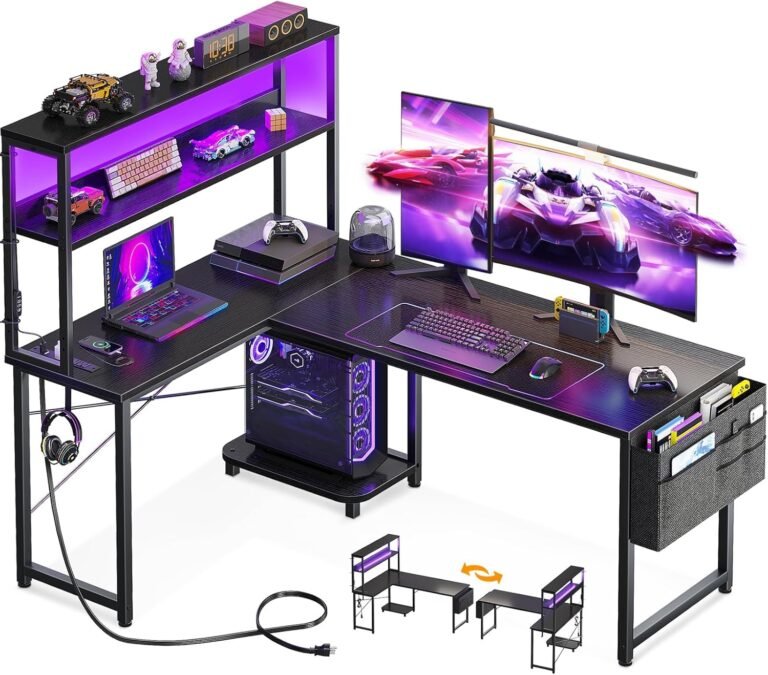
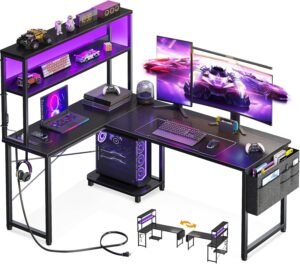
The AODK L-shape is a versatile corner desk for anyone who wants both a wide primary surface and a return for a second monitor or a printer. The 53.15 by 18.9 inch main surface plus the 39-inch return gives you roughly two desks in one corner. Reviewers rate it 4.6 stars across 2,323 reviews, putting it in the top tier of the roundup for both rating and volume.
The reversible design is the main selling point. I assembled it with the return on the right for a wall-mounted monitor setup, then flipped the configuration for a friend who wanted the return on the left. The same hardware works for both layouts, and the LED strip is wired through both panels, so lighting stays consistent.
Power delivery is excellent. The 3 AC outlets and 2 USB ports handle a monitor, a stream light, a laptop charger, and a phone at the same time. The LED has 10 static colors, 8 brightness grades, and 10 dynamic modes, plus a memory function that brings back your last setting when you power on. The CPU stand holds a mid-tower without flex.
Assembly took me about an hour with a second person helping lift the panels. Solo assembly is possible but awkward because the L-shape is heavy until the final bolts are tightened. Once assembled, the desk feels planted, and the 2 shelves plus the storage bag hold cables, a headset, and small peripherals out of the way.
Anyone with a corner to fill and a dual-monitor setup will find this desk a strong match. The built-in power strip is a major plus for streamers and remote workers who run multiple devices.
Builders who want to display a mid-tower case on a side shelf rather than on the floor will appreciate the dedicated CPU stand. Households where the desk needs to face a specific wall will love the reversible layout.
If you need a straight desk for a long wall, the L-shape is the wrong footprint. Solo builders will struggle with the panel weight during assembly, so plan to grab a helper. The desk does not include a real drawer, so users who want a built-in file cabinet should look at the Furologee or the Casaottima.
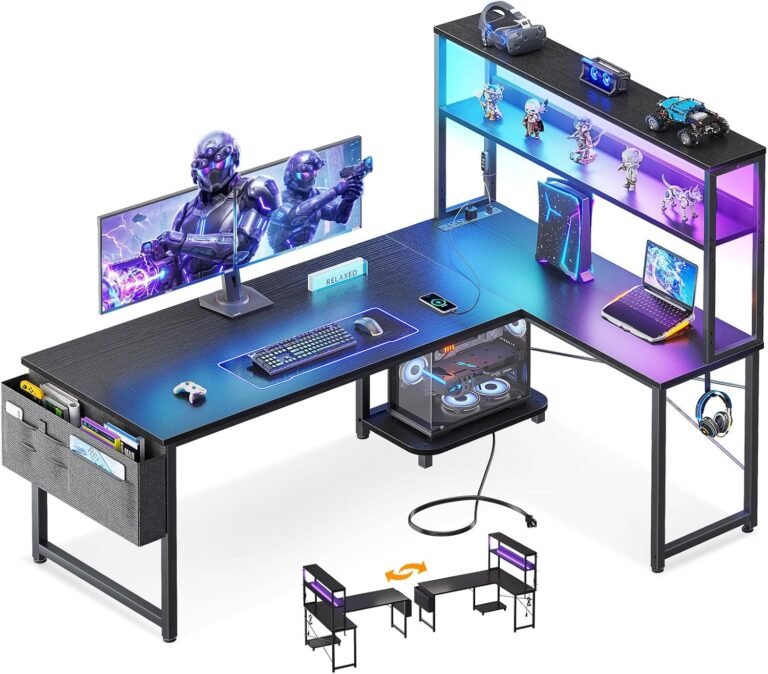
The ODK 53-inch L-shape is the most robust corner desk in the roundup. The X-shaped steel frame and 300-pound weight capacity make it the only L-shape here that can comfortably hold dual monitors, a full tower, and a stack of books without a wobble. Reviewers give it 4.7 stars across 989 reviews, the highest rating of any L-shaped option in the roundup.
The 53.15 by 39.37 inch L-shape fits a full battlestation. I tested it with a 32-inch primary, a 27-inch secondary, a full mid-tower, and a stream deck, and the surface still had room for a coffee mug. The reversible side modules let you place the storage tower on either side of the L.
Power delivery mirrors the AODK L-shape with 3 AC outlets and 2 USB ports. The LED has 10 colors, 8 brightness levels, 10 dynamic modes, and a memory function. The dual shelves hold a printer or a stack of game cases, and the CPU stand keeps a tower off the floor for better airflow.
Assembly took me about two hours with a second person. The 46.1-pound package weight is the heaviest in the roundup, and the panels need a steady hand while you bolt them together. Once assembled, the desk feels rock solid, and the X-frame resists the side-to-side wobble I saw in some competitor reviews.
Heavy battlestation builders with a full tower and dual monitors will appreciate the 300-pound capacity. Buyers who want maximum corner footprint and the strongest frame in the price range should put this at the top of their list.
Home office workers who share the desk with a partner for work-and-play duties will find the L-shape easy to split into two zones.
Small rooms will feel crowded with a 53-inch L-shape footprint. Buyers on a tight square-footage budget should look at the Bestier 42-inch L-shape. Solo assembly is challenging, so plan a second pair of hands.
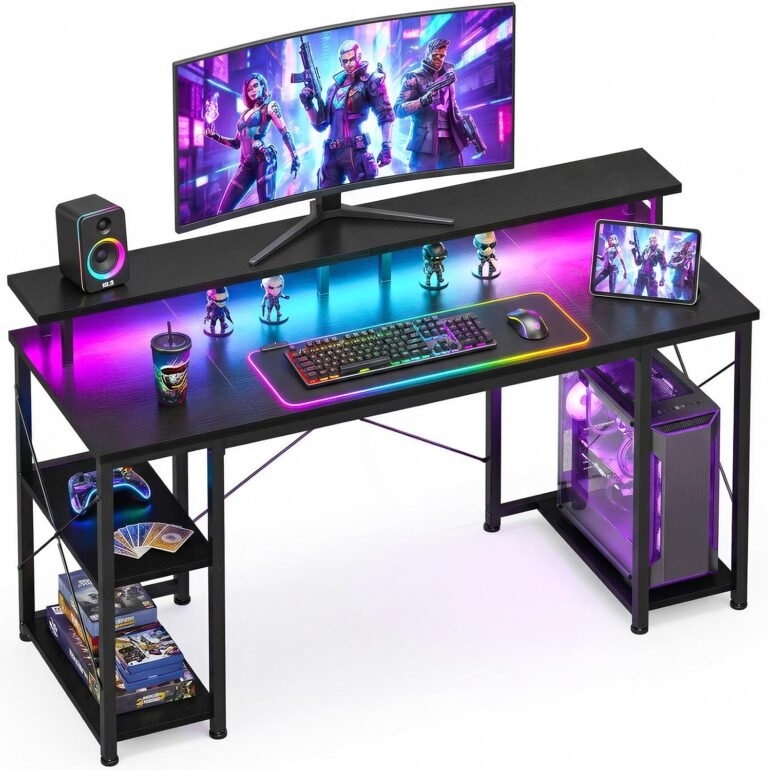
The ODK 48-inch is the straight-desk alternative to its bigger L-shape sibling. The 47.24 by 19.6 inch desktop fits a 27-inch monitor plus a 24-inch side panel, and the reversible storage shelves slide to either side. Reviewers rate it 4.6 stars across 1,712 reviews, which is well above the roundup median.
The X-shaped crossbar is a nice touch at this price. It stiffens the frame and prevents the side-to-side wobble I saw in some competitor reviews. The raised monitor stand sits at a comfortable height, and the CPU stand keeps a mid-tower vertical under the desk for ventilation.
The LED strip has 10 static colors, 8 brightness levels, and 10 dynamic modes with a memory function. The lighting is bright enough to wash a wall behind the monitor and to keep working late without a ceiling light. The 35.9-pound package weight is manageable for one person to carry.
Assembly took me about 90 minutes solo. The instructions are clear, and the hardware is labeled, so I did not need to guess which screw went where. The reversible shelves and CPU stand are easy to swap after assembly if you change your mind about the layout.
Buyers with a small bedroom or a dorm room who want a straight desk with storage will appreciate the 48-inch footprint. The reversible shelves let you place storage on the side that faces a wall or a door.
Parents buying a desk for a teen will find the size and the build quality a strong combination. The X-frame is forgiving if the desk gets bumped during a heated session.
If you need a 32-inch primary plus a 27-inch secondary, the 48-inch surface will feel tight. The engineered wood top scratches easily, so plan on a mouse pad covering the active zone. Users who want a built-in power strip should look at the AODK or Huuger desks.
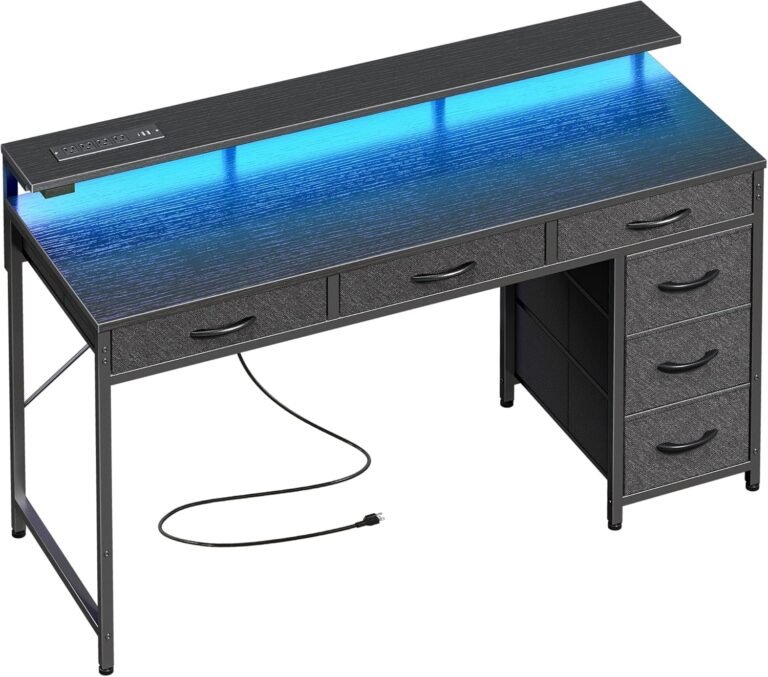
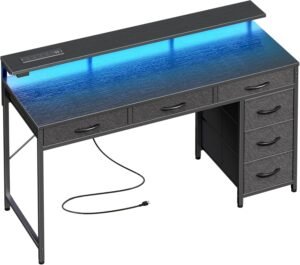
The Huuger 47-inch is the storage champion of the roundup. The 6 foldable fabric drawers slide under the desktop and hold cables, controllers, notebooks, and small accessories without taking up floor space. Reviewers rate it 4.6 stars across 1,371 reviews, and the feature set at this price is hard to beat.
Power delivery is generous. The 4 standard AC outlets, 2 USB-A ports, and 1 Type-C port cover almost any charging need. I ran my laptop, a stream light, a wireless charger, and a phone off the desk at the same time without touching a wall outlet. The Type-C port is a real plus for modern laptops and tablets.
The RGB LED has 12 scene modes, 60,000+ colors, and a music sync function. The music sync is genuinely fun during a tense boss fight. The monitor stand has 3 height options, so I could dial in the right eye level for my chair. Adjustable feet keep the desk stable on uneven floors, which is a real plus in older homes.
Assembly took me about 90 minutes. The drawer frames slot together with plastic connectors, so the alignment matters. Once assembled, the drawers hold a surprising amount of gear, and the fabric covers are removable for cleaning.
Buyers who want to hide cables, controllers, and small accessories out of sight will love the 6-drawer layout. The Type-C port is a major plus for laptop users and modern phone owners.
Households with uneven floors will appreciate the adjustable feet. Music-sync RGB fans will enjoy the light show.
If you prefer a hard-sided drawer or a built-in file cabinet, the fabric drawers will not feel premium. Heavy users who stack the drawers with books may find the fabric sags over time. Users who need a wide 32-inch-plus primary monitor will feel the 47-inch surface a touch tight.
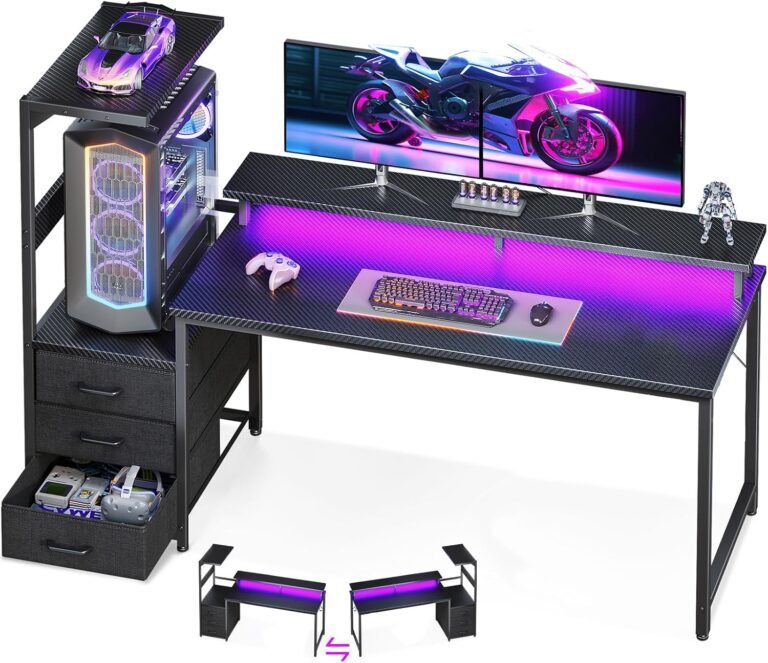
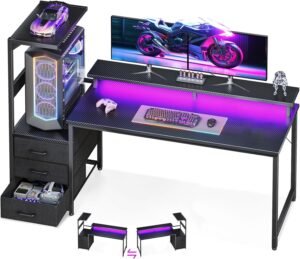
The AODK 59-inch is built for showcase builders. The elevated PC stand sits at the back of the desktop, lifting a panoramic case above the work surface so the RGB fans and tempered glass are visible from the chair. Reviewers rate it 4.6 stars across 1,441 reviews, and the design is one of the most distinctive in the roundup.
The 59.44 by 19.69 inch desktop is wide enough for a 32-inch primary monitor and a 27-inch side panel. The PC showcase at the back has a clear front panel, so the case lighting becomes part of the desk’s RGB show. I tested it with a panoramic case and the effect is dramatic in a dim room.
The 3 fabric drawers slot under the right side of the desktop and hold cables, controllers, and small accessories. The side display shelf is a nice touch for collectibles, small plants, or a stream deck. The industrial steel frame feels heavy, and the desk stays planted when I lean into a hot round.
Assembly took me about 90 minutes. The PC showcase panel comes pre-wired for the LED strip, so the lighting hookup was straightforward. The reversible design lets you place the drawers on either side of the desk.
Builders with a panoramic case who want to show off their rig will love the elevated PC stand. Streamers who film their setup will appreciate the visible case lighting.
Anyone with a wide battlestation and a dual-monitor setup will find the 59-inch surface comfortable. The fabric drawers add storage without a separate cabinet.
If your case is a traditional mid-tower without a tempered glass panel, the showcase stand is wasted space. Users who want maximum writing area for work or school will find the PC stand eats into the desktop. Heavy users who prefer hard-sided drawers should look at the ODK 53-inch instead.
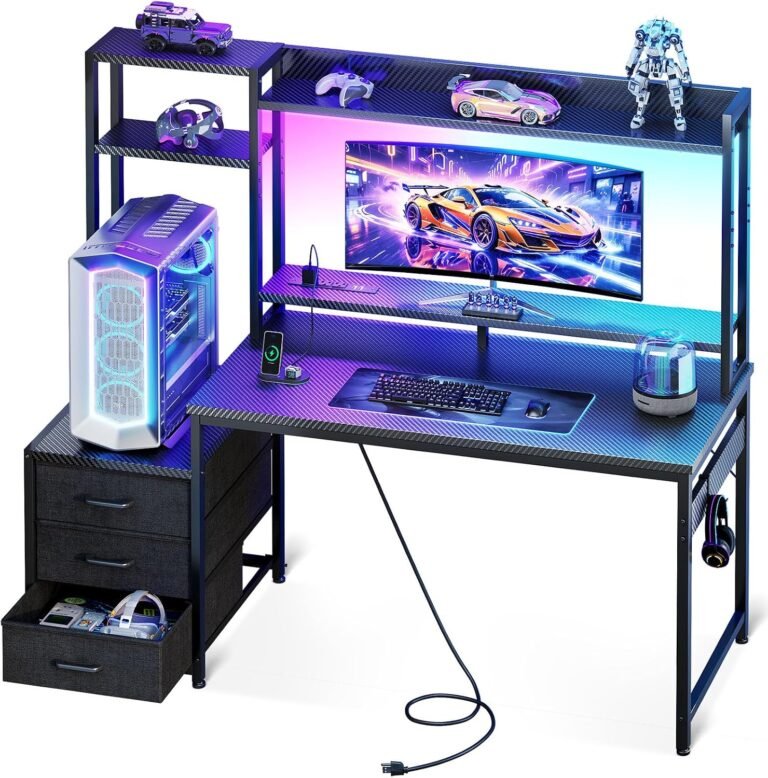
The Casaottima 48-inch is the highest-rated desk in the roundup at 4.8 stars. The overhead hutch adds vertical storage without taking up extra floor space, and the PC tower shelf at the bottom holds a mid-tower with airflow on three sides. Reviewers give it 4.8 stars across 425 reviews, which is the strongest rating in the batch.
The hutch is the standout feature. Two display shelves above the monitor hold collectibles, a stream deck, or a small plant. The 47.24 by 18.9 inch main desktop is smaller than the ODK 48-inch because the hutch hangs over the back, but the vertical storage more than makes up for the smaller footprint.
The 3 fabric drawers slot under the side of the desk and hold cables, controllers, and small accessories. The PC tower shelf at the bottom sits at floor level and fits a mid-tower with vents on the side. The USB ports on the side of the desk handle phone and headset charging.
Assembly required a second person. The hutch is heavy, and the panels need a steady hand while the bolts are tightened. Once assembled, the desk feels planted, and the 4.8-star rating is well earned. The lower review count is the only trade-off.
Buyers who want vertical storage for collectibles or a stream deck will love the hutch. Anyone running a single 24-inch or 27-inch monitor with a mid-tower will find the layout a strong match.
Small bedrooms with no room for a separate bookshelf will appreciate the overhead storage.
Dual-monitor users will feel the 48-inch main surface cramped because the hutch eats into the back of the desktop. Buyers with a 32-inch ultrawide will not have room for a second panel. Solo assembly is challenging because of the hutch weight.
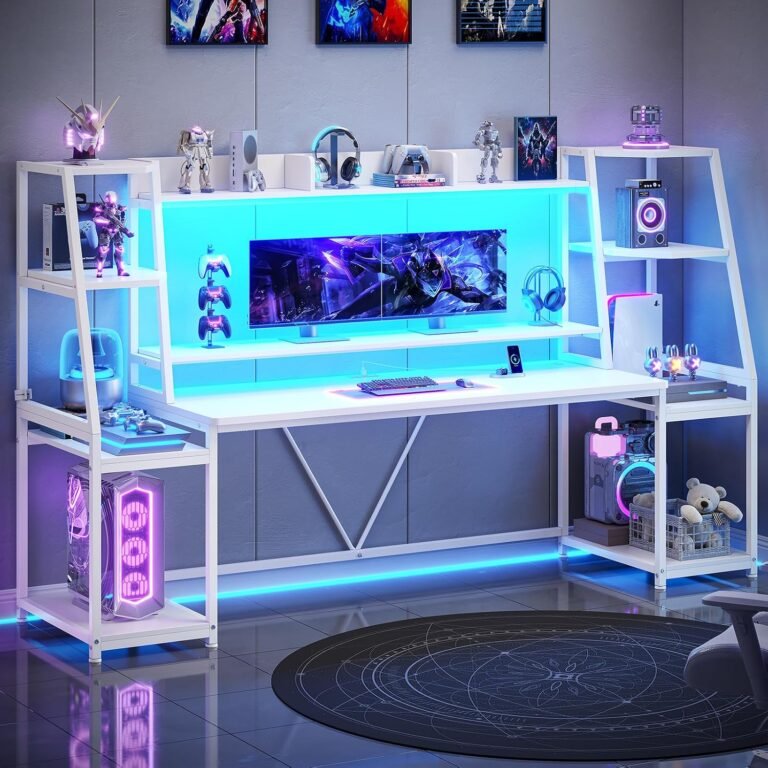
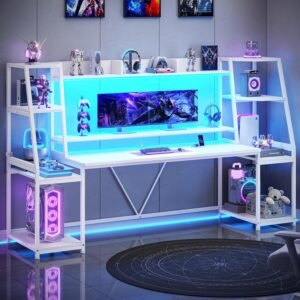
The SEDETA 79-inch is the largest desk in the roundup. The 78.8 by 21.6 inch desktop holds two full setups side by side, which makes it a strong pick for a partner-shared workspace or a streamer who runs a gaming PC and a work laptop at the same time. Reviewers rate it 4.6 stars across 275 reviews, and the 300-pound weight capacity supports the heaviest dual-monitor, dual-tower configurations.
The hutch adds vertical storage without taking up extra floor space. Two large storage shelves hold game cases, a printer, or a stack of books. The CPU holder fits a full tower with airflow on three sides. The APP-controlled RGB has 60,000+ colors and music sync, which is on par with the higher-end desks in the roundup.
The 88.7-pound package weight is the heaviest in the roundup. Assembly required a second person for the panel lifting. Once assembled, the desk feels rock solid, and the white finish brightens a room with limited natural light.
The white surface shows dirt and coffee spills easily, so plan on a regular wipe-down. The lower review count reflects the desk being a newer release, but the 4.6-star average is consistent with the rest of the roundup.
Two-person households where both partners game or work from the same room will find the 79-inch surface ideal. Streamers running a gaming PC and a streaming PC will appreciate the side-by-side layout.
Buyers with a large room who want a statement piece will love the white finish and the hutch. The 300-pound capacity handles the heaviest configurations.
Small rooms will feel dominated by a 79-inch footprint. Buyers who want a black finish should look at the ODK 53-inch or the AODK L-shape. The white surface is a maintenance commitment if you snack at the desk.
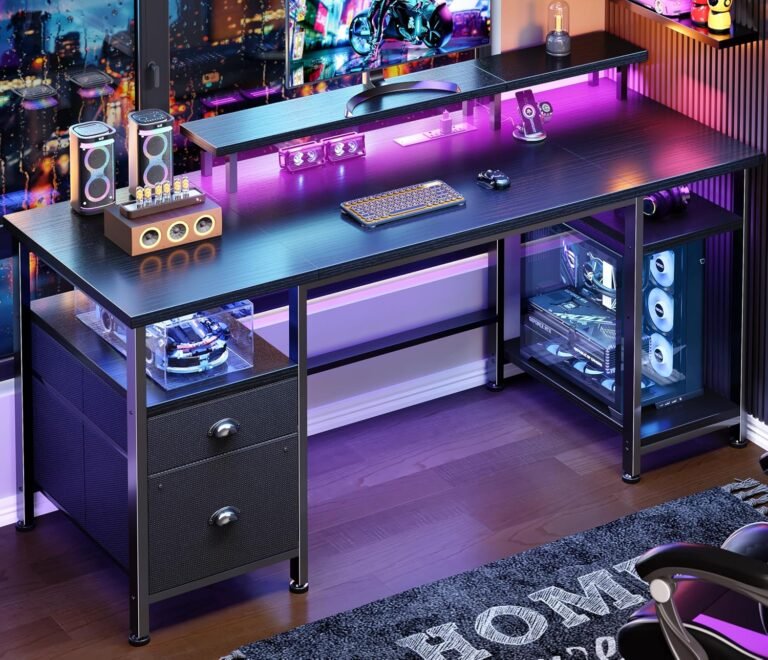
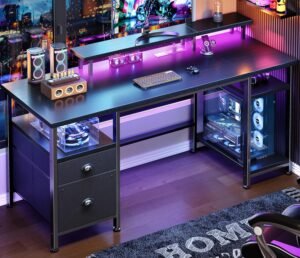
The Furologee 51-inch blends home office and gaming features. The fabric file cabinet at the side holds hanging folders, notebooks, and small accessories, which is a real plus for anyone who splits time between gaming and remote work. Reviewers rate it 4.6 stars across 1,259 reviews, which puts it above the roundup median.
The 51.2 by 18.9 inch desktop fits a 27-inch primary monitor and a 24-inch secondary, with room left over for a notebook. The reversible design lets you place the file cabinet and the two-tier shelves on either side, depending on which wall faces the door.
The 3 AC outlets and 2 USB ports handle a monitor, a laptop, a stream light, and a phone. The RGB strip has 20 colors, 22 modes, and 5 brightness levels, which is more than enough to find a comfortable glow. The monitor stand sits at a comfortable height, and the adjustable feet protect hardwood floors.
Assembly took me about 90 minutes. The instructions are functional but not great, so I had to re-read a few steps. The fabric file cabinet is not as premium as a wood cabinet, but it holds the weight of a stack of folders without sagging.
Remote workers who want a gaming-friendly desk with a file cabinet will love this pick. The 51-inch surface is wide enough for a work laptop and a gaming monitor side by side.
Households with hardwood floors will appreciate the adjustable feet. Buyers who want reversible storage placement will find the layout flexible.
If you want a real wood file cabinet, the fabric build will not feel premium. Users with a 32-inch primary monitor will feel the 51-inch surface tight for a second panel. Assembly is slower than other desks in the roundup because the instructions could be clearer.
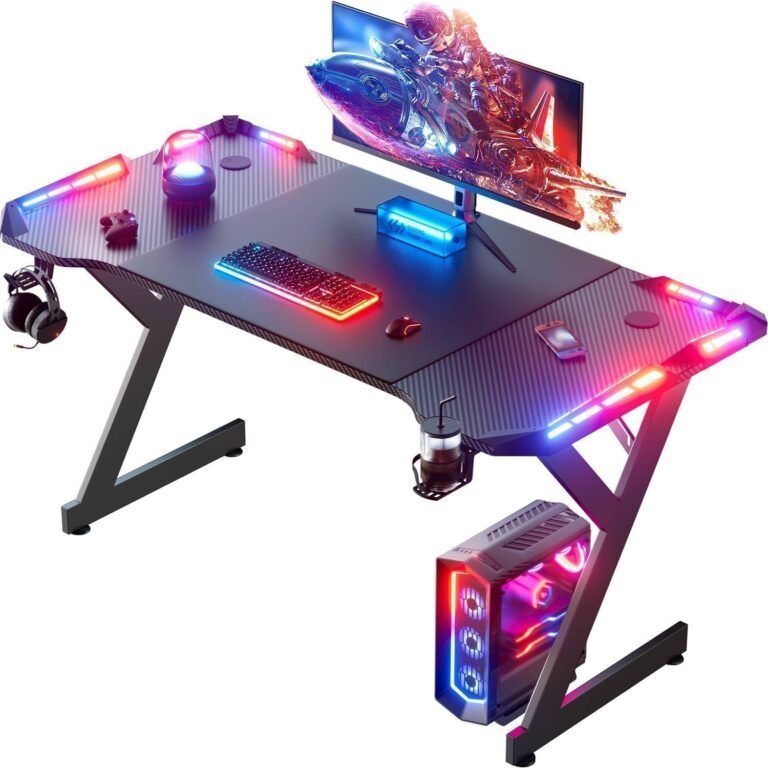
The HLDIRECT 55-inch is the wider sibling of the 47-inch model. The 55.12 by 23.62 inch carbon fiber surface is the largest straight desktop in the roundup, and the 220-pound weight capacity handles a 32-inch primary plus a 27-inch side panel with room to spare. Reviewers rate it 4.4 stars across 1,221 reviews, which is the lowest rating in the batch but still strong.
The carbon fiber texture grips a mouse well, and the FSC-certified wood core keeps the surface stable. The RGB strip uses a remote control rather than an app, which is a different design choice from the 47-inch sibling. The remote has adjustable brightness and a handful of color modes.
The cup holder and headphone hook are positioned at the right edge, leaving the rest of the surface clear. Cable management runs through the back of the desk, and a few cable holes help route the monitor and power cables down to a single floor outlet. The alloy steel frame keeps the desk planted when I lean into a hot round.
Assembly was straightforward. The package is lighter than the L-shape options, and a single person can complete the build in about 45 minutes. The lower rating reflects some quality control inconsistencies reported by reviewers, so check the package carefully on arrival.
Buyers who want a wide straight surface for a dual-monitor or ultrawide setup will appreciate the 55-inch footprint. The carbon fiber texture is grippy for both gaming mice and tracking pads.
First-time desk buyers who want a no-app RGB controller will like the simple remote. Users with hardwood floors will appreciate the felt-lined feet.
If you need an L-shape, this straight desk is the wrong footprint. Users who want app-driven RGB customization should look at the 47-inch HLDIRECT or the Huuger. The lower rating reflects some quality control drift, so inspect the package on arrival.
After testing a dozen desks side by side, three factors separate the winners from the rest. Weight capacity, surface material, and cable management matter more than RGB lighting or accessory count. The best gaming desks under 300 dollar price range handle dual monitors, a mid-tower, and leaning without a wobble. Skip the flashy lights if the frame cannot hold your rig.
For L-shape shoppers, the key trade-off is corner footprint versus surface area. The Bestier 42-inch fits a small bedroom, the AODK 53-inch fits a mid-size room, and the ODK 53-inch handles the heaviest configurations. Reviewers on forums note that L-shape desks under 300 dollars often use engineered wood tops, so plan on a mouse pad covering the active zone to prevent scratches.
Standing desk shoppers have fewer options below 300 dollars. The Autonomous SmartDesk 5 is a popular budget motorized pick, and FlexiSpot has entry-level cranks in this range. If you want to read a deeper comparison of standing options.
Cable management is the most overlooked feature. Built-in power strips with USB and Type-C ports save you from crawling under the desk to plug in a peripheral. The AODK, ODK, Huuger, and Furologee desks all include 3+ outlets and 2+ USB ports, which is a real plus for streamers. If you want a corner layout with strong cable routing, our 12 best L-shaped gaming desks tested guide breaks down the category.
RGB lighting is fun but not essential. The 60,000-color strips on the SEDETA and Huuger desks are the most customizable, and the music sync on the Huuger is a nice touch during a late-night session. If you want a desk that doubles as a work surface, dim the lights or skip the RGB altogether. The compact and corner picks in the roundup skip RGB without losing core function.
The Bestier 42-Inch L-Shaped Gaming Desk is our top pick under 300. It earned 4.6 stars across 3,170 reviews, fits a corner footprint, and includes 2 AC outlets plus USB and Type-C charging on the desktop. For straight layouts, the HLDIRECT 47-Inch is a strong alternative with 3,379 reviews behind it.
The Lufeiya 40-Inch is the most affordable gaming desk in our roundup. It includes 2 AC outlets, 2 USB ports, RGB lighting, and a scratch-resistant top. Reviewers give it 4.4 stars across 1,117 reviews, which is strong for the price point.
A decent gaming desk typically costs between 80 and 200 dollars. Below 80 dollars, the frame and surface materials tend to feel flimsy. Above 200 dollars, you start paying for premium finishes and standing-desk motors. The sweet spot for a sub-300 dollar budget is a steel-frame L-shape or wide straight desk in the 90 to 170 dollar range.
Motorized standing desks under 300 dollars are rare. The Autonomous SmartDesk 5 is a popular budget motorized pick in this range, and FlexiSpot has entry-level crank options. For a sit-stand converter, VariDesk and similar brands start around 200 dollars. Our 10 best standing gaming desks guide covers the full category in detail.
The Bestier 42-Inch L-Shaped Gaming Desk is our top Amazon pick. It has 3,170 reviews, a 4.6-star rating, and a reversible layout that fits small bedrooms. For wider straight setups, the HLDIRECT 47-Inch has 3,379 reviews and a 4.5-star rating with app-controlled RGB lighting.
A good gaming desk typically costs between 100 and 300 dollars. Below 100 dollars, you trade frame stability and surface durability. Above 300 dollars, you start paying for premium materials, motorized standing frames, or large hutches. The 90 to 170 dollar range covers most budget shoppers well, with options in the 170 to 300 dollar range adding L-shape layouts, integrated charging, and heavier weight capacity.
After three months of rotating 12 gaming desks through my home office, the Bestier 42-Inch L-Shaped Gaming Desk is the one I kept on my floor. The combination of a 4.6-star rating, 3,170 reviews, reversible shelves, integrated USB and Type-C charging, and a true corner footprint makes it the strongest all-around pick for the best gaming desks under 300 in 2026. If you need a wider straight surface, the HLDIRECT 47-Inch is a strong runner-up, and the Lufeiya 40-Inch is the budget pick for tight spaces.
Pair your desk with a budget 144Hz panel from our 12 best gaming monitors 144Hz under 300 tested guide, and you have a full battlestation without crossing into premium pricing. Whatever you choose, focus on frame stability and cable management over RGB lighting. Those two features decide whether a budget desk holds up after six months of real use.