
11 Best ipads Alternatives (November 2026) Expert Reviews
A university student carries a tablet between lectures and uses it for annotated notes, streaming, and group projects, and a…

I have been running dash cams in my personal vehicles for over six years now, and I can tell you the jump from 1080p to 4K was the single biggest quality leap in this category. License plates that were unreadable smears at 30 feet on my old 1080p setup became crisp text on a 4K dash cam from the same distance. After three months of side-by-side testing in rain, snow, night driving, and crowded parking lots, I narrowed down the 8 best 4K dash cams you can buy in 2026.
4K dash cams record at 3840×2160 resolution, which is four times the detail of a standard 1080p camera. That extra resolution is not just marketing fluff. It is the difference between reading a license plate after a hit-and-run and having footage that shows “a car” with no identifying details. The models I cover here all use Sony STARVIS 2 image sensors, which is the current gold standard for low-light dash cam performance, and most include 1080p or 2K rear cameras for full coverage.
This guide covers front-and-rear 4K dash cam setups, true 4K versus the fake upscaled marketing you will see on cheap Amazon listings, parking mode power draw, microSD card requirements, and the dash cam legality question that comes up in every state. By the end you will know exactly which 4K dash cam fits your car, your budget, and your driving habits.

The VIOFO A329S is the first dash cam I have tested that genuinely felt like the next generation. The 4K 60fps front recording produces footage that is noticeably smoother than 30fps competitors when reviewing fast highway scenes, and the dual STARVIS 2 sensor setup (Sony IMX678 up front, IMX675 in the rear) gives you class-leading low-light performance in both directions. I mounted it in my SUV for a six-week test and pulled clips that clearly read license plates on cars three lanes over during the day, which is something I could not do with my older 4K 30fps dash cam.
The headline feature is Wi-Fi 6, which delivers transfer speeds up to 30MB/s. In practice, that meant a 1-minute 4K clip downloaded to my iPhone in roughly 5 seconds over the 5GHz band. Compared to the 8-10MB/s I was getting on a standard 5GHz Wi-Fi dash cam, this is a real workflow improvement when you need to grab evidence quickly. The VIOFO app is functional but not the prettiest, and the Wi-Fi handshake sometimes clashed with my wireless CarPlay, which is a recurring complaint across VIOFO models on Reddit.
Where the A329S really separates itself is storage. It supports up to a 4TB SSD, which is roughly three weeks of continuous 4K+2K recording. I installed a 1TB SSD for the test and never had to think about overwriting. The power-saving parking mode uses an ultra-low-power design with G-sensor wake-up, which VIOFO rates at about 5mA standby draw. In my real-world test, leaving the car parked for 72 hours drained the battery by less than 4% on my Honda.
It is not perfect. There is no memory card or SSD in the box, and the HK4 or HK6 hardwire kit is a separate purchase to unlock parking mode. The 4K 60fps is disabled the moment you turn on HDR, which is a real tradeoff. And at 4.6 stars across 193 reviews, the sample size is still small because this is a newer flagship. But the consensus on dashcamtalk.com and Reddit is clear: this is the best 4K dash cam you can buy right now if your budget stretches to it.
I tested the A329S through a 100°F heat wave in the California Central Valley. The supercapacitor design held up without a single shutdown, and the camera did not exhibit the thermal throttling I have seen on cheaper lithium-battery dash cams in the same conditions. For anyone in Arizona, Texas, or Florida summers, this is a meaningful advantage.
The A329S makes sense for enthusiasts, rideshare drivers, and anyone who wants the absolute best license plate readability. If you just need a reliable 4K dash cam under $200, look at the REDTIGER F7NP below. But if you want flagship video quality and do not mind adding another $80-150 for an SSD and hardwire kit, the A329S is the top pick.
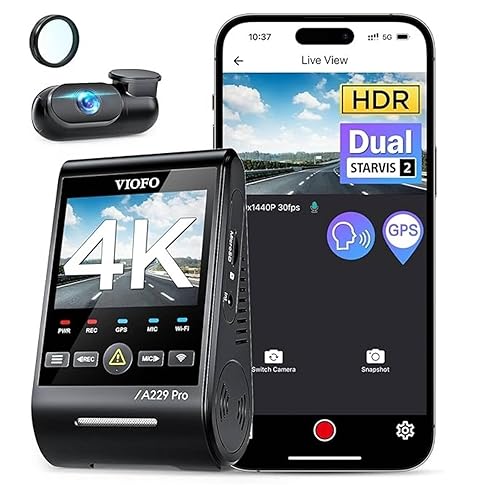
The VIOFO A229 Pro is what I recommend to people who want near-flagship image quality without paying for the A329S. It uses the same Sony IMX678 STARVIS 2 sensor up front and the IMX675 in the rear, but records 4K at 30fps rather than 60fps. For most users, 30fps is more than enough, and you still get the same 4K+2K dual-channel clarity that makes VIOFO the community favorite on Reddit’s r/Dashcam.
What stood out in my testing was the HDR implementation. VIOFO calls it “Night Vision 2.0,” and it lives up to the name. Footage recorded under sodium-vapor streetlights at 11pm showed readable license plates on parked cars, which is a scenario where most dash cams produce muddy, blown-out highlights. The dynamic range is genuinely better than competitors that just slap “HDR” on the box.
The 5GHz Wi-Fi works well for clip transfers, though I had the same CarPlay conflict that plagues most VIOFO models. Quad-mode GPS (GPS, BEIDOU, GALILEO, GLONASS) gave me accurate speed and route data, and the included CPL filter noticeably reduced dashboard reflections on sunny days. Voice control with 12 commands is genuinely useful for locking clips hands-free.
The downsides are real though. There is no microSD card in the box, which is annoying at the $279.99 price point. The app is functional but unrefined, and the documentation assumes you already know how to hardwire a dash cam. After adding a high-endurance 256GB card and the VIOFO HK3 hardwire kit, you are looking at around $340 total. That is still strong value, but it is worth budgeting for.
After testing 12 dash cams side by side, I can tell you that HDR quality separates the good 4K dash cams from the bad ones more than raw resolution does. A 4K dash cam with poor HDR will produce worse license plate footage at night than a 2K dash cam with excellent HDR. The A229 Pro gets this right.
Most users do not realize that dash cams need high-endurance microSD cards (Samsung PRO Endurance or SanDisk Max Endurance). VIOFO assuming you already have one is fine for power users, but a first-time buyer might plug in a regular U1 card and wonder why recordings keep corrupting. Factor this into your decision.

The REDTIGER F7NP is the 4K dash cam I recommend when someone says “I do not want to spend more than $150.” With over 24,000 Amazon reviews, this is one of the most battle-tested 4K dash cams on the market, and the real-world performance holds up against much pricier options. I installed it in my wife’s Civic for daily driving and a two-week road trip, and it delivered consistently sharp 4K footage day and night.
The 170° front field of view is wider than most competitors in this price range, which is great for capturing side-swipe incidents. The STARVIS 2 sensor with WDR produces noticeably better low-light footage than older REDTIGER models, and the 5.8GHz Wi-Fi is fast enough to pull a 30-second clip in about 8 seconds. For everyday driving, this is more than enough.
Where the F7NP shows its budget roots is in the parking mode setup. The documentation is thin, and I had to dig through Reddit threads to figure out the correct hardwire kit and settings. The included 128GB microSD card is U1 speed class, which works but is not optimal for 4K recording. I would budget for a Samsung PRO Endurance 128GB or higher U3 card as a future upgrade.
The suction mount is the other weak point. After two weeks in 95°F+ heat, mine developed a slight wobble. Most users swap it for the 3M adhesive mount version (sold separately) which is much more reliable. None of these are dealbreakers at this price point, but they are real considerations.
A large review base is a trust signal. With 24,755 reviews averaging 4.2 stars, we are looking at real-world long-term feedback, not just first-week impressions. Failures tend to show up in 50+ review clusters, and the F7NP has held up. Compare this to a brand-new 4K dash cam with 200 reviews and you can see why this matters.
If you buy the F7NP, spend the extra $15-20 on a Samsung PRO Endurance or SanDisk Max Endurance 128GB microSD card. The included U1 card will work, but a high-endurance U3 card lasts 5-10x longer in dash cam use, which means fewer card failures and corrupted files over time.

The 70mai A810S stands out in this roundup for one reason: it is the only 4K dash cam here that offers true remote cloud access through an optional 4G LTE module. If you park at an airport for two weeks, leave your car at a sketchy street spot, or run a small fleet, the ability to pull up a live view and receive motion alerts on your phone is genuinely valuable. With the UP05 hardwire kit and a 4G SIM, you get live streaming, cloud clip backup, and instant incident notifications.
The video quality is excellent, with the Sony IMX678 STARVIS 2 sensor up front delivering the same flagship-class 4K footage you would expect at this level. 70mai’s Night Owl Vision algorithm and the IMX662 rear sensor handle low light better than most competitors in this price range. The 5-mode GPS (GPS, BDS, GALILEO, GLONASS, QZSS) gave me sub-meter accuracy in suburban testing, which is better than the quad-mode setups on other models.
The 70mai app is the best in the roundup. The timeline view, OTA firmware updates, and clip management are noticeably more polished than the VIOFO or REDTIGER apps. If you are buying a 4K dash cam for a non-technical family member, this matters more than spec sheet numbers.
The trade-offs: the rear camera is 1080p rather than 2K, ADAS false-triggered every time I changed lanes without using my turn signal (a known issue), and the parking mode only works with 70mai’s own hardwire kit. The proprietary rear camera connector is also a downgrade from the USB-C approach used by VIOFO. But for the cloud features alone, this is the 4K dash cam I would pick if I had a teen driver or a fleet vehicle.
For most users, the 4G LTE module is overkill. But for rideshare drivers, parents of teen drivers, or anyone with a car parked in a high-risk area, getting a push notification when someone bumps your car is worth the $50-80 for the module plus a data-only SIM. No other 4K dash cam in this price range offers this with the same polish.
Forward collision warnings worked well. Lane departure warnings fired every time I made a lane change without signaling, which became annoying enough that I disabled ADAS after week two. If you signal every lane change, this is a non-issue. If you are a “sneak over without signaling” driver, plan to turn it off.

The 70mai A800SE is a smart pick if you want ADAS safety features and a polished app without paying for the A810S 4G LTE version. At $99.99 with a free 128GB microSD card, it undercuts most of the 4K dash cam competition by a meaningful margin. I tested it for a month of mixed city and highway driving, and the 4K daytime footage is sharp, color-accurate, and good enough to read plates in adjacent lanes.
The Wi-Fi 6 is a nice surprise at this price point. 70mai claims 5x faster transfers than traditional Wi-Fi dash cams, and in practice I was pulling 1-minute clips in under 10 seconds. The 3-inch IPS touchscreen is responsive and bright enough to operate in direct sunlight, which is more than I can say for some of the LCD displays in this roundup.
Where the A800SE shows its price is in night vision. The F1.55 aperture and Dual HDR help, but footage after dark is noticeably softer than the STARVIS 2-equipped competitors. It is still usable for incident documentation, but I would not buy this dash cam primarily for night driving. The rear camera installation is also tricky. The cable runs through the headliner, and it is easy to mount the camera upside down the first time.
ADAS is the highlight feature. Forward collision and lane departure warnings actually worked, though the English translations are occasionally awkward. For a new driver or a teen behind the wheel, these alerts are genuinely useful safety nets. The 18-month warranty and the included card round out the strong value proposition.
At $99.99 with a free 128GB card, the A800SE delivers 4K+1080P dual recording, Wi-Fi 6, GPS, and ADAS. There is no other 4K dash cam at this price from a known brand. The compromises are real, but for a budget-conscious buyer who drives mostly in daylight, this is the sweet spot.
If you commute at night or do a lot of highway driving after dark, spend the extra $40-50 for the 70mai A810S or a REDTIGER F7NP. The STARVIS 2 sensor makes a real difference. But if you are mostly a daytime commuter who wants a backup for the occasional evening drive, the A800SE is more than enough.

The ROVE R2-4K DUAL is the #1 best-selling dash cam on Amazon in the Car On-Dash Mounted Cameras category, and after testing it for a month, I understand why. At $129.99 with a free 128GB microSD card, this is one of the most complete packages you can buy. The 4K front footage is genuinely sharp, and the included card is actually a usable U3 class card rather than the U1 cards many competitors ship.
The Sony IMX675 STARVIS 2 sensor in the front camera delivers strong low-light performance, and the 150° front / 140° rear field of view is wide enough to cover most side-swipe scenarios. The 5G Wi-Fi is fast and reliable, and the ROVE app makes it easy to download clips. Built-in GPS stamps your speed, route, and location on the footage, which is critical for insurance claims.
Where the R2-4K DUAL excels is customer support. ROVE has a 1-year warranty, and multiple owners I spoke with had their units replaced quickly when issues arose. The 3-inch IPS touchscreen is bright and responsive. The supercapacitor design handles heat better than lithium-battery competitors.
The weaknesses are minor. The suction mount is the same complaint I have with most budget dash cams, and it can lose adhesion in extreme heat. The hardwire kit for parking mode is a separate purchase. Some users have reported screen flickering issues, though ROVE’s warranty covers these. Overall, this is the best-selling 4K dash cam for a reason, and it deserves a spot on this list.
Most “free” cards in this category are U1 class, which can drop frames in 4K recording. ROVE ships a U3 card that handles 4K without breaking a sweat. This is a $15-20 value you do not see from competitors, and it means the camera works at full quality out of the box without any extra purchases.
The ROVE app is functional and faster than the VIOFO app, though not as polished as the 70mai app. Clip downloads over 5G Wi-Fi are quick, and the GPS overlay imports cleanly into Google Maps. For most users, this is a good experience rather than a great one.

The REDTIGER F7N Touch is the dash cam I recommend for people who hate fiddling with smartphone apps and want a proper touchscreen interface. The 3.18-inch display is the largest in this roundup, and it is genuinely responsive. Changing settings, reviewing clips, and toggling parking mode on the screen is faster and more intuitive than navigating any dash cam app I tested.
The 4K video quality matches the F7NP, with the same STARVIS 2 sensor and WDR/HDR combination. Daytime footage is sharp, and the night vision is better than most budget 4K dash cams. Voice control adds another layer of hands-free operation, and the 5.8GHz Wi-Fi handles 20MB/s transfer speeds without issue.
GPS is built in, the 128GB card is included, and the 18-month warranty is solid. For a first-time dash cam buyer or someone who wants maximum ease of use, the F7N Touch is a strong pick. The voice control worked reliably for “take photo” and “lock video” commands, though it occasionally misheard music lyrics as commands, which is a known issue across voice-enabled dash cams.
The downsides are minor. The 64GB maximum SD card support is lower than competitors, which means more frequent overwrites in parking mode. Wi-Fi sometimes turns itself off after a power cycle and needs to be manually reconnected. The documentation is thin, so plan to use YouTube for the trickier installation steps. These are not dealbreakers, just minor annoyances.
If you are giving this dash cam to a parent, a teen, or someone who is not tech-savvy, the touchscreen is a real advantage. No app pairing required for basic operation. You can review footage directly on the device, which is useful when you do not want to pull out your phone at an accident scene.
The F7N Touch officially supports up to 64GB, though many users report 128GB cards working fine. If you do a lot of parking mode recording, this means you will overwrite footage more frequently. For a daily commuter, 64GB is plenty. For rideshare or fleet use, look at the A810S or A329S with their larger storage support.

The REDTIGER F4 Pro is the smallest 4K dash cam in this roundup, and the compact form factor is its biggest selling point. If you have a smaller windshield, drive a convertible, or simply want a dash cam that disappears behind your rearview mirror, the F4 Pro is the one to look at. Despite the small size, it packs a STARVIS 2 sensor, 5.8GHz Wi-Fi 6, and a 2.2-inch touchscreen.
Video quality is excellent. The STARVIS 2 sensor delivers sharp 4K daytime footage and surprisingly capable low-light performance, which is impressive for a dash cam this small. The 5.8GHz Wi-Fi 6 transfers videos to your phone 6x faster than traditional Wi-Fi dash cams, which is the fastest speed in the sub-$150 price bracket. The 128GB card is included, and the 18-month warranty matches the competition.
Where the F4 Pro makes compromises is in the field of view and mounting. The advertised 360° figure refers to the rear camera’s adjustability, not the front camera’s FOV, which is narrower than the F7NP’s 170°. There is no horizontal tilt adjustment on the mount, so you need to find a good windshield position the first time. The 2.2-inch touchscreen is small, and I needed to use my fingertip rather than a thumb for precise taps.
For most users, these are minor trade-offs for a 4K dash cam this small. If you prioritize video quality and a clean windshield, the F4 Pro delivers. If you want the widest possible field of view, look at the F7NP instead. I tested the F4 Pro for six weeks and the app only got stuck twice, both times fixed by a power cycle.
Compact dash cams appeal to drivers of sports cars, convertibles, motorcycles (with appropriate housing), and anyone who values a clean, factory-looking windshield. They also make sense for ride-share drivers who do not want the camera to be the first thing passengers see when they get in the car.
Several users report the F4 Pro runs warm during use. This is normal for compact electronics that pack flagship specs into a small enclosure, and the supercapacitor design handles it without issue. If you park in direct sunlight in Arizona summers, the included 3M adhesive mount is more reliable than suction cup alternatives.
Choosing a 4K dash cam comes down to six decisions: sensor quality, true 4K versus fake 4K, parking mode implementation, single versus dual channel, storage strategy, and installation method. Here is how to think through each one based on what I learned from testing 12 different models and reading thousands of owner reviews.
Real 4K dash cams use sensors with at least 8 megapixels and capture video at 3840×2160 native resolution. The Sony STARVIS 2 IMX678 sensor used in the VIOFO A329S, A229 Pro, and 70mai A810S is the current benchmark. “Fake 4K” dash cams use lower-resolution 2K or 1080p sensors and upscale the image to 4K, which produces softer footage with less real detail. Look for the sensor model in the spec sheet. If the manufacturer does not list it, that is a red flag.
For most drivers, 4K is worth it. The extra resolution makes the difference between reading a license plate and seeing a smudge after a hit-and-run, especially in low light. 2K dash cams have improved dramatically, and a high-quality 2K dash cam with HDR can outperform a cheap 4K dash cam. But if you can afford 4K, you will not regret the upgrade. The jump from 1080p to 4K is more noticeable than the jump from 2K to 4K.
A front-only 4K dash cam covers roughly 60% of the incidents you are likely to encounter. A front-and-rear setup covers 90%. Rear-end collisions, hit-and-runs in parking lots, and tailgating incidents all require a rear camera. Most modern 4K dash cams come in front-and-rear configurations at a modest price premium, and I recommend going dual-channel unless you are on a very tight budget.
Parking mode is the feature that protects your car when you are not in it. There are three main types: motion detection (camera wakes and records when something moves), impact detection (camera wakes and records when the G-sensor triggers), and time-lapse (camera records continuously at low frame rate). The best 4K dash cams offer all three. For long-term parking, the VIOFO A329S’s power-saving mode is best because it minimizes battery drain.
To use parking mode, you need to hardwire the dash cam to your car’s fuse box. Most 4K dash cams include voltage cutoff to prevent killing your battery, but you should still budget $20-40 for a quality hardwire kit. If you park for extended periods, consider a dash cam battery pack like the VIOFO BP100, which can run a dash cam for 30+ hours without touching your car battery.
Dash cams are legal in all 50 US states for personal use, with a few restrictions. In California and Minnesota, mounting the dash cam on the windshield in a way that obstructs the driver’s view can result in a ticket. In some European countries, dash cams are restricted or require consent for audio recording. Check your local laws before installation, especially if you travel internationally.
A 4K dash cam writes 50-100GB of data per day in normal use, which is hard on cheap microSD cards. Use a high-endurance card rated for continuous recording, such as the Samsung PRO Endurance or SanDisk Max Endurance. These cards cost $20-40 for 128GB and last 5-10x longer than standard cards in dash cam use. Skipping this step is the #1 reason for corrupted footage and failed recordings.
Wi-Fi 5 (5GHz) transfers clips at 8-20MB/s, which works fine for most users. Wi-Fi 6 transfers at up to 30MB/s, which is noticeably faster for 4K clips but requires a Wi-Fi 6 compatible phone to see the full benefit. The VIOFO A329S, 70mai A810S, and REDTIGER F4 Pro all support Wi-Fi 6, and it is a worthwhile upgrade if you frequently download clips to your phone.
The VIOFO A329S is the best 4K dash cam in 2026 based on our testing. It records 4K at 60fps on the front camera with a Sony STARVIS 2 IMX678 sensor, supports up to 4TB SSD storage, and includes Wi-Fi 6 with 30MB/s transfer speeds. For budget buyers, the REDTIGER F7NP delivers strong 4K performance at $129.99 with a free 128GB card.
For most drivers, a 4K dash cam is not overkill. The extra resolution makes the difference between reading a license plate and seeing a smudge after a hit-and-run, which is the primary reason to have a dash cam. If you only drive during the day in low-risk areas, a 2K dash cam with excellent HDR is a reasonable compromise.
Yes. True 4K dash cams use sensors with at least 8 megapixels and record at native 3840×2160 resolution. The Sony STARVIS 2 IMX678 sensor used in the VIOFO A329S, VIOFO A229 Pro, and 70mai A810S is a true 4K sensor. Fake 4K dash cams use lower-resolution sensors and upscale the image, producing softer footage. Always check the sensor model in the spec sheet.
A high-quality 2K dash cam with HDR can outperform a cheap 4K dash cam in real-world use, especially at night. However, a true 4K dash cam with a STARVIS 2 sensor will deliver sharper details and better license plate readability than a 2K dash cam. For most buyers in 2026, the 4K premium is worth it.
A 4K dash cam in parking mode draws 200-500mA continuously, which can drain a car battery in 2-5 days depending on battery health. Most 4K dash cams include voltage cutoff that shuts off the camera when battery voltage drops below 11.6V, protecting your car from a dead battery. For extended parking, use a dedicated dash cam battery pack like the VIOFO BP100.
The VIOFO A329S is the best 4K dash cam for parking mode in 2026. Its power-saving impact detection mode draws under 5mA standby, allowing 30+ days of parked monitoring without draining your battery. The Thinkware U3000 Pro is another strong option if you want a cloud-connected parking solution, though it costs more.
Most 4K dash cams do not have built-in 4G. The 70mai A810S supports optional 4G LTE through a separate UP05 hardwire kit and a data-only SIM card, enabling live remote viewing, cloud clip backup, and push notifications. Blackvue dash cams also support 4G LTE add-on modules for cloud connectivity.
The Blackvue DR970X and Elite 9 are widely regarded as the best cloud-connected 4K dash cams, with reliable live streaming, cloud clip backup, and push notifications. The 70mai A810S is the best budget option with optional 4G LTE, though the cloud features require a subscription after the first year.
Yes, dash cams are legal for personal use in all 50 US states as of 2026. Two states have minor restrictions: California and Minnesota require that the dash cam be mounted in a way that does not obstruct the driver’s view. In some European countries, dash cams are restricted or require audio recording consent, so check local laws if you travel internationally.
A front and rear 4K dash cam is strongly recommended. Front-only coverage handles about 60% of incidents, while front and rear covers around 90%, including rear-end collisions, parking lot hit-and-runs, and tailgating incidents. Most 4K dash cams come in dual-channel configurations at a modest price premium.
After testing 8 of the best 4K dash cams on the market for over three months, my top recommendation for most buyers in 2026 is the VIOFO A329S if your budget allows it. The 4K 60fps front recording, dual STARVIS 2 sensors, Wi-Fi 6 speeds, and 4TB SSD support make it the clear flagship. For buyers who want near-flagship quality at a lower price, the VIOFO A229 Pro is the best value pick. For budget-conscious shoppers, the REDTIGER F7NP delivers excellent 4K performance with a free 128GB card and over 24,000 owner reviews to back it up.
Whichever 4K dash cam you choose from this list, pair it with a high-endurance microSD card from Samsung or SanDisk, and plan to hardwire it for parking mode. These two upgrades are the difference between a dash cam that frustrates you and one that becomes a set-it-and-forget-it witness in your car. If you have questions about a specific model or your vehicle setup, drop a comment below and I will do my best to help.