12 Best Video Lights For YouTube Under $200 (November 2026) Reviews
A solo creator at a desk records talking-head videos and needs reliable lighting that won’t flicker on camera or break…

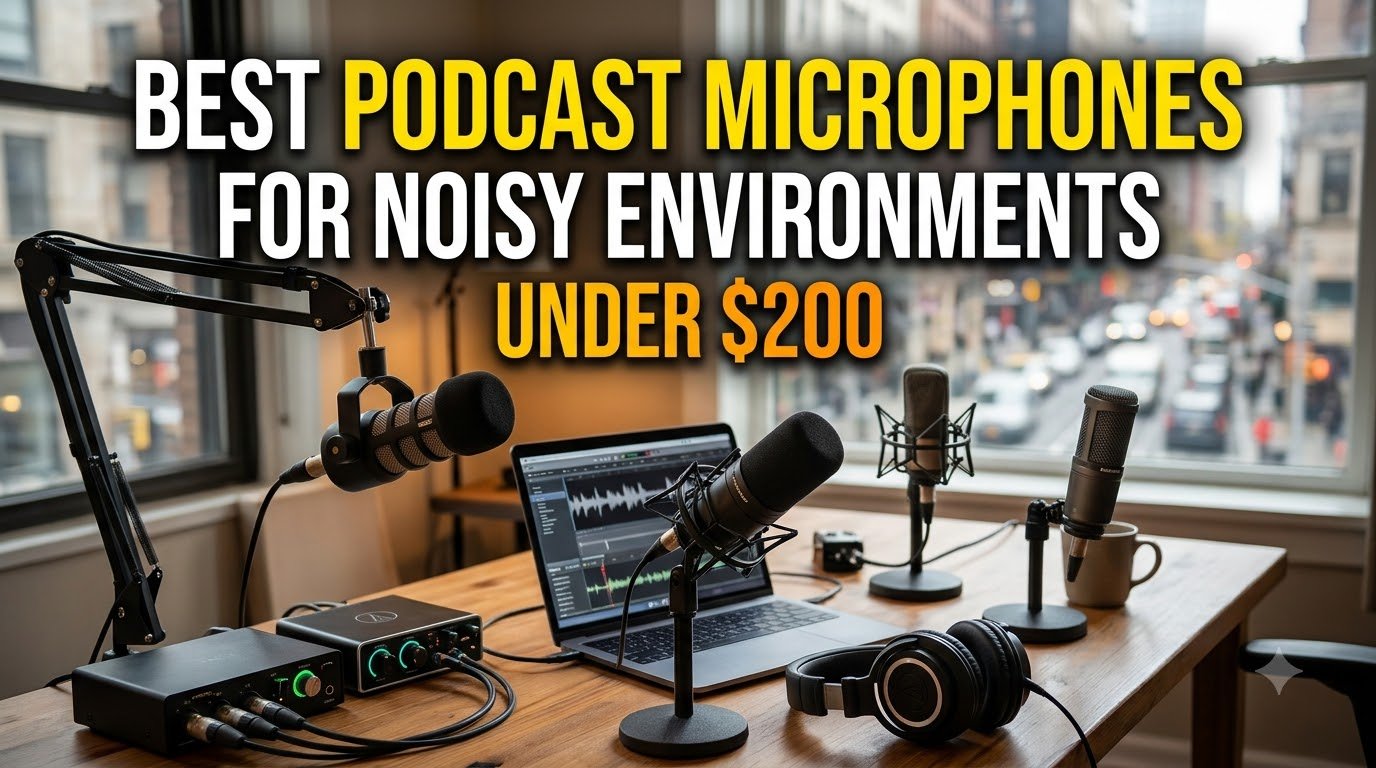
A home podcaster recording in a spare bedroom with a loud computer fan and street noise needs clear audio without spending hundreds on room treatment, and the best podcast microphones for noisy environments under $200 are how you get there. A wrong pick costs you every session: you hear the fan under your voice, you fight the gain, and you clean up tracks that should have been clean. A promising first episode can turn into an evening of noise removal faster than you expect. Three things settle this choice: how well the mic rejects background noise, how its polar pattern handles the room, and whether it connects to the gear you already own.
For most home podcasters, a dynamic mic with a tight pattern and a USB option is the sensible start, and the FIFINE AmpliTank K688 meets that need with USB and XLR connectors on one body. If you already own an interface and record close on a boom arm, look past it to the Rode PodMic, which is built for that position.
Background noise rejection came first, because a fan or traffic outside the window reaches the mic on every take and no editing removes it cleanly. A dynamic capsule that responds mostly to close speech keeps that noise low, and a tight polar pattern turns down what arrives from the sides and rear.
We also weighed how the pattern holds up when you sit close, whether the mic connects by USB, XLR or both, and how the body and mount take daily desk life. The best podcast microphones for noisy environments under $200 have to keep working after the novelty of a new show wears off.

The FIFINE AmpliTank K688 is the one to start with if you want a USB mic today and a path to an interface later. Its metal body and shock mount give it a solid feel on a desk, and the dual USB and XLR connectors mean the same mic can move to an interface when your setup grows.
A gain knob on the body lets you set input level without digging into software, and a 3.5mm jack gives real-time monitoring with headphone volume control. FIFINE says the dynamic capsule and a close working distance keep fan and street noise low without software processing, and the unidirectional pattern backs that up.
Keep the mic close when you record, because the dynamic capsule needs a short working distance to sound full. The included windscreen dampens plosives and reduces harshness in vocals, so fit it before your first take. A 5/8” to 3/8” adapter and an 8.2ft USB-C to USB cable come in the box, which covers most desk and arm mounts. The metal enclosure takes normal desk knocks, and a quick wipe with a dry cloth keeps the grille clear.
The XLR cable, boom arm and mic stand are not included, so a USB-only start works out of the box but an XLR setup needs those parts bought separately. That matters most if you plan to move to an interface right away, since the cable is the first thing you will reach for. If you record at a desk with the included shock mount and USB cable, the gap costs you nothing on day one. The close working distance the capsule needs is a habit to build, not a fault, and it keeps room noise down.
This one is for the home podcaster who wants to begin on USB and add an interface when the show grows. The dual connectors make that step a cable change rather than a new microphone. If you already own an interface and record close on a boom arm, the Rode PodMic is built for that job and states a 2-year warranty. For a first setup that keeps its options open, the AmpliTank K688 earns its place at the top of this list.

The Logitech Blue Yeti is the multi-purpose desk mic here, built for one person who records voice and instruments from the same spot. Four pickup patterns let you switch from cardioid for a single voice to wider patterns for several people, and onboard controls cover headphone volume, pattern selection, instant mute and mic gain. Logitech G credits a three-capsule array for that range, and the metal enclosure gives the body a solid feel. A 2-year limited warranty backs it.
The adjustable desktop stand pivots the mic toward the sound source, and no-latency monitoring lets you track your voice in real time through headphones. Set the pattern before you hit record, because the wrong one picks up the room instead of your voice. The mic connects by USB Type-A to a computer, and the box includes the stand and a USB cable. At 1.45 kg it is heavy for a light boom arm, so a sturdy desk stand is the safer home.
At 1.45 kg the Yeti is heavy, and it connects only by USB, so there is no XLR path to an interface. On a light boom arm that weight can sag or drift, which is a real problem if you record standing or move the mic often. On its own desktop stand the weight is an asset, holding the mic steady while you talk. If you already own an interface and want an XLR mic, this one will not connect to it at all.
Pick the Yeti if you record podcasts, instruments and the occasional group session from one desk and want the patterns built in. The four pickup options save you from buying a second mic for interviews or room sound. A podcaster who wants levels shaped without plugins gets that from the MAONO PD200X, which carries EQ, limiter and compressor in USB mode. For a single flexible USB mic that covers many jobs, the Yeti is the premium pick here.

The MAONO PD200X is the value pick for a podcaster who wants shaped levels without plugins. EQ, limiter and compressor adjustments run in USB mode, and MAONO says the onboard DSP shapes gain and dynamics before the signal reaches the computer, so levels stay even. A 2-in-1 smart knob adjusts mic gain and headphone volume, and a one-click mute key with LED indicator cuts the mic fast during a stream. The metal body is built for durability, and the shock mount comes in the box.
Plug in over USB-C and the mic works with Windows, Mac OS and Android, so you can start without an interface. The box holds the dynamic microphone, shock mount, a 2.5m USB-C to USB-A/C cable and a 5/8” to 3/8” adapter. Set your gain and mute key before recording so the DSP has a clean level to work from. An 18-month warranty covers the mic.
The XLR cable is not included, so XLR use needs a separate cable, and the DSP features work only in USB mode. That is a real problem if you record through an interface and expect the same shaping there, because the EQ, limiter and compressor will not follow you. If you stay on USB, the missing cable costs you nothing and the DSP does the work. Your honest view of its main weakness is that the software side stops at the USB port, and a podcaster who records straight into a computer can live with that easily.
This one is for the podcaster who wants levels shaped without plugins and records straight into a computer. The USB mode carries the EQ, limiter and compressor, so a clean take needs no extra software. If you record through an interface and want a light mic on a boom arm, the FIFINE AmpliTank K688 weighs 0.51 kg and keeps an XLR path open. For a desk setup that stays on USB, the PD200X gives you the most control for the least fuss.

The SAMSON Q2U is the microphone to pick when you want to start recording today and sort out the rest later. It works over USB straight into a computer, and the same body takes an XLR cable when you add an interface. Both cables come in the box, along with a mic clip, a desktop tripod stand with an extension piece and a windscreen, so nothing else is needed for a first episode. A 3.5mm headphone output lets you hear the recording and your computer audio as you go.
The Q2U uses a cardioid dynamic capsule, and that pattern picks up sound from the front and keeps ambient noise down. That is the right behavior for a room with a fridge humming or traffic outside, because the mic listens mostly to the voice in front of it. The 70 db signal to noise ratio is the highest figure among these three picks, which fits a mic meant to be forgiving of a busy room.
The stand is the part to think about before you record. The included tripod is short, so the mic sits low near the desk and picks up more of the room and less of your mouth.
You can raise it with the extension piece, or move to a boom arm later, and the closer the capsule sits to your mouth the more the voice dominates the track. The whole kit arrives ready to record, cables and stand included, so a first session costs you no extra shopping.
The one real shortcoming is the desktop tripod, which is short enough that the mic sits low near the desk. That position puts your mouth farther from the capsule, so the voice arrives weaker and the room arrives stronger. For a first recording at a desk it is workable, and the extension piece helps. If you plan to record long sessions close to the mic, budget for a boom arm.
This is the pick for a first-time podcaster who wants a complete kit and no extra purchases. You get USB and XLR in one body, so you can start simple and move to an interface when you are ready. The Q2U is the simplest way to get a first recording onto a computer, with both cables and a stand in the box.

The Shure MV7X is built for a podcaster who records close in a room with echo and vibration. Its dynamic cardioid capsule with an integrated shock mount is the core of the design, and Shure says that combination responds to close speech and shrugs off room echo and vibration.
The 25 db noise figure is far below the SAMSON Q2U’s 70 db, a clear step down that points to a mic meant to stay quiet in a live room. An all-metal body and an adjustable yoke mount round out a microphone that can take daily handling.
The mount is where setup goes right or wrong. The yoke takes a standard stand or boom arm, and the included 3/8 inch adapter opens up the common thread sizes, so the mic can sit close to your mouth at the angle you speak from. Set the mic on a desk at arm’s length and the voice thins out as the room creeps back in, so close placement is what makes the noise rejection work for you.
The MV7X is XLR only, so it needs an audio interface or mixer, and it offers one unidirectional pattern with no switching. That is fine for one voice and a problem for two people around one mic. The metal enclosure and yoke hold up to that kind of handling.
The MV7X has no USB output and no pattern switch, so it cannot plug straight into a laptop and it cannot be shared between two speakers. You need an interface or mixer before it makes any sound, and that is an extra purchase and an extra setup step. For a solo podcaster who already owns an interface, neither point costs anything. For someone hoping to start on USB, this is the wrong first microphone.
Pick the MV7X if your recording space is untreated and you already have an interface ready. The dynamic capsule and integrated shock mount are aimed at exactly that situation, and the 2 year warranty backs a mic that stays put. A podcaster who records close on a boom arm may prefer the Rode PodMic, which weighs 937 g against the MV7X’s 508 g and brings an internal shock mount and pop filter. For echo and vibration in a live room, the MV7X is the calmer choice.

The Rode PodMic is the close-talk microphone for someone who already records through an interface. Its dynamic capsule with an internal shock mount and a built-in pop filter is the heart of it, and Rode says the capsule responds mostly to close, loud sound, so distant fan and street noise stays low in the mix.
The 18 db noise figure is the lowest among these three picks, a clear step below the Shure MV7X’s 25 db. An all-metal body and an integrated yoke mount with dual 3/8 inch and 5/8 inch threads mean it mounts on a stand or boom arm without adapters.
The yoke and threads are the setup detail to get right. Because the mount is built in, the mic hangs at the angle you set and stays there, and the dual threads let it go onto a boom arm without hunting for an adapter. Set it close to your mouth on that arm and the pop filter handles the plosives that would otherwise thump the track. Leave it on a desk at a distance and you lose the benefit of the close-pickup design.
The PodMic is XLR only, so an interface or mixer is required before it records anything. Rode builds it in an all-metal enclosure and covers it with a 2 year warranty, which is the longest on this list alongside the Shure MV7X. The internal shock mount and pop filter save you from buying those parts separately, and that is a real saving in setup time and desk clutter.
At 937 g the PodMic is heavy for lightweight arms and small stands, and it needs an interface or mixer because it is XLR only. A flimsy arm may droop or drift under that weight, so a sturdier arm is the safer pairing. For a fixed desk stand or a solid boom arm, the weight is a non-issue. For a travel setup or a cheap arm, it is worth planning around.
This is the pick for a podcaster with an interface who records close on a boom arm. The internal shock mount and pop filter are built for that position, and the 2 year warranty covers a mic that stays mounted. A podcaster in an untreated room with an interface ready may prefer the Shure MV7X, which weighs 508 g against the PodMic’s 937 g and carries an integrated shock mount of its own. The PodMic rewards a solid arm and a close mouth with a clean, controlled voice.

A hypercardioid capsule is the whole idea behind the Audio-Technica AT2040, and it is the reason this mic belongs in a room where voices and traffic creep in from the sides. Audio-Technica says the tighter pattern listens mostly straight ahead, so side and rear noise is picked up far less. That means you can sit close and let the pattern do the work instead of treating the room. The mic is XLR only, so an interface or mixer has to be part of your setup before it makes any sound.
The included pivoting stand mount and 5/8″-27 to 3/8″-16 threaded adapter let you angle the body toward your mouth on most stands and booms. Set the capsule a few inches from your lips and slightly off axis, because a hypercardioid pattern loses its advantage once you drift back from it.
The multistage foam mesh windscreen handles plosives inside the mic, so a separate pop filter is one less thing to clamp on. Keep the soft protective pouch for transport, since the integrated shock mount and foam are the parts you want shielded from knocks.
The single real shortcoming is that the AT2040 has no USB output, so it needs an audio interface or mixer to connect to a computer. For a close-talk podcaster who already owns one, that is no burden at all and the isolation is worth it. If you hoped to plug straight into a laptop, this mic will sit silent until you buy the rest of the chain.
This is the pick for a podcaster who speaks close to the capsule and fights noise arriving from the sides and rear. The hypercardioid pattern and internal shock mount work together on that problem, and the pivoting mount makes the close angle easy to hold. A podcaster who records from across the desk, or who wants a USB cable straight into a laptop, gets less from it. For side noise and a disciplined working distance, the AT2040 earns its place.

Controls on the body are what set the HyperX Quadcast 2 apart for a streamer who mutes and rides gain in the middle of a session. A tap on the top mutes the mic, and the LED shows whether it is live, so you never guess.
The gain knob lets you trim sensitivity by hand instead of digging through software. HyperX credits the removable elastic shock mount with suspending the capsule, which keeps desk knocks and bumps out of the recording. The everyday adjustments live on the mic itself, so a mid-stream mute takes one tap and no window switching.
The Quadcast 2 connects by USB Type-A and is made for PC and gaming console, so route the cable before you settle the stand. Its aluminum body is the sturdiest enclosure among these three, and the removable shock mount comes off for cleaning or packing.
The 4.02 x 5.28 x 9.51 in frame stands tall on a desk, and on a low monitor the body can sit right in your sightline. A boom arm moves it off the desk surface and out of the way, and the mount is built to come off for that swap.
Customization through HyperX NGenuity is unreliable, so treat the on-board controls as the real interface and the software as a bonus. The tall body can also block a low monitor, which is a genuine nuisance on a cramped desk. Neither point hurts a streamer who mutes and adjusts gain by hand and has room to raise the screen. If you plan to build lighting and profiles in software, this is where the Quadcast 2 disappoints.
A console or PC streamer who mutes and adjusts gain mid-session gets the most from this mic. The tap-to-mute top, the LED status and the gain knob put those moves within reach, and the USB Type-A connection covers PC and gaming console. Someone who wants deep software control over lighting and profiles meets a weaker side here. For hands-on control during a live session, the Quadcast 2 keeps everything on the body.

The HyperX QuadCast is the one to reach for when you want sound on air in minutes, with no interface and no software in the path. It connects by USB and is made for PC, PS4, PS5 and Mac, so the cable goes from mic to machine and you are recording.
Cardioid mode keeps the focus on your voice, and the four polar patterns let you switch to stereo, omnidirectional or bidirectional when a second person or a room sound calls for it. The built-in shock mount and tap-to-mute sit on the body where you can reach them without looking away.
Weight separates the two HyperX mics in a way that changes how you mount them. If the mic will live on a desk stand, the difference matters little. If you plan to swing it on an arm or pack it for recording elsewhere, the Quadcast 2 is the easier body to move.
Setup is a single USB cable, and the box includes the stand, a mini USB to USB cable and a mic arm adapter. The adapter fits 3/8-inch and 5/8-inch threads, so most boom arms take the mic without a separate purchase.
HyperX says the elastic suspension isolates the capsule from stand vibration, which cuts rumbles and desk bumps. Keep the internal pop filter in mind when you place the mic, since it already handles plosives and you can spend the clamp money elsewhere.
The enclosure is plastic, and the top and bottom feel less sturdy than a metal body when you handle them. There is also no XLR output, so the QuadCast connects only by USB to a computer. For a desk streamer who leaves the mic in place, neither point costs anything in daily use. If you want to add an interface later or carry the mic between locations often, the plastic shell and the single connection are real drawbacks.
A plug-and-play desk streamer on PC or console is the person this mic serves best. The USB connection, the cardioid mode and the tap-to-mute cover a live session without extra gear. A podcaster who wants to grow into an interface meets a wall here, because there is no XLR output. For simple, immediate streaming from a desk, the QuadCast keeps the setup to one cable.

A desk streamer who types through a session gets a dynamic capsule here, and the cardioid pattern points it at your voice instead of the room. FIFINE says that pattern minimizes ambient noises such as computer fans or air conditioning, which cuts the cleanup work after a stream. The metal enclosure takes the knocks of daily desk life, and the 8.2′ USB A to USB C cable gives you room to place the mic away from the tower.
The shock mount is the part that earns its place on a typing desk. FIFINE says it absorbs desk vibrations from keyboard typing and mouse clicks before they reach the capsule, so your viewers hear your voice rather than every keystroke. A locking knob lets you tilt the mic toward your mouth and hold that angle. Tap the top to mute, and the built-in LED shows the mute status at a glance when someone walks in mid-stream.
Set the shock mount on a stand and thread the metal ring and screw adapter to lock the mic in place, then run the detachable USB-C cable to your computer. Keep the sound source in front of the mic top, because the unidirectional pickup favors what sits ahead of it. The 3.5 mm jack takes headphones for direct monitoring, and the gain knob lets you trim level without opening software.
The stand is the piece to plan for, since the box holds the mic, shock mount, ring, adapter and cable but no stand. Without one the mic sits loose on the desk and the shock mount has nothing to isolate. The USB connection covers a laptop, a personal computer and PS4/PS5, and Xbox consoles are not supported, so an Xbox-only setup needs a different mic.
The missing stand is the first thing you have to solve, because the shock mount needs something solid to sit on before any of its vibration damping works. Budget for a desk stand or boom arm along with the mic, and the rest of the setup goes quickly. Xbox owners hit a harder wall, since the compatible devices list covers laptop, personal computer and PS4/PS5 but not Xbox. If you stream only on PlayStation or a PC, neither gap slows you down much.
A desk streamer who types through a session will benefit from the cardioid dynamic capsule and shock mount that suppress keyboard vibrations. The tap-to-mute top and LED indicator let you silence the mic instantly without hunting for a button. If you prioritize the lowest self-noise, the Shure MV7X offers 25 db noise, a low figure here. For a typing-heavy setup on PC or PlayStation, this mic keeps your voice clear and your hands free.
A dynamic capsule rejects room noise better than a condenser in a spare bedroom with a loud computer fan. Dynamic designs respond mostly to close, loud sound, so distant fan hum and street rumble stay low in the mix. Condensers are more sensitive and capture more of the room around you, which is why they need treatment to sound clean. The FIFINE AmpliTank K688 uses a dynamic capsule and includes a gain knob on the body for quick level changes.
Placement often matters more than mic choice in a noisy room, and a dynamic mic at a proper distance is the best bet for minimizing background noise. Keep the microphone farther from the noise source than it is from your mouth, using a simple ratio as a guide. If the fan sits close to the desk, move the mic toward you and push the fan away. The Shure MV7X pairs a dynamic cardioid capsule with an integrated shock mount to help with this balance.
Dynamic mics typically need more gain than condensers for the same output level, so plan for a clean gain source. A gain-staging example shows the trap: a dynamic mic needing high gain paired with an interface providing less gain requires an inline booster or a higher-gain interface to avoid noisy recordings. The FIFINE AmpliTank K688 gives you a gain knob on the body, which helps when you want to set level without software. The Shure MV7X also offers an integrated shock mount that reduces handling noise.
A polar pattern sets which direction the mic listens to, and a cardioid pattern is the right default for one voice in a noisy room. It favors sound from the front and rolls off what arrives from the sides and rear, which is what off-axis rejection means in practice. Omni and stereo patterns pick up the whole room, so they belong to group recordings and room sound, not to a solo podcast beside a fan. The Logitech Blue Yeti offers four pickup patterns, so you can switch to cardioid for a single voice.
Tighter patterns push further. A supercardioid or hypercardioid narrows the listening window and asks for more careful aim at your mouth. The Audio-Technica AT2040 uses a hypercardioid capsule for side noise, and the tighter pattern listens mostly straight ahead. The trade is that you must sit close and stay centered, because a voice that drifts off the front loses level fast. This pattern works well when you can control your position.
Read pattern claims with care. Some listings advertise noise cancelling when the mic only has a cardioid pattern that reduces off-axis sound, and that is a direction, not a filter. The Logitech Blue Yeti lets you choose cardioid, omni, bidirectional, or stereo, so you can match the pattern to the session. For a solo room, stay on cardioid and let the pattern do the work.
USB gets you recording with one cable, and XLR gives you a cleaner path once you own an interface. Choose USB for simplicity or XLR for quality and expandability based on whether you already own an audio interface. A hybrid mic covers both, and the FIFINE AmpliTank K688 carries USB and XLR connectors so the same body moves to an interface later. This flexibility suits a growing setup.
On Windows, USB trouble usually starts at the port. For USB microphones, ensure your computer port can supply enough power or use a powered hub. A port that cannot deliver that current causes dropouts and unrecognized devices. Run one USB mic per computer; two or more USB mics on one PC are a path of pain, so a two-person show is better built on an interface with two XLR inputs.
XLR mics need an interface or mixer before they make sound, and the Audio-Technica AT2040 and Rode PodMic are XLR only. The SAMSON Q2U ships with USB and XLR cables, a mic clip, a desktop tripod stand and a windscreen, so a first episode needs nothing else. The MAONO PD200X works over USB-C with Windows, Mac OS and Android, and its XLR mode connects to interfaces and mixers.
A desk stand keeps the mic close to your keyboard, and a boom arm lifts it off the desk where typing and mouse clicks travel through the surface. A shock mount suspends the capsule so those vibrations fade before they reach it. Decide whether you need a boom arm and shock mount now or can add them later based on desk space and vibration issues.
Check the fit on arrival. A shock mount that grips the body loosely lets knocks through, and one that fits too tight strains the frame. The MAONO PD200X includes a shock mount in the box, and the HyperX QuadCast has a built-in anti-vibration shock mount. The FIFINE K658 shock mount absorbs desk vibrations from keyboard typing and mouse clicks, which matters on a typing desk.
Secure a boom arm firmly to prevent falling equipment injuries, and keep cables organized to prevent tripping hazards in your recording space. The Rode PodMic has an integrated yoke mount with dual 3/8 inch and 5/8 inch threads, and the Audio-Technica AT2040 includes a pivoting stand mount and a 5/8″-27 to 3/8″-16 threaded adapter. A pop filter protects the capsule from moisture damage, and a built-in one may not fully stop plosives.
Set gain before you speak, not during the take. Speak at your normal level and raise gain until peaks sit below clipping, then leave the knob alone. A dynamic mic needs more of it, and the 10-20 dB gap over a condenser is normal rather than a fault. The HyperX Quadcast 2 puts a gain knob and a one-touch mute on the body, and the MAONO PD200X pairs a smart knob for gain and headphone volume with a one-click mute key and LED indicator.
Monitor with headphones so you hear the fan and street as the mic does. The FIFINE AmpliTank K688 has a 3.5mm jack for real-time monitoring with headphone volume control, and the SAMSON Q2U has a 3.5mm headphone output for the recording and your computer audio. If you cannot control software settings, a mic with built-in DSP shapes levels for you; the MAONO PD200X runs EQ, limiter and compressor adjustments in USB mode. Otherwise prefer a clean signal and shape it later.
Measure the noise floor before buying. Record silence in your room and listen back at your normal monitoring level; if the fan is loud there, no gain setting will hide it. Test the mic at your intended distance, and monitor gain levels during your first recordings. The best podcast microphones for noisy environments under $200 still reward a quiet starting point.
Record a short sample of room silence and listen for fan and street noise before you buy.
Keep the mic closer to your mouth than to any noise source.
Verify your USB port can deliver sufficient power or use a powered hub.
Decide whether an interface is already in your setup before choosing XLR only.
Confirm the shock mount fits the mic body snugly on arrival.
Set gain at your speaking level and monitor with headphones during the first take.
The mic is hearing the room because it sits too far from your mouth or listens too widely. A dynamic capsule helps, but distance and aim do most of the work.
The port is the usual cause, so plug into one that supplies 500 mA or use a powered hub. Skip unpowered hubs and front-panel ports, and run one USB mic per computer. If the device still disappears, try another cable before blaming the mic.
A shock mount only isolates what reaches it, so check that it grips the body snugly and that the stand sits on a solid surface. Move the mic to a boom arm so typing energy never enters the desk under it. Keep the arm tight and cables clear of the frame.
It often does, since dynamic mics typically need 10-20 dB more gain than condensers. Check your interface’s gain range against the mic before you commit. If the two do not meet, an inline booster or a higher-gain interface keeps the recording clean.
They hold up well when you sit close and use a cardioid or tighter pattern, but none removes the fan entirely. Moving the tower away from the desk often changes the recording more than the mic does.
Most home podcasters reach for a USB dynamic microphone first, because it plugs in with one cable and rejects room noise. Those who already own an interface lean toward XLR dynamics for a cleaner path. A hybrid model lets you start on USB and move to XLR later.
Logitech Blue Yeti fits a solo creator who records podcasts, instruments and occasional group sessions from one desk and wants built‑in pickup patterns.
FIFINE AmpliTank K688 gives the home podcaster a USB start and an XLR path later, with a gain knob and monitoring jack on the body.
MAONO PD200X earns its recommendation on value, because EQ, limiter and compressor run in USB mode and shape your levels without plugins.
For the common case, the FIFINE AmpliTank K688 gets the important things right: a dynamic capsule that keeps room noise low, a gain knob on the body, and dual connectors that make an interface a cable change rather than a new mic. I would commit to it for most home podcasters starting in a noisy room. The one reason it settles the usual buyer is that it works on USB today and stays useful when the show grows. If you already own an interface and record close on a boom arm, the Rode PodMic is the better buy instead, and its 937 g weight means you want a solid arm before it arrives.