
How to Get Ace’s Flame Flame Fruit in Fortnite (November 2026) Easy Guide
Ace’s Flame Flame Devil Fruit is the strongest Mythic pick-up in Fortnite’s One Piece crossover, and I’m going to show…

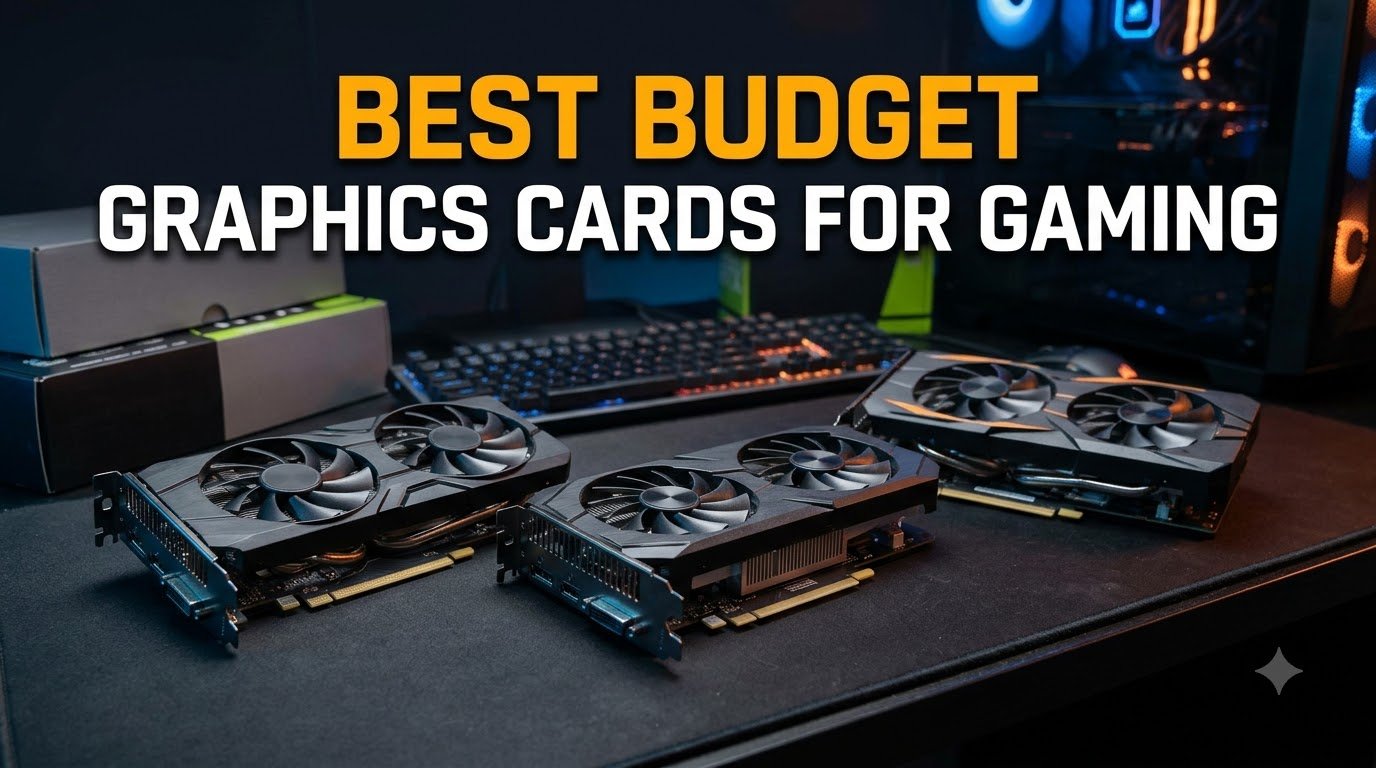
Buying the wrong card means stuttering in new games, a case that won’t close, or a power supply that can’t feed it, and I know how frustrating that is when money is tight. The best budget graphics cards for gaming come down to graphics memory, power needs and whether the card fits your case and monitors. A laptop chip or a pre-built’s integrated graphics is not what this guide covers.
GIGABYTE GeForce RTX 4070 OC is the one I would buy for most desktops, because its 12 GB of GDDR6X leaves room for newer games without a power-hungry design. If you run several screens and want the most memory with five outputs, pick ASUS ROG Strix instead.
Graphics memory and card length matter most, because memory decides how long a card handles new games and length decides whether it fits your case. Memory runs from 4 GB to 12 GB here, and lengths from 7.4 inches to 11.81 inches.
Each pick was also weighed on its fan setup, its power needs and its video outputs. These shape noise, the supply you need and how many screens you can plug in. That is how we narrowed the best budget graphics cards for gaming to ten.

Setup starts with the slot and the power supply. This card is a PCI-Express x16 desktop part, so it needs a desktop motherboard with a free x16 slot. Its documentation leaves out power connector details, so read your power supply’s connector list before you buy and before you open the box. That keeps you from stalling mid-install.
The card is 10.28 inches long, so look at the room between your case’s front fan mount or drive cage and the slot. A tight fit can block airflow to its three fans. GIGABYTE says the three-fan WINDFORCE cooler moves heat away from the card while keeping the low-power design manageable.
The 12 GB of GDDR6X gives you room as new games ask for more memory. The metal back plate and anti-sag bracket named in the maker’s list give a long card some support. Nvidia drivers keep it working with new games over time, so install updates now and then. It has no RGB lighting, which matters if your build is about looks.
Its 12 GB of memory ties the ASUS ROG Strix, so it gains no memory edge there. The 10.28-inch length also asks for adequate case clearance. In a small case that can be a real problem, while a mid-size tower should take it without trouble.
This card is for the desktop gamer who wants room for newer titles without a power-hungry card. Its 12 GB of GDDR6X and the 4K at 120 Hz maximum resolution give it headroom beyond 1080p. DLSS 3, which GIGABYTE names, helps if you like Nvidia’s upscaling. If you play on a compact case, pick a shorter card. For a roomy tower and a long-lived upgrade, this one is a strong fit.

Length is the point to get right here. The card measures 11.81 inches, and it is a 2.7-slot design, so it takes up more than two slots on the motherboard. Compare that to your case’s maximum card length and to the space beside the slot. If the card is too long, it will not seat, or it will press against drive bays and fans, and you would be returning a large box.
Power matters too. You need a power supply with enough wattage and the right connectors for stable operation during install, so read the supply’s label first. The card works only in a desktop PC. It comes with ROG Velcro hook and loop straps, which help you tidy cables once it is seated.
Once it runs, the card gives you 12 GB of GDDR6 and five display outputs, two of them HDMI. That makes a multi-monitor desk simple to plug in. ASUS says the Axial-Tech fan has more blades and a reversed center fan to push air through the heatsink. A 3 year warranty comes with it. It supports up to 8K, a ceiling you will probably never reach on a budget monitor.
The size is a hard limit in a compact build. At 2.5 lb and 11.81 inches long, it needs a spacious case and a sturdy mount. In a mid-tower with room to spare, that costs you nothing.
This is the card for someone running several displays who wants as much memory as the list offers. Its 12 GB shares the top spot with the GIGABYTE RTX 4070 OC, and five outputs mean fewer adapters. It asks for a roomy desktop and a capable power supply. If you have both, this card gives a multi-screen setup plenty to work with.

Power is the point to learn before you buy. MSI lists a 120 W power draw and recommends a 450 W power supply. A weak or older supply can cause crashes or a card that will not start. Look at the wattage label on yours and at its free connectors. The card works in a desktop only.
Against the ASUS ROG Strix, the difference is memory. This card has 6 GB, while the ASUS card has 12 GB. For 1080p play that gap may not decide anything. For newer games with big textures, the extra memory means fewer dropped settings and less stuttering. Pick the ASUS card if you want to keep it for years.
Setup is simple. The box holds the card, cables and connectors, and a quick setup guide. The card is 8.1 inches long, so it fits many mid-size cases.
MSI says its dual-fan layout moves heat away from the 120 W card while keeping the cooler relatively compact. Three DisplayPort outputs and one HDMI 2.0B output cover most monitor setups. A 3 year warranty is included.
The 6 GB of memory is a real problem if you play demanding new titles at high settings. It is not one for 1080p esports or older games. The 450 W power supply recommendation also means a very old supply may need replacing.
This card is a good match for a 1080p player whose desktop already has a 450 W power supply. Its 1830 MHz boost clock and 6 GB of GDDR6 handle esports and older games well. The ASUS ROG Strix is the better pick if you want more memory for newer games and several screens. If your goals are modest and your supply is ready, this card is a sound, low-effort upgrade.

ASUS ROG Strix GeForce gives your desktop gaming setup a headset connection alongside familiar display outputs. Its USB Type-C port gives you a connection for a VR headset, and DisplayPort and HDMI outputs give you options for a monitor.
Graphics memory is an important part of your decision if you play demanding games. This card has 8 GB of GDDR6 memory, which holds game data for the graphics processor. ASUS ROG Strix has a larger memory pool, giving you more room for games that place heavy demands on graphics memory.
The graphics processor has 2560 CUDA cores and a boost clock of 1830 MHz. Those figures describe different parts of the card: the cores work on graphics tasks, and the boost clock describes processor speed. Your game’s settings and workload still matter when you judge performance.
Getting your desktop ready starts with its PCI-Express x16 interface. Use the included ROG Velcro hook to bundle cables away from the card’s 3 fans, leaving their airflow path clear. The box also includes a driver CD and GPU Tweak software.
ASUS says its Max-Contact Technology maximizes heatsink contact and that its components support quality and reliability. That design claim gives you a reason to consider the card’s cooling construction, though it does not predict performance in your particular desktop. The card also comes with a 3 Year Warranty.
Is the main restriction for your setup: this card is compatible with a desktop, not a laptop. That rules it out if your gaming computer is a laptop, but it is not an obstacle when you already use a desktop.
A desktop gamer who also uses a VR headset has a clear use for this card’s USB Type-C connection. Its DisplayPort and HDMI outputs also give you options when connecting a display. The 8 GB of graphics memory gives you room for game data, with your settings and games affecting how much you need. Choose it for a desktop setup where headset connectivity matters alongside gaming.

GIGABYTE GV-N207SGAMING OC-8GD is a long, tall card, and its size is the first thing to get right. It measures 11.26 inches long and sits on a PCI-Express x16 slot. In a compact case, the card height can interfere with CPU cooler clearance. Pick a case with room, or the side panel may not close.
Its cooling is why you would buy it. GIGABYTE says the Windforce 3X cooler alternates fan rotation to spread cooling across the card during sustained gaming. It pairs 3 fans with 8 GB of 256-bit GDDR6.
Fan noise is something you can tune, because the fan curve can be adjusted, and doing so reduces noise significantly. Do that when you first set up the card, before long gaming sessions. There is no RGB lighting on this model, so a showy build looks elsewhere.
One buying point is easy to miss. The warranty runs 4 years and it has registration is needed. Register the card after you install it so that coverage applies.
The tall body can crowd a CPU cooler in a small case. Its 8 GB also trails the 12 GB models. That matters most for heavy new games.
Pick this card if you build in a roomy desktop case and want strong cooling with 8 GB of memory. It offers one HDMI and three DisplayPort outputs, so a multi-screen desk is covered. It also supports real-time ray tracing through its Turing architecture. For a cool, quiet desktop with room to breathe, this one earns its place.

XFX Speedster SWFT210 is the current-generation AMD option here, built on the Radeon RX 7600 with 8 GB of GDDR6. Its boost clock reaches up to 2655 MHz. XFX says its dual-fan cooling solution moves heat away from the card during extended gaming sessions.
Size is the point to get right. The card is 9.49 inches long and 5.16 inches wide, so it needs a case with enough depth. In a compact case it may not fit, and you would only learn that after the card arrives. Measure the clearance in front of your drive cages first.
Shopping on a tight budget is stressful, and I understand wanting a modern card that does not break the bank. This one gives you recent AMD hardware with a 3 year manufacturer warranty.
Next to the 12 GB cards in the list, its 8 GB is the difference to weigh. That extra memory helps in newer games that fill memory quickly, where you might otherwise lower settings. If you stay at 1080p, 8 GB is a reasonable fit. If you want longer headroom, a 12 GB card holds up better.
Its 8 GB trails the 12 GB cards, so demanding modern games can force lower settings. The 9.49 inch length also reduces flexibility in compact cases. It is a desktop-only card. If you play at 1080p in a mid-size tower, none of this is a real problem.
This card is for an AMD player with a desktop and a case that has some depth. It pairs 2 fans with 8 GB, and it outputs through HDMI. A buyer who plays the newest demanding games should look to the 12 GB cards, which give more room before settings need to drop. For 1080p play on current AMD hardware, the card fits well.

Small cases and older monitors are what the MOUGOL card is built around. It carries 8 GB of GDDR5 and gives you DVI, DisplayPort and HDMI, so a mixed set of screens can plug straight in. The Card Size is 240 x 135 x 45 mm, which keeps it manageable in a tight desktop.
Run the driver install right after the card is seated, and plug each monitor into the output that matches its cable. The card has two fans, and the maker says the heat pipes beside them handle gaming heat without needing a large card body. A cooler like that is only as good as the airflow around it, so leave the fan side open to the case.
Size and warranty are worth settling before you buy. The card is made for desktops and sits in a PCI-Express x16 slot. Its warranty is 1 Year Manufacturer, which is short, so give it a careful first few weeks of use.
Next to the ASUS ROG Strix, the gap is Graphics Memory, where that card has 12 GB against the MOUGOL’s 8 GB. If you want headroom for newer games at high settings, that extra memory is the better answer. The MOUGOL makes more sense when budget, case room and older ports matter more than that headroom.
The MOUGOL uses GDDR5, and that older memory type leaves it behind newer 8 GB cards when you play recent demanding titles. Its own cons list limited modern AAA use and driver quirks, so expect to lower settings and to spend some time on driver updates. For esports titles and older games, that matters little. If you want new releases at high settings, it will frustrate you. The 1 Year Manufacturer warranty also gives you less cover than most cards in this guide.
The MOUGOL is a sensible match when your case is small and one of your monitors only has a DVI input. Triple outputs let you run three screens without adapters, and the 8 GB of memory is enough for 1080p play in lighter games. The ASUS ROG Strix is the better route if you want a much larger memory pool for demanding titles. For a modest desktop upgrade on older screens, the MOUGOL does the job.

Against the ASUS ROG Strix, the MSI 2X gives up a lot of Graphics Memory, with 6 GB here and 12 GB there. In use that means this card is happiest at 1080p with sensible settings, while newer games at high settings will push past what it holds. The trade is a body only 7.4 inches long, which is what lets it into cases the larger card cannot enter.
Fitting the MSI 2X is simple because it is built for desktops and uses a PCI-Express x16 slot. The box holds the card and a quick setup guide. Its outputs are one DisplayPort and two HDMI 2.1a ports, so plug your main high-refresh monitor into the DisplayPort and use the HDMI ports for the others. The maker says the short dual-fan layout combines cooling with room for three display connections.
Six gigabytes trails 8 GB alternatives, and demanding modern games can run past it. The single DisplayPort also limits high-refresh multi-monitor setups, since only one screen gets that connection. If you play lighter titles at 1080p on one or two monitors, neither point will bother you. A player who wants several fast displays or high settings in new releases will feel both limits.
The MSI 2X handles a compact gaming desktop well, with an RTX 3050 chip and three outputs in a short body. It handles a wall of high-refresh monitors less well, because the lone DisplayPort caps that plan. The 3 Years warranty adds some reassurance on a small-case build. If your priority is a small case and a few screens, it is a good match.

Case room decides whether the ASUS GTX 1660 works for you. Its 2.7 slot form factor means the body takes up well over two slots, and it measures 9.5 x 5.1 in. If a neighbouring slot holds a capture card or a drive cage, the thick body will block it. Look at the space beside your PCI-Express x16 slot before you order, because a card that does not fit cannot be returned to a smaller case.
Next to the ASUS ROG Strix, the gap is Graphics Memory, with 6 GB here and 12 GB there. That extra memory is what you want for newer games at high settings. I know shopping on a budget while wanting several screens is a hard balance, and this card strikes it well for 1080p. It supports up to 3 monitors through HDMI 2.0B, DisplayPort 1.4 and DVI-D, and GPU Tweak II is included for monitoring and streaming.
Six gigabytes matters only if you play newer titles at high settings, where it trails 8 GB alternatives. For 1080p esports and older games, it holds up fine. The 2.7-slot body needs more case room, and the three-monitor limit may not suit larger multi-screen setups. Anyone planning four screens or a cramped case should look elsewhere.
The ASUS GTX 1660 is a good pick when you have a spacious desktop and want up to three monitors on one card. Its overclocked 6 GB of GDDR6 and 1408 CUDA cores cover 1080p play well, and the 3 Year Warranty backs it. A card with a far larger memory pool, like the ASUS ROG Strix, wins when you want newer games at high settings. If room and three screens are your plan, this card fits it.

A card with 4 GB of memory and a GT 1030 chip is a starter part, and MSI G103044PC makes sense as a first graphics card for a desktop. Its PCI-Express x16 interface is the standard slot on desktop boards, so the board side is simple. The listing names desktops as the compatible device, so a laptop is out. Before ordering, look at how much room your case has and whether the slot is free, since a cramped layout is the usual surprise.
Setup is short. The box holds the card and a quick setup guide. Put the card in the x16 slot, connect your monitor, then install the driver so the card can run its full 1430 MHz boost clock. MSI lists one DisplayPort (v1.4a) and one HDMI 2.0b output, which it says covers a basic two-display setup.
Plan your cables around that pair, because a second monitor on DisplayPort or HDMI is all it takes. The maximum display resolution is 4K UHD at 3840×2160, so a high-resolution monitor will light up for desktop work. A 3-year warranty covers the card.
It has a 64-bit memory interface, which adds to the squeeze. The single DisplayPort also limits high-refresh multi-monitor setups. If you mostly play older titles, esports games or light everyday games, you can live with this. If you want to run recent games at high settings, this card will frustrate you.
MSI G103044PC is a sensible first card for someone building a desktop with two plain displays, one on HDMI and one on DisplayPort. It works if your games are undemanding and you want a card that installs without fuss. If you want more room for newer games, the MSI Gaming GeForce GTX 1660 offers 6 GB of memory, which gives you more headroom for demanding titles. Choose this card when a basic build and a simple two-screen desk matter more than raw gaming power.
Your target games and resolution determine how much graphics memory you need. For 1080p gaming aim for at least 8 GB VRAM; for 1440p aim for 10 GB or more. These are starting points, not guarantees that every game will run at high settings. For more help, see this related guide.
Memory across these picks runs from 4 GB in MSI G103044PC to 12 GB in ASUS ROG Strix. The lower end calls for modest expectations, especially in newer games with large textures. If a game recommends more memory than your card has, high texture settings can cause stuttering.
I favor GIGABYTE GeForce RTX 4070 OC for your overall choice because its memory gives you more room for demanding games. If you mainly play esports or older games, a smaller memory capacity can be enough. For newer releases, read the recommended memory for each game before settling on high settings.
Your power supply needs enough capacity for the whole computer and the right connectors for the card. Target a GPU whose TDP is no more than 60 % of your PSU’s rated wattage. TDP is a useful starting point for judging power needs, but the rest of the system also draws power.
Compare the card’s power requirements with your PSU label and its available PCIe cables, including any required 8-pin connectors. An inadequate supply or missing connector can stop your upgrade before the first game. Use a quality PSU with proper certifications, and keep the total demand within its rated wattage.
Power off and unplug your PC before installing or removing a card. When you connect power, seat every connector fully to avoid fire risk. A desktop also gives you a replaceable graphics card; a laptop with a fixed GPU does not offer that same upgrade path.
Your case needs room for the cooler as well as airflow around its fans. Compare card length, slot width and clearance near the CPU cooler with the space inside your desktop. Leave at least 2 cm clearance between card length and case side panel. A card that crowds another component can block installation or airflow.
Fan count alone cannot tell you how quiet a cooler will be. Examine the heatsink design as well as the fans, because a dual-fan description does not tell you the heatsink’s size. Noise can rise as temperatures climb, so allow open space around the fan side of the card.
I would give a roomy cooler priority if your games keep the GPU busy for long sessions. A compact build calls for closer attention to the whole card shape, not just its length. Keep fans unobstructed after installation, and arrange nearby cables so they cannot enter the blades.
Your monitors need matching outputs and support for the resolution and refresh rate you want. Count the screens you plan to connect, then match each cable type to an available card output. A maximum display resolution does not promise a playable game frame rate at that resolution.
If you have an older DVI screen, MOUGOL AMD Radeon RX GDDR5 Card has DVI, DisplayPort and HDMI outputs. If your setup uses several screens, ASUS GeForce GTX 1660 supports up-to 3 monitors. For either choice, verify the connections and refresh rates for your particular displays before ordering.
The best budget graphics cards for gaming should be judged against your actual monitor setup, not a resolution label alone. Look for game performance results at your target resolution and settings, including frame-time consistency as well as average frame rate. A high peak can hide uneven delivery that makes motion feel jerky.
Your preferred games and software features should guide your choice of graphics ecosystem. Driver quality and support for new releases can differ, so read recent performance reports for the games you play. An old synthetic score cannot show how a current game update behaves on your system.
Compare the upscaling options supported by both your games and the card you are considering. DLSS, FSR and XeSS can render a game at a lower resolution and reconstruct the image, but support varies by game and hardware. Frame generation is a separate feature, so verify it independently if you want it.
Ray tracing can place a heavy load on a budget card, so compare game results with that setting enabled and disabled. I would put stable performance in your favorite games ahead of an advertised boost clock. A boost figure describes a peak, not a promise that the card will hold that speed throughout play.
Stuttering in a new game can come from textures filling your graphics memory. Lower the texture setting first, then compare frame-time consistency during the same part of the game. If the interruptions persist, review the game’s other demanding settings rather than assuming memory is the sole cause.
Crashes or display glitches after a game update can point to a driver or configuration problem. Install a current driver before your first game, then review release information if trouble follows an update. A clean installation or a return to a stable driver can help you isolate the cause.
Louder fans during play can signal rising temperatures or restricted airflow. Monitor temperatures during your first weeks and clear accumulated dust with the PC powered off and unplugged. Adjust the fan curve if your software permits it, keeping an eye on temperatures as you balance noise against cooling.
Match graphics memory to your games and settings.
Verify PSU capacity and required power cables.
Allow case, slot and cooler clearance.
Match monitor ports and refresh rates.
Review game performance and driver support.
Read return and warranty terms.
Yes, it can be enough, but your games and texture settings decide. Some newer games can exhaust that memory at high settings, causing stutter or forcing you to lower textures. Read each game’s recommended memory and look for performance results using settings you actually want. That gives you a more useful target than capacity alone.
The required wattage and connectors depend on the card and the other parts in your desktop. Use the card maker’s PSU recommendation together with the supply’s rated output and available PCIe power leads. A connector that looks close is not a substitute for the required type. If you cannot establish the requirements, resolve that uncertainty before buying.
Yes, a driver issue can contribute to crashes, glitches or poor performance in your games. Game updates and other system changes can also cause trouble, so a driver is not always the culprit. Note when the problem began and compare it with recent software changes. Release notes and reports about the same game can help you narrow the cause.
Fans often spin faster when your card gets hotter under a gaming load. Dust, restricted airflow and an aggressive fan curve can add to the noise. A sustained mechanical rattle is a different symptom from normal fan rush and deserves inspection. For a used card, make sure your return terms leave room to investigate that kind of problem.
Yes, a desktop card can be replaced later if your system has the space and power for its successor. That does not guarantee every future card will fit your case or work with your existing supply. Consider whether you want to keep the desktop itself for several years. A modest card upgrade can be more useful than replacing a system that already meets your other needs.
No, a maximum resolution describes display output capability, not the frame rate your games will achieve. Game settings, GPU workload and monitor refresh rate all affect the result you see. Compare results from the games you play at your chosen resolution, rather than relying on the maximum display figure. Pay attention to uneven frame delivery as well as the average.
Not necessarily; the useful amount depends on your games, resolution and the settings you want to keep. More memory gives you room for larger textures, but it does not guarantee that the GPU has enough processing power for every future release. Give more weight to game requirements and actual performance than to memory capacity by itself. Your upgrade plans matter too.
They meet your game, display and desktop requirements without leaving a critical mismatch. The right choice balances memory, measured game performance, physical fit and power requirements rather than winning on a single number. For a used or refurbished card, read the warranty conditions and return window as well. Those terms determine your options if a problem appears after delivery.
When your desktop already has a 450 W power supply and you play at 1080p, MSI Gaming GeForce GTX 1660 delivers the most for what it asks.
ASUS ROG Strix gives a multi-screen desk five display outputs and 12 GB of memory to work with.
If you want a desktop card with room for newer titles, GIGABYTE GeForce RTX 4070 OC is the one to buy, thanks to its 12 GB of GDDR6X.
GIGABYTE GeForce RTX 4070 OC is where I would start if you play on a roomy desktop and want a card that stays useful as games grow. Its 12 GB of GDDR6X and 4K at 120 Hz maximum resolution give it headroom beyond 1080p. If you run several monitors, ASUS ROG Strix is the better buy, but at 11.81 inches long and 2.7 slots wide it needs a spacious case.